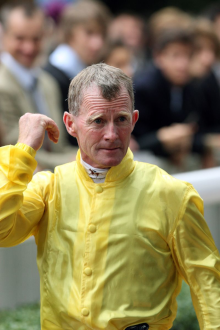
Kinane first comes to prominence as the stable jockey to Liam Browne, winning the 1982 Irish 2000 Guineas and St. James’s Palace Stakes at Ascot Racecourse, both on Dara Monarch, and finishing second in the 1983 Epsom Derby on Carlingford Castle, before moving to Dermot Weld. He is later retained by John Magnier and Aidan O’Brien as stable jockey at Ballydoyle for many years prior to joining leading Irish flat trainer John Oxx. He becomes one of the world’s elite jockeys and excels on the big occasions at Longchamp Racecourse and Epsom Downs Racecourse and is regarded as one of the leading professionals of his sport.
Kinane retires at the end of 2009, a season which is highlighted by his association with Sea The Stars, regarded as one of the greatest racehorses of all time. He breeds the 2007 Epsom Derby winner Authorized.
Kinane is current working for Hong Kong Jockey Club in Europe to select horses suitable for running in Hong Kong. Those horses are resold by Hong Kong Jockey Club in an auction.
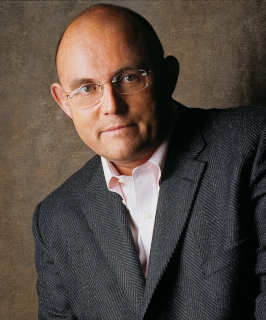
Although born in Dublin, Tynan’s family home is in Johnstown, County Kilkenny. He is born with phocomelia, causing both of his lower legs to be underdeveloped. Although now 6’4″ tall, his legs are unusually short, his feet are splayed outward, and he has three toes on each foot. He is one of a set of twins, his twin brother Edmond dying at 11 months old. At age 20, he has his legs amputated below the knee following a back injury in a car accident. The injury to his back makes it impossible for him to continue using prosthetic legs without the amputation. Within weeks of the accident, he is climbing stairs at his college dormitory on artificial legs. Within a year, he is winning in international competitions in track and field athletics. He represents Ireland in the 1984 and 1988 Summer Paralympics, winning four golds, two silvers, and one bronze medal. Between 1981 and 1984, he wins 18 gold medals from various competitions and sets 14 world records.
In the following years, Tynan becomes the first person with a disability to be admitted to the National College of Physical Education in Limerick. He works for about two years in the prosthetics industry, then goes to Trinity College, Dublin, becomes a physician specialising in Orthopedic Sports Injuries, and graduates in 1993. Encouraged to also study voice by his father Edmund, Tynan wins a series of voice competition awards and joins The Irish Tenors.
Tynan sings for George H. W. Bush at Bush’s Houston home on the day of the president’s death on November 30, 2018. The first song is “Silent Night,” while the second is a Gaelic song. Bush’s friend and former aide James Baker says that while Tynan is singing “Silent Night,” “believe it or not, the president was mouthing the words.”
While a real estate agent and prospective buyer Dr. Gabrielle Gold-von Simson are looking at an apartment in Tynan’s building on Manhattan‘s East Side, Tynan makes what is construed to be an anti-semitic remark. Shortly after this, the New York Yankees cancel Tynan’s performance of “God Bless America” for Game 1 of the 2009 American League Championship Series on October 16, 2009 because of the incident.
According to Tynan’s version of the event, two Jewish women came to view an apartment in his building. Some time afterwards, another real estate agent shows up with a potential client. The agent jokes to Tynan “at least they’re not (Boston) Red Sox fans.” Tynan replies, “As long as they’re not Jewish,” referring to the exacting women he had met earlier. The prospective client, Jewish pediatrician Dr. Gabrielle Gold-Von Simson, takes umbrage and says, “Why would you say that?” Tynan replies, “That would be scary,” and laughs, referring to the previous incident. He subsequently apologises for his remark. The Anti-Defamation League (ADL) accepts his apology. He performs at an ADL event in Manhattan soon thereafter.
Only July 4, 2010 Tynan performs “God Bless America” for the Boston Red Sox at Fenway Park with the support of some in the local Jewish community.
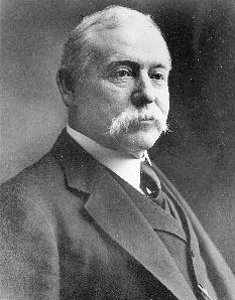
Daly emigrates from Ireland to the United States as a young boy, arriving in New York City. He sells newspapers and works his way to California in time to join the gold rush in what is to become Virginia City, Nevada, and the fabulously rich silver diggings now known as the Comstock Lode, in 1860.
Daly gains experience in the mines of the Comstock under the direction of John William Mackay and James Graham Fair. While working in the mines of Virginia City, Daly meets and befriends George Hearst, father of William Randolph Hearst, and Lloyd Tevis, co-owners of the Ophir Mining Company. In 1872, Daly recommends purchase by the Hearst group of the Ontario silver mine, near Park City, Utah. In ten years, the Ontario produces $17 million and pays $6,250,000 in dividends.
Their business friendship extends for many years and helps establish the Anaconda Copper Mine in Butte, Montana. Daly originally comes to Butte in August 1876 to look at a mine, the Alice, as an agent for the Walker Bros. of Salt Lake City. The Walkers purchase the mine, install Daly as superintendent, and award him a fractional share of the mine.
Daly notices, while working underground in the Alice, that there are significant deposits of copper ore. He gains access into several other mines in the area and concludes that the hill is full of copper ore. He envisions an ore body several thousand feet deep, some veins of almost pure copper, and hundreds of millions of dollars. He urges his employers, the Walker Bros., to purchase the Anaconda and when they refrain, Daly purchases it himself. Daly finds his fortune on the Anaconda Copper Mine in Butte, after selling his small share of the Alice Mine for $30,000.
The Anaconda began as a silver mine, but Daly’s purchase is for the copper, found to be one of the largest deposits known at the time. However, he lacks the money to develop it, so he turned to Hearst, Haggin and Tevis. The first couple hundred feet within the mine are rich in silver, and took a few years to exhaust. By that time, Butte’s other silver mines are also playing out, so Daly closes the Anaconda, St. Lawrence, and Neversweat. Prices on surrounding properties drop and Daly purchases them. Then he re-opens the Anaconda. Due to Thomas Edison‘s development of the light bulb the world would need copper which is a very excellent conductor of electricity. Butte has copper, hundreds of thousands of tons of it, waiting to be taken from the ground.
He builds a smelter to handle the ore, and by the late 1880s, has become a millionaire several times over, and owner of the Anaconda Mining and Reduction Company. Daly owns a railroad, the Butte, Anaconda and Pacific Railroad, to haul ore from his mines to his smelter in Anaconda, a city he founds. He owns lumber interests in the Bitterroot Valley and a mansion and prized stables in the same valley, south of Missoula.
In 1894, Daly spearheads an energetic but unsuccessful campaign to have Anaconda designated as Montana’s state capital, but loses out to Helena. Daly is active in Montana politics throughout the 1890s, because of his opposition and intense rivalry with fellow copper king, and future U.S. Senator, William A. Clark. He attempts to keep Clark out of office by lavishly supporting his opponents.
In 1891, Daly becomes the owner of Tammany, said to be one of the world’s fastest racehorses in 1893. He also arranges the breeding of the great Sysonby, ranked number 30 in the top 100 U.S. thoroughbred champions of the 20th Century by The Blood-Horse magazine. However, Daly dies in New York City on November 12, 1900, before the horse is born.
Following his death, New York’s Madison Square Garden hosts a dispersal sale for the Bitterroot thoroughbred studs on January 31, 1901. One hundred eighty-five horses are sold for $405,525.

 seamus dubhghaill