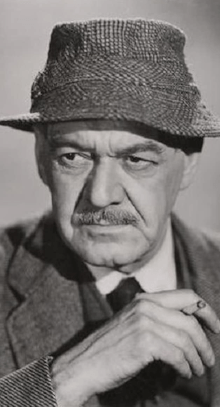
O’Rorke is born as William Francis Breffni O’Rorke at 2 Esplande Villas in Dollymount, and baptised at Clontarf Parish Church on August 1, 1889. His father, Frederick O’Rorke, is a cork merchant, and his mother, Jane Caroline O’Rorke (née Morgan), is an actress. He has an older brother, Frederick, who is twelve years older than him.
O’Rorke begins studying acting with his mother and makes his professional début in 1912 at the Gaiety Theatre, Dublin, in a production of George Bernard Shaw‘s John Bull’s Other Island. In 1916, while still living in Dublin, he meets and marries Alice Cole, a chorus-girl turned actress, who had divorced her first husband and immigrated from South Africa with her young son. Thus O’Rorke becomes the stepfather of Cyril Cusack. Other theatre roles include the title role in Finn Varra Maa (1917), a musical “pantomime” or light opera written by Thomas Henry Nally with music by Geoffrey Molyneux Palmer.
National Television starts in October 1936, initially broadcast just two hours a day. The station stops broadcasting at the start of World War II, and does not restart until 1946. Plays, like everything else, can last just one hour maximum, but some are only 25 minutes long. Also, there is no recording possible, so any repeat is really a new broadcast, as in The Advantages of Paternity.
O’Rorke is a busy character actor up to his death on November 11, 1946, and his legacy lay not only in several memorable performances but also, to some extent, in the subsequent success of his stepson. From the late 1940s thru the 1980s, Cyril Cusack is one of the most renowned stage actors of his generation, as well as an acclaimed film actor, and he founds an acting dynasty to rival that of the Redgrave family through his actress daughters.
Cyril James Cusack, Irish actor who appears in numerous films and television productions in a career lasting more than 70 years, dies in Chiswick, London, England on October 7, 1993. In 2020, he is listed at number 14 on The Irish Times‘s list of Ireland’s greatest film actors.
Cusack is born in Durban, Natal, South Africa, on November 26, 1910. His mother, Alice Violet (née Cole), is an English Cockney actress and chorus girl, and his father, James Walter Cusack, is an Irish mounted policeman in the Colony of Natal, South Africa. His parents separate when he is young and his mother takes him to England, and then to Ireland. His mother and her partner, Brefni O’Rorke, join the O’Brien and Ireland Players.
Cusack makes his first stage performance at the age of seven. He is educated at Newbridge College in Newbridge, County Kildare, then reads law at University College Dublin. He leaves without a degree and joins the Abbey Theatre in 1932. Between then and 1945, he performs in over 60 productions, particularly excelling in the plays of Seán O’Casey. He also performs Irish playwright Teresa Deevy‘s plays Katie Roche and The King of Spain’s Daughter. In 1932 he also joins the Gate Theatre company, appearing with them in many notable productions over the years. In 1947, he forms his own company and stages productions in Dublin, Paris and New York.
In 1963, Cusack joins the Royal Shakespeare Company in London and appears there for several seasons. By this stage he has established a successful career in films, which had started at the age of eight. Also in 1963, he wins a Jacob’s Award for his performance in the Telefís Éireann production of Triptych. He receives honorary degrees in 1977 and 1980 from the National University of Ireland (NUI) and the University of Dublin respectively.
Cusack, who is bilingual in English and Irish, has a leading role in the controversial Irish language film Poitín (1977). He is also offered the role of the First Doctor in Doctor Who.
Cusack’s last stage performance is in Anton Chekhov‘s Three Sisters (1990), in which three of his daughters play the sisters.
Cusack is twice married, firstly to Mary Margaret “Maureen” Kiely (1920–1977), on April 5, 1945. Together they have five children: Paul (1946), Sinéad (1948), Sorcha (1949), Niamh (1959), and Pádraig (1962). He and his second wife, Mary Rose Cunningham (1979–1993), have one daughter, Catherine (1968).
In later life, Cusack becomes a campaigner for conservative causes in Ireland, notably in his opposition to abortion, where he becomes a frequent letter-writer to the main liberal Irish newspaper, The Irish Times. Regarding his Catholic faith, he comments “Religion promotes the divine discontent within oneself, so that one tries to make oneself a better person and draw oneself closer to God.” His religious credentials come under scrutiny following his death and the revelation that he had been unfaithful in his first marriage, with a long-term mistress, Mary Rose Cunningham. He marries Cunningham following his first wife’s death.
On October 7, 1993, Cusack dies at the age of 82 at home in Chiswick, Greater London, from amyotrophic lateral sclerosis (ALS). His acting career had lasted 75 years.