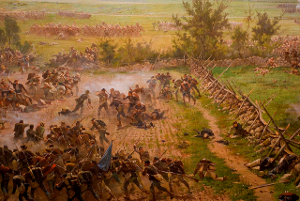
Irish-born Confederate Brigadier General Patrick Cleburne commands a division at the Battle of Richmond in Kentucky on August 29-30, 1862, where he is wounded.
The battle is a stunning Confederate victory by Major General Edmund Kirby Smith against Union Major General William “Bull” Nelson‘s forces. It is the first major battle in the Confederate Heartland Offensive. The battle takes place on and around what is now the grounds of the Blue Grass Army Depot, outside Richmond, Kentucky.
In the fall of 1862, two Confederate armies move on separate paths into Kentucky, hoping to put the shadow Confederate government of Kentucky of that state into power, threaten Union cities along the Ohio River, and recruit men to join the army. First to move is Kirby Smith, departing Knoxville on August 13, leading the Confederate Army of Kentucky, whose ideas provide the initiative for the offensive. General Braxton Bragg, commanding the Army of Mississippi, leaves Chattanooga on August 27 and moves on a roughly parallel track to the west.
Brigadier General Patrick Cleburne leads Smith’s advance with Colonel John S. Scott’s cavalry out in front. The Confederate cavalry, while moving north from Big Hill on the road to Richmond, Kentucky, on August 29, encounters Union troopers and begin skirmishing. After noon, Union artillery and infantry join the fray, forcing the Confederate cavalry to retreat to Big Hill.
At that time, Brigadier General Mahlon Dickerson Manson, who commands Union forces in the area, orders a brigade to march to Rogersville, toward the rebels. Fighting for the day stops after pursuing Union forces briefly skirmish with Cleburne’s men in the late afternoon. That night, Manson informs his superior, Bull Nelson, of his situation, and he orders another brigade to be ready to march in support, when required.
Kirby Smith orders Cleburne to attack in the morning and promises to hurry reinforcements. Cleburne starts early, marching north, passes through Kingston, disperses Union skirmishers, and approaches Manson’s battle line near Zion Church. As the day progresses, additional troops join both sides. Following an artillery duel, the battle begins, and after a concerted Confederate attack on the Union right, the Union troops give way. Retreating into Rogersville, they make another futile stand at their old bivouac.
By this time, Smith and Nelson arrive and take command of their respective armies. Nelson rallies some troops in the cemetery outside Richmond, but they are routed.
Nelson and some of his men escape, but the Confederates capture over 4,300 Union troops. Total casualties are 5,353 (206 killed, 844 wounded, and 4,303 captured or missing) on the Union side, 451 (78 killed, 372 wounded, and one missing) for the Confederates. The way north towards Lexington and Frankfort is open.
During the battle Cleburne is wounded in the face when a Minié ball pierces his left cheek, smashes several teeth, and exits through his mouth. He recovers in time to re-join Bragg and William Joseph Hardee and participate in the Battle of Perryville.
The Civil War Trust, a division of the American Battlefield Trust, and its partners have acquired and preserved 365 acres of the Richmond Battlefield. The Mt. Zion Christian Church, which served as a hospital during the battle and has cannonballs embedded in its brick walls, is listed on the National Register of Historic Places. Two discontinuous areas totaling 214 acres are listed on the National Register of Historic Places as Battle of Richmond Historic Areas in 1996.
(Pictured: Major General Patrick Ronayne Cleburne, courtesy of Library of Congress)