seamus dubhghaill

Promoting Irish Culture and History from Little Rock, Arkansas, USA


Leave a comment

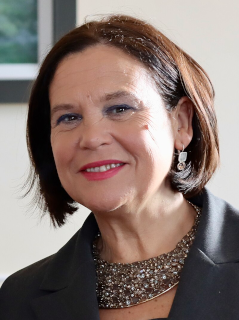
Birth of Mary Lou McDonald, Current President of Sinn Féin

Mary Louise McDonald, Irish politician and President of Sinn Féin since February 2018, is born in Dublin on May 1, 1969.

McDonald is born into a middle-class family in south Dublin. Her father Patrick McDonald, a builder and surveyor, and her mother Joan, separate when she is nine years old, and she stays with her mother in Rathgar. She has three siblings, one older and two younger. Her great-uncle, James O’Connor, was a member of the Anti-Treaty IRA and was executed at the Curragh Camp during the Irish Civil War.

McDonald is educated at Rathgar National School and at the Catholic all-girls, Notre Dame des Missions in Churchtown, South Dublin, where she is involved in debating. She then attends Trinity College Dublin (TCD), the University of Limerick and Dublin City University (DCU), studying English Literature, European Integration Studies and Human Resource Management.

She works as a researcher for the Institute of European Affairs, a consultant for the Irish Productivity Centre, a human resources consultancy that is jointly operated by Ibec and Irish Congress of Trade Unions (ICTU), and a trainer in the Partnership Unit of the Educational and Training Services Trust.

McDonald starts her political career by first joining Fianna Fáil in 1998 but leaves the party after a year due to core policy differences, particularly in relation to Northern Ireland and social justice. She quickly realises that Sinn Féin is a more appropriate party for her Republican views after meeting Sinn Féin members through the Irish National Congress.

She first runs for office at the 2002 Irish general election when she unsuccessfully contests the Dublin West constituency for Sinn Féin, polling 8.02% of first preference votes.

In 2004, McDonald becomes Sinn Féin’s first Member of the European Parliament (MEP) in Ireland, when she is elected at the 2004 European Parliament election in Ireland for the Dublin constituency, receiving over 60,000 first preference votes. She serves until 2009 and is a prominent member of the Employment and Social Affairs committee and Civil Liberties committee.

McDonald is an unsuccessful candidate in the Dublin Central constituency at the 2007 Irish general election. In 2009 she becomes the vice president of Sinn Féin.

McDonald contests the Dublin Central constituency again at the 2011 Irish general election, this time picking up 13.1% of first preference votes. She is successful in taking the last seat in the constituency. Following the election, she becomes Sinn Féin’s Spokesperson for Public Expenditure and Reform and is a member of the Public Accounts Committee from then until 2017.

After her re-election to the Dáil at the 2016 Irish general election, in which she tops the poll in Dublin Central, she becomes Sinn Féin’s All-Ireland Spokesperson for Mental Health and Suicide Prevention, which she holds until being elected president of Sinn Féin in 2018.

At a Sinn Féin party conference on November 18, 2017, Gerry Adams is re-elected party leader but announces that he will ask party leadership to call for a special Ard Fheis to be held within three months to choose a new president, and that he will not stand for re-election as TD for the Louth constituency in the next election.

At the close of nominations to succeed Adams on January 20, 2018, McDonald is announced as the president-elect of Sinn Féin, as she is the sole nominee to enter the race. She is confirmed as president at a special Ard Fheis on February 10, 2018, in Dublin.

McDonald is nominated as Taoiseach on February 20, 2020, but is defeated 45 to 84. On June 26, 2020, Fianna Fáil, Fine Gael, and the Green Party form a coalition government, leaving Sinn Féin as the largest opposition party, and McDonald as Leader of the Opposition. She dismisses the coalition agreement as a “marriage of convenience,” and accuses Fianna Fáil and Fine Gael of conspiring to exclude Sinn Féin from government.

At the 2024 Irish general election, McDonald is re-elected to the Dáil topping the poll in Dublin Central with Sinn Féin increasing their seat share by two seats, remaining the second largest party by representation in the Dáil and attaining 19% of the first preference votes, a fall of 5.5% from 2020 and fall behind Fianna Fáil by 2.9% and Fine Gael by 1.8%.

McDonald is again nominated as Taoiseach on December 18, 2024, but is defeated 44 to 110.

McDonald’s husband, Martin Lanigan, works as a gas control superintendent for the emergency dispatch division of Gas Networks Ireland, a state infrastructure provider. They have two children and live in Cabra, Dublin.

2 Comments

Birth of Billy Whelan, Irish Footballer

William Augustine Whelan, known as Billy Whelan or Liam Whelan, Irish footballer who plays as an inside-forward, is born at 28 St. Attracta’s Road, Cabra, Dublin, on April 1, 1935. He dies at the age of 22, as one of eight Manchester United players who are killed in the Munich air disaster.

Whelan is the fourth of seven children born to John and Elizabeth Whelan. His father is an accomplished centre half-back for Dublin club Brunswick and is instrumental in winning the FAI Junior Shield in 1924. His mother is an avid Shamrock Rovers supporter. His father dies in 1943 when Whelan is just eight years old.

Whelan plays Gaelic games, winning a medal for St. Peter’s national school in nearby Phibsborough. After leaving school at the age of fourteen, he works in Cassidy’s, an outfitter on South Great George’s Street. He is an accomplished Gaelic footballer and hurler, but association football is his first love.

Whelan begins his career at the age of twelve when he joins Home Farm before joining Manchester United as an 18-year-old in 1953. He is capped four times for the Republic of Ireland national football team, including a surprising 4–1 victory against Holland in Rotterdam in 1956, but does not score. His brother John plays for Shamrock Rovers and Drumcondra and his eldest brother Christy plays for Transport.

Whelan makes his first appearance for Manchester United during the 1954–55 season and quickly becomes a regular first-team player. He goes on to make 98 first-team appearances in four seasons at United, scoring 52 goals. He is United’s top scorer in the 1956–57 season, scoring 26 goals in the First Division and 33 in all competitions as United wins their second successive league title and reaches the semi-finals of the 1957-58 European Cup. He also gives a commanding display in the 1957 FA Cup final despite losing 2–1 to Aston Villa. Such is the strength of the competition in the United first team that he is soon being kept out of the side by Bobby Charlton. He is a traveling reserve for United’s ill-fated European Cup match against Red Star Belgrade in Belgrade on February 6, 1958, and is one of eight players to die in the subsequent air crash that destroys Matt Busby‘s young team and claims twenty-three lives. Fellow Irishman Harry Gregg, United’s goalkeeper and a survivor and hero of the Munich air crash, recalls Whelan’s last words as the plane is attempting take-off for the third and final time as “Well, if this is the time, then I’m ready.”

Thousands attend Whelan’s funeral on February 12 in St. Peter’s Church, Phibsborough, Dublin, and line the streets as the funeral procession makes its way to his burial-place in Glasnevin Cemetery. In December 2006 Dublin Corporation unveils a commemorative plaque on a bridge at Faussagh Road, Cabra, which was renamed Liam Whelan Bridge.

Although of a cheerful disposition, Whelan is also modest and shy by nature, and a quietly devout Catholic. He has a particular dislike of swearing and tends to fix a look of pained disappointment on teammates who use bad language. Nobby Stiles admits that he “would rather be caught swearing by the pope than by Billy Whelan.” His religious devotion regularly fuels rumours that he is considering being a priest, although at the time of his death he is engaged to be married to Ruby McCullough.


Leave a comment

The Niemba Ambush

The Niemba ambush takes place on November 8, 1960, when an Irish Army platoon in Congo-Léopoldville is ambushed, the first time the Irish Army is embroiled in battle since the founding of the Irish state in 1922. The Republic of Ireland had deployed troops as United Nations Operation in the Congo (ONUC) peacekeepers.

After the Belgian Congo becomes independent (as Republic of the Congo) in 1960, a civil war breaks out in Katanga, the southern, mineral-rich province of Congo. A local political leader, Moïse Tshombe, declares Katanga an independent state. United Nations peacekeeping troops are invited to help restore order and to end the Katanga secession.

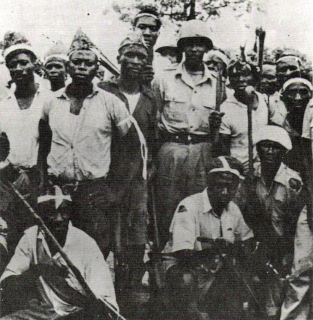
The Luba people or “Baluba” ethnic group do not support the Katangese secession. As a result, they come under attack from pro-Katangese and allied forces. On October 4, several villages are attacked by Katangese gendarmes and European mercenaries and many Baluba are massacred. This leaves them suspicious of and hostile to any white European troops. Irish troops are sent to the area to secure it and encourage local people to return.

On November 8, 1960, an eleven-man section from the Irish Army’s 33rd Battalion arrives at the bridge over the Luweyeye River. They are forced to leave their vehicles when they encounter a blockade on the road. While clearing it, they encounter about 100 Luba militiamen armed with bows, poison-tipped arrows, spears and clubs, as well as some guns. While the Irish troops had arrived to protect the Baluba, the militia undoubtedly mistakes them for Katangese mercenaries. Lieutenant Kevin Gleeson, advancing unarmed with his platoon sergeant, Hugh Gaynor, attempt to greet them peacefully, but is hit with a barrage of poison-tipped arrows.

Gleeson and Gaynor are overtaken, beaten and hacked to death. The surprised Irish soldiers, who had not been deployed in a defensive formation after dismounting from their vehicles, retreat behind trees on either side of the road and open fire on the tribesmen with their Gustav submachine guns, Lee–Enfield rifles and Bren light machine guns. The Baluba however advance on them, and the Irish are cut off from their vehicles. Despite taking heavy losses, the Baluba overrun the Irish soldiers, and fierce hand-to-hand fighting breaks out, during which most of the Irish troops are killed.

The surviving Irish troops regroup by a ridge but are surrounded by the Baluba. They fight to hold them off, but their position is rapidly overrun and all but three of them are killed. The three survivors manage to escape. One of them, Anthony Browne, reaches a nearby village and gives all the money he has to the village women, hoping they will get him help, but is instead mobbed and beaten to death by the village men. His body is recovered two years later. The two surviving soldiers manage to hide and are found by other UN troops the following day.

A total of nine Irish soldiers die: Lt. Kevin Gleeson of Carlow, Sgt. Hugh Gaynor of Blanchardstown, Cpl. Peter Kelly of Templeogue, Cpl. Liam Dougan of Cabra, Pt. Matthew Farrell of Jamestown, Dublin, Tpr. Thomas Fennell of Donnycarney, Tpr. Anthony Browne of Rialto, Pte. Michael McGuinn of Carlow, and Pte. Gerard Killeen of Rathmines. Some 25 Baluba are also killed.

The bodies of the Irish dead are flown to Casement Aerodrome in Baldonnel, where they lay in state. Lt. Kevin Gleeson’s coffin is placed on a gun carriage, while those of the rest are placed on army trucks. Following a funeral procession through Dublin, they are buried at Glasnevin Cemetery.

A stone commemorating Lt. Gleeson can be found in his hometown of Carlow while a plaque commemorating Sgt. Hugh Gaynor can be found in his hometown of Blanchardstown.

The notoriety of the attack, and the allegations of mutilation and cannibalism that circulate in the Irish popular press in its aftermath, lead to the word “baluba” (sometimes spelled “balooba”) becoming a synonym for any “untrustworthy and barbaric” individual in certain parts of Ireland.

(Pictured: Baluba militiamen in 1962)


Leave a comment

Birth of Martin Fay of The Chieftains

martin-fay-1

Martin Joseph Fay, Irish fiddler and bones player and co-founder of the Irish traditional music ensemble The Chieftains, is born in Cabra, Dublin on September 19, 1936.

The Chieftains are credited with reviving worldwide interest in traditional Celtic music. Fay performs as the group’s fiddler and bones player for some 40 years.

Fay develops an early interest in the violin and takes music lessons at the Municipal School of Music in Dublin. He joins the orchestra of the Abbey Theatre during his teen years and is introduced to Irish folk music by the theatre’s musical director Sean O’Riada.

It was through O’Riada’s folk band, Ceoltóirí Chualann, that Fay meets the other original Chieftains members, Paddy Moloney, Seán Potts, and Michael Tubridy. The foursome releases their first album, Chieftains 1, in 1964. The Chieftains perform on local radio and television programs and in pubs throughout the British Isles, but it is not until the 1970s that they begin touring overseas.

The Chieftains gain international acclaim when their music is used in the Academy Award-winning soundtrack for the film Barry Lyndon (1975). In 1989, The Chieftains are officially designated Ireland’s musical ambassadors. Although the quartet’s membership changes over the years, Fay records more than 30 albums with The Chieftains.

In 2001, Fay decides to stop touring with The Chieftains, limiting his appearances with the group to events in Ireland. He subsequently retires in 2002. After a lengthy illness, he dies at the age of 76 in Cabra on November 14, 2012.


Leave a comment

The Munich Air Disaster

munich-air-disaster

The Munich air disaster occurs on February 6, 1958, when British European Airways Flight 609 crashes on its third attempt to take off from a slush-covered runway at Munich-Riem Airport, West Germany. On the plane is the Manchester United football team, nicknamed the “Busby Babes“, along with supporters and journalists. Twenty of the 44 on the aircraft die at the scene. The injured, some unconscious, are taken to the Rechts der Isar Hospital in Munich where three more die, resulting in 23 fatalities with 21 survivors. Among the Manchester United fatalities is inside forward Liam “Billy” Whelan who was born in Cabra on the northside of Dublin in 1935.

The team is returning from a European Cup match in Belgrade, Yugoslavia, having eliminated Red Star Belgrade to advance to the semi-finals of the competition. The flight stops to refuel in Munich because a non-stop flight from Belgrade to Manchester is beyond the Airspeed Ambassador‘s range. After refuelling, pilots James Thain and Kenneth Rayment twice abandon take-off because of boost surging in the left engine. Fearing they will get too far behind schedule, Captain Thain rejects an overnight stay in Munich in favour of a third take-off attempt. By then snow is falling, causing a layer of slush to form at the end of the runway. After the aircraft hits the slush, it ploughs through a fence beyond the end of the runway and the left wing is torn off after hitting a house. Fearing the aircraft might explode, Thain begins evacuating passengers while Manchester United goalkeeper Harry Gregg helps pull survivors from the wreckage.

An investigation by West German airport authorities originally blames Thain, saying he did not de-ice the aircraft’s wings, despite eyewitness statements to the contrary. It is later established that the crash is caused by the slush on the runway, which slows the plane too much to take off. Thain is cleared in 1968, ten years after the incident.

At the time of the disaster, Manchester United is trying to become the third club to win three successive English Football League titles. They are six points behind League leaders Wolverhampton Wanderers with 14 games to go. They also hold the Charity Shield and have just advanced into their second successive European Cup semi-final. The team has not been beaten in eleven consecutive matches. The crash not only derails their title ambitions that year but also virtually destroys the nucleus of what promised to be one of the greatest generations of players in English football history. It takes ten years for the club to recover, with Busby rebuilding the team and winning the European Cup in 1968 with a new generation of “Babes.”


Leave a comment

Death of Martin Fay, Founding Member of The Chieftains

Martin Fay, Irish fiddler and bones player, and a former member of The Chieftains, dies on November 14, 2012. The Chieftains collaborate with musicians from a wide range of genres and cultures and bring in guest performers such as Mick Jagger, Van Morrison and James Galway. Yet traditional tunes lay at the heart of the band, with Fay’s fiddle a vital part of their distinctive sound.

Fay is born in Cabra, Dublin, where his mother teaches him to play the piano. As a boy, he is captivated by the music in the film The Magic Bow (1946), about the life of Niccolò Paganini, and he changes instrument. He progresses well in his classical violin lessons and at fifteen is playing in a Butlins holiday camp orchestra. After leaving school at eighteen, Fay works in an office by day and in the evenings plays in the Abbey Theatre orchestra, where he meets the Abbey’s musical director, Seán Ó Riada.

In the 1950s, traditional music is regarded as distinctly old-fashioned in Ireland, but Ó Riada’s success with a film score, and a play at the Abbey, encourage him to establish a folk orchestra which includes Fay, piper Paddy Moloney and the tin whistle player Seán Potts. Instead of all the musicians playing together in unison, as in the established cèilidh bands, Ó Riada wants to create a chamber orchestra, playing arrangements of folk music. Fay’s classical music background is essential for this approach. The resulting ensemble, Ceoltóirí Cualann, enjoys radio success and, in 1961, plays the soundtrack for a film of The Playboy of the Western World. Fay was soon earning more playing traditional music than in his day job.

Garech Browne, a member of the Guinness family and founder of Claddagh Records, asks Moloney to record some traditional Irish music. Moloney brings in Fay, Potts and Michael Tubridy on flute, and uses a similar approach to arranging the tunes. Their eponymous album, The Chieftains, is released in 1964, before they first perform in public. The success of this new approach to traditional Irish music leads to radio and television work, and they attract celebrity fans. Browne is a great thrower of parties, where the guests included Jagger, Princess Grace of Monaco, Peter O’Toole and Sean Connery, with The Chieftains invariably playing through the night.

By 1968, Moloney is working full time for Claddagh Records, and when he, Potts and Fay are offered a recording contract by a rival company, Gael Linn, Moloney refuses to sign. Potts and Fay believe that their future lay with Gael Linn, and they leave The Chieftains, only to return a year later. In the meantime, Seán Keane has joined to play fiddle, but on Fay’s return the pair work well together.

The Chieftains’ popularity is extending far beyond folk enthusiasts, but they are still playing only in their spare time. That changes in 1975 when they provide music for the Oscar-winning score of Stanley Kubrick‘s film Barry Lyndon and the promoter Jo Lustig books the group into the Royal Albert Hall in London on St. Patrick’s Day. The sell-out concert is a triumph, and Fay and his fellow Chieftains finally give up their day jobs.

The relentless international touring takes its toll on band members with young families, and Tubridy and Potts leave, to be replaced by the flautist Matt Molloy. Fay is happy to continue. A reserved and modest man with a great sense of humour, he is unfazed by the pressures of extensive touring. He is the only Chieftain not to be racked by nerves when playing to well over a million people at Phoenix Park during Pope John Paul II‘s visit to Dublin in 1979.

Although he has a classical training, Fay has a natural understanding of traditional music. He is a master of changing the mood at Chieftains concerts from the lively onstage parties to a more tranquil atmosphere, through his emotional interpretations of the slow airs. In total, Fay records more than 30 albums with the group before he withdraws from touring in 2001 and retires altogether in 2002.

Martin Fay dies in Cabra, Dublin, on November 14, 2012, after a lengthy illness.