

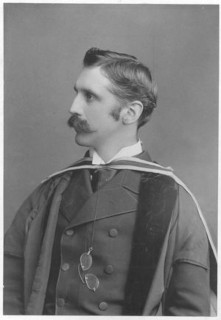
Sir Joseph Larmor FRS FRSE, Irish and British physicist and mathematician who makes breakthroughs in the understanding of electricity, dynamics, thermodynamics, and the electron theory of matter, is born in Magheragall, County Antrim, on July 11, 1857. His most influential work is Aether and Matter, a theoretical physics book published in 1900.
Larmor is the son of Hugh Larmor, a Belfast shopkeeper and his wife, Anna Wright. The family moves to Belfast around 1860, and he is educated at the Royal Belfast Academical Institution, and then studies mathematics and experimental science at Queen’s College, Belfast, where one of his teachers is John Purser. He obtains his BA in 1874 and MA in 1875. He subsequently studies at St. John’s College, Cambridge where in 1880 he is Senior Wrangler and Smith’s Prizeman and obtains his MA in 1883. After teaching physics for a few years at Queen’s College, Galway, he accepts a lectureship in mathematics at Cambridge in 1885. In 1892 he is elected a Fellow of the Royal Society of London, and he serves as one of the Secretaries of the society. He is made an Honorary Fellow of the Royal Society of Edinburgh in 1910.
In 1903 Larmor is appointed Lucasian Professor of Mathematics at Cambridge, a post he retains until his retirement in 1932. He never marries. He is knighted by King Edward VII in 1909.
Motivated by his strong opposition to Home Rule for Ireland, in February 1911 Larmor runs for and is elected as Member of Parliament for Cambridge University (UK Parliament constituency) with the Conservative Party. He remains in parliament until the 1922 general election, at which point the Irish question has been settled. Upon his retirement from Cambridge in 1932 he moves back to County Down in Northern Ireland.
Larmor receives the honorary Doctor of Laws (LLD) from the University of Glasgow in June 1901. He is awarded the Poncelet Prize for 1918 by the French Academy of Sciences. He is a Plenary Speaker in 1920 at the International Congress of Mathematicians (ICM) at Strasbourg and an Invited Speaker at the ICM in 1924 in Toronto and at the ICM in 1928 in Bologna.
Larmor dies in Holywood, County Down, Northern Ireland, on May 19, 1942.
 seamus dubhghaill