
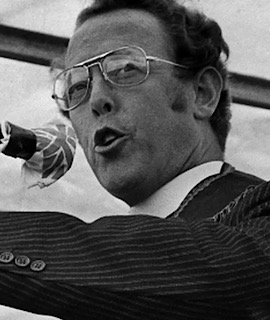
The Rev. Robert J. Bradford, an Ulster Unionist Member of Parliament (MP) for the Belfast South constituency in Northern Ireland, is killed by Provisional Irish Republican Army gunmen on the morning of November 14, 1981, as he sits talking with constituents in a Belfast community center.
The gunmen, who are wearing workmen’s overalls, escape in a car afterward, killing Ken Campbell, a caretaker, as they leave. The people with whom Bradford had been meeting, most of them elderly, dive under tables for cover, and dozens of teenagers dancing nearby break into hysterical tears, but there are no injuries.
The killing is part of an escalation of IRA violence, both in London and in Northern Ireland, after the collapse of the prison hunger strike the previous month. The previous night an IRA bomb damages the London home of Britain’s Attorney General for Northern Ireland, Michael Havers. The home is empty and no one is seriously injured.
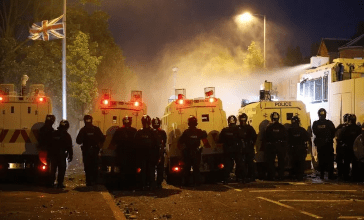
Bradford, a 40-year-old Methodist minister who is married and has a 6-year-old daughter, is shot several times, according to witnesses, and he dies almost immediately. His brother, Roy, who lives near the scene of the killing, in South Belfast, is at his side within moments. “But he was unconscious when I reached him, and he only lived for about a minute,” Roy Bradford says. News of the killing arouses fears of a Protestant reaction that could lead to serious civil unrest in Northern Ireland.
John “Jack” Hermon, the Chief Constable of the Royal Ulster Constabulary, issues an appeal to both the Protestant majority and the Roman Catholics to show “good sense and restraint.” He says security is being tightened in the province as a precautionary measure. He orders a wide-ranging search for the gunmen, who number at least three and possibly four, a point upon which the witnesses differ.
Bradford, who has been in Parliament since 1974, is an outspoken critic of the Irish nationalist guerrillas. He repeatedly calls for the reimposition of capital punishment in the province and for other strong deterrent measures.
With the Rev. Ian Paisley, another hard-line Member of Parliament, Bradford had planned to visit the United States In early 1982 to counteract the publicity of the IRA, which depends heavily on the money it receives from its American sympathizers. “There is a need for Americans to recognize that Ulster is not an occupied country,” Bradford says the previous month, “and that our political history is one of which we can be proud.”
The IRA, in a statement claiming responsibility for the killing, calls Bradford “one of the key people responsible for winding up the loyalist paramilitary sectarian machine in the North.” All twelve of Northern Ireland’s Members of Parliament – ten Protestants and two Catholics – are considered likely targets in the sectarian struggle that has claimed 2,100 lives in the province since 1969.
In a statement expressing shock and sympathy, Prime Minister of the United Kingdom Margaret Thatcher says, “We shall pursue with utmost vigor those who committed this wicked act.”
(From: “I.R.A. Gunmen Slay a Protestant M.P.” by William Borders, The New York Times, http://www.nytimes.com, November 15, 1981)
 seamus dubhghaill