seamus dubhghaill

Promoting Irish Culture and History from Little Rock, Arkansas, USA


Leave a comment

1997 Coalisland Attack

On the evening of March 26, 1997, the Provisional Irish Republican Army (IRA) East Tyrone Brigade launches an improvised grenade attack on the fortified Royal Ulster Constabulary (RUC)/British Army base in Coalisland, County Tyrone, Northern Ireland. The blast sparks an immediate reaction by an undercover Special Air Service (SAS) unit, who shoots and wounds Gareth Doris, an Irish republican and alleged IRA volunteer. The SAS unit is then surrounded by a crowd of protesters who prevent them approaching Doris or leaving. RUC officers arrive and fire plastic bullets at the crowd, allowing the special forces to leave the area.

Coalisland is a town in County Tyrone that has a tradition of militant republicanism; five residents are killed by British security forces before the first IRA ceasefire in 1994. In February 1992, four IRA volunteers are killed in a gun battle with the SAS during their escape after a machine gun attack on the RUC/British Army barracks there. Three months later, an IRA bomb attack on a British Army patrol at Cappagh, in which a paratrooper loses his legs, triggers a series of clashes between local residents and British troops on May 12 and 17. A number of civilians and soldiers are injured, a soldier’s backpack radio destroyed, and two British weapons stolen. The melee is followed by a 500-strong protest in the town and bitter exchanges between Republic of Ireland and British officials. Further scuffles between civilians and soldiers are reported in the town on March 6, 1994.

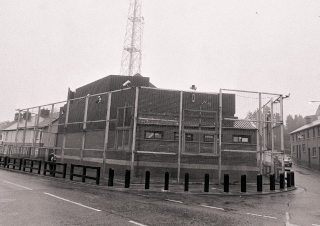
At 9:40 p.m. on Wednesday, March 26, 1997, a grenade is thrown at the joint British Army/RUC base at Coalisland, blowing a hole in the perimeter fence. The RUC reports that a 1 kg device hit the fence ten feet off the ground. Another source claims that the device is a coffee-jar bomb filled with Semtex. The grenade is thrown or fired by two unidentified men. At the time of the attack, there is an art exhibition at Coalisland Heritage Hall, also known as The Mill, from where the explosion and the gunshots that follow are clearly heard. The incident lasts less than two minutes.

Just one minute after the IRA attack, bypassers hear high-velocity rounds buzzing around them. A number of men, apparently SAS soldiers, get out of civilian vehicles wearing baseball caps with “Army” stamped on the front. A source initially describes them as members of the 14 Field Security and Intelligence Company. The men are firing Browning pistols and Heckler & Koch submachine guns. Witnesses say there are eight to ten gunshots, while a republican source claims that up to eighteen rounds are fired. Nineteen-year-old Gareth Doris is shot in the stomach and falls to the ground. He is allegedly returning from the local church and is in the company of a priest when he is shot. A local priest, Seamus Rice, is driving out of the church car park when his car is hit by bullets, smashing the windscreen.

Three minutes after the blast, hundreds of angry residents gather at the scene and confront the undercover soldiers. The soldiers fire live rounds at the ground and into the air to keep people back. The crowd keeps drawing back and moving forward again until 9:50 p.m., when the RUC arrives and begins firing plastic bullets at the protesters. Two women are wounded by plastic bullets and the undercover soldiers then flee in unmarked cars, setting off crackers or fireworks at the same time. Sinn Féin councillor Francie Molloy claims that the protesters forced the SAS to withdraw, saving Doris’s life in the process. Witnesses allegedly fear an undercover soldier brandishing a pistol would have killed the wounded Doris with a shot to his head.

Afterward, hundreds of residents are forced to leave their homes as security forces search the area near the base. This keeps tensions high, according to local republican activist Bernadette McAliskey. Two men are later questioned by the RUC about the attack.

The attack, along with two large bombings the same day in Wilmslow, England, raise concerns that the IRA is trying to influence the upcoming UK general election. Martin McGuinness describes the shooting as “murderous,” while independent councillor Jim Canning says that more than a dozen soldiers “were threatening to shoot anybody who moved […] while a young man lay shot on the ground.” Republican sources claim that this is another case of shoot-to-kill policy by the security forces. Ulster Unionist Party (UUP) MP Ken Maginnis, however, praises the SAS for their actions.

Gareth Doris is admitted to South Tyrone Hospital in Dungannon, where he is arrested after undergoing surgery. He is later transferred to Musgrave Park Hospital in Belfast. He is later convicted for involvement in the bombing and sentenced to ten years in jail, before being released in 2000 under the terms of the Good Friday Agreement. Gareth is the cousin of Tony Doris, an IRA member killed in an SAS ambush in the nearby village of Coagh on June 3, 1991, and a cousin of Sinn Féin leader Michelle O’Neill. According to Sinn Féin councillor Brendan Doris, another cousin of Gareth, “He absolutely denies being involved in terrorist activity of any description.” Amnesty International raises its concerns over the shooting and the fact that no warning is given beforehand.

DNA evidence collected in the area of the shooting leads to the arrest of Coalisland native Paul Campbell by the Police Service of Northern Ireland (PSNI) in 2015, on the charges of being the other man with Doris during the attack. In February 2020, he is convicted by a Diplock court in Belfast. He denies the charges but receives a seven-and-a-half-year sentence. The prosecutor acknowledges that Campbell would have been released by this time under the provisions of the Good Friday Agreement but argues that that was a decision for the parole commission, not the court.

On July 5, 1997, on the eve of the 1997 nationalist riots in Northern Ireland, the British Army/RUC base is the scene of another attack, when an IRA volunteer engages an armoured RUC vehicle with gunfire beside the barracks. One female officer is wounded. The former RUC station at Coalisland is eventually shut down in 2006 and sold for private development in 2010.

(Pictured: Coalisland RUC/British Army base in Coalisland, County Tyrone, Northern Ireland)


Leave a comment

Birth of Michelle O’Neill, Vice President of Sinn Féin

Michelle O’Neill (née Doris), Irish politician who serves as deputy First Minister of Northern Ireland between 2020 and 2022, is born in Fermoy, County Cork, Republic of Ireland, on January 10, 1977. She has been serving as Vice President of Sinn Féin since 2018 and is the Member of the Legislative Assembly (MLA) for Mid Ulster since 2007.

O’Neill comes from an Irish republican family in Clonoe, County Tyrone, Northern Ireland. Her father, Brendan Doris, was a Provisional Irish Republican Army (IRA) prisoner and Sinn Féin councillor. Her uncle, Paul Doris, is a former national president of the Irish Northern Aid Committee (NORAID). A cousin, Tony Doris, was one of three IRA members killed by the British Army‘s Special Air Service (SAS) in the Coagh ambush in 1991. Another cousin, IRA volunteer Gareth Malachy Doris, was shot and wounded during the 1997 Coalisland attack.

After the death of Brendan Doris in 2006, Martin McGuinness pays tribute to the Doris family as “a well-known and respected republican family [who] have played a significant role in the republican struggle for many years.”

O’Neill attends St. Patrick’s Girls’ Academy, a Catholic grammar school in Dungannon, County Tyrone. She subsequently begins to train as an accounting technician, before pursuing a political career.

O’Neill becomes involved in republican politics in her teens, assisting her father with constituency work in his role as a Dungannon councillor. She joins Sinn Féin after the Good Friday Agreement in 1998, at the age of 21, and starts working as an advisor to Francie Molloy in the Northern Ireland Assembly, holding this role until 2005.

O’Neill serves on the Dungannon and South Tyrone Borough Council from 2005 to 2011. She serves as the first female Mayor of Dungannon and South Tyrone from 2010 to 2011. In the 2007 Northern Ireland Assembly election she is elected to represent Mid Ulster in the Northern Ireland Assembly. In 2011, she is appointed to the Northern Ireland Executive by deputy First Minister Martin McGuinness as Minister for Agriculture and Rural Development. In 2016, she is promoted to Minister of Health. In January 2020, she becomes deputy First Minister of Northern Ireland after the New Decade, New Approach (NDNA) agreement restores the power sharing executive.

O’Neill automatically relinquishes her office following Paul Givan‘s resignation as first minister on February 3, 2022. Sinn Féin becomes the largest party after the 2022 Northern Ireland Assembly election, putting O’Neill in line to become the First Minister of Northern Ireland, and the Democratic Unionist Party (DUP) leader to become the deputy First Minister of Northern Ireland. However, she remains to be officially sworn in as First Minister because, as part of its opposition to the Northern Ireland Protocol, the DUP has refused to nominate a deputy First minister and there is therefore no functioning executive of Northern Ireland.

In August 2022, O’Neill is asked in a BBC interview whether it was right during the Troubles for the Provisional IRA “to engage in violent resistance to British rule.” She is criticised for her response, “I think at the time there was no alternative, but now thankfully we have an alternative to conflict, and that is the Good Friday Agreement – that is why it’s so precious to us all.”

In May 2023, O’Neill attends the coronation of King Charles, saying, “Well obviously I wanted to be here. We live in changing times, and it was the respectful thing to do, to show respect and to be here for all those people at home, who I had said I would be a first minister for all. Attendance here is about honouring that and fulfilling my promise.”

Under O’Neill’s leadership, Sinn Fein has led most opinion polls for the next United Kingdom general election.


Leave a comment

The Glenanne Barracks Bombing

The Glenanne barracks bombing is a large truck bomb attack carried out by the Provisional Irish Republican Army (IRA) against a British Army (Ulster Defence Regiment) base at Glenanne, near Mountnorris, County Armagh, on May 31, 1991. The bombing leaves three soldiers dead and 14 people wounded, four of them civilians.

The bombing takes place at a time when the Northern Ireland Office arranges multi-party talks, known as the Brooke/Mayhew talks, on the future of Northern Ireland. Sinn Féin members are not invited to attend because of their links with the IRA, which prevents them from being recognised as a “constitutional” party. The talks end in failure soon after.

Built in 1972, the barracks house two companies of the 2nd Battalion, Ulster Defence Regiment (UDR). Seen as an outpost, it sits on the dividing line between a Protestant area and a Catholic area. Although the military barracks itself had not been attacked by the IRA previously, seven UDR soldiers from the base had already been killed during the Troubles.

At 11:30 PM, a driverless truck loaded with 2,500 lb (1,100 kg) of a new type of homemade explosive is rolled down a hill at the rear of the barracks and crashes through the perimeter fence. According to a witness, a UDR lance corporal who alerts the base, the truck is a Mercedes, and a Toyota HiAce van carrying at least two men acts as a support vehicle. The men are seen outside the parked van, masked and armed, one with a handgun and the other with a submachine gun. This same witness alerts the base believing the IRA team are about to carry out a mortar attack, and debris thrown up on the roof by the lorry as it plunges down the hill is misinterpreted by some inside the base as a mortar projectile. Automatic fire is heard by other witnesses just before the main blast. A Reuters report claims that IRA members trigger the bomb by firing upon the driverless vehicle. It is later determined that the lorry had been stolen the day before in Kingscourt, County Cavan, in the Republic of Ireland.

The blast leaves a crater 200 ft. (61 m) deep and throws debris and shrapnel as far as 300 yards (270 m). The explosion can be heard over 30 miles (48 km) away, as far as Dundalk. This is the biggest bomb detonated by the IRA up to this point. Most of the UDR base is destroyed by the blast and the fire that follows. At first, a massive mortar attack is suspected. Some livestock are killed and windows broken around the nearby Mossfield housing as a result of the explosion. The cars parked outside the base are obliterated. Ceilings are brought down and the local primary school is also damaged.

The barracks is usually manned by eight soldiers, but at the time there are 40 people in the complex, attending a social event. Three UDR soldiers – Lance Corporal Robert Crozier (46), Private Sydney Hamilton (44) and Private Paul Blakely (30) – are killed and ten are wounded. Two of them are caught by the explosion when they come out to investigate after a sentry gives the alarm. A third dies inside the base. Four civilians are also wounded. The Provisional IRA claims responsibility two days later.

Author Kevin Toolis lists the destruction of Glenanne UDR barracks in County Armagh as part of the cycle of violence and tit-for-tat killings in neighbouring County Tyrone. The IRA later claims that the death of three of its men in the town of Coagh is a Special Air Service (SAS) retaliation for the Glenanne bombing.

The base is never rebuilt. It had outlived its operational usefulness and a decision had already been taken to close it down. The decision not to rebuild the compound raises some controversy among unionists. A memorial stone is erected by the main entrance road with the names of the UDR soldiers killed over the years while serving in Glenanne.


Leave a comment

The Coagh Ambush

coagh-county-tyrone

The Coagh ambush takes place in Coagh, County Tyrone, Northern Ireland, on June 3, 1991, during The Troubles, when a Provisional Irish Republican Army (IRA) active service unit from its East Tyrone Brigade is ambushed by the British Army‘s Special Air Service (SAS) while on its way to kill a part-time member of the Ulster Defence Regiment (UDR). The ambush results in the deaths of all three IRA men involved.

The series of killings which lead to the Coagh ambush begin on April 26, 1988, when a 23-year-old UDR soldier from Coagh, Edward Gibson, is shot dead by an IRA unit at Ardboe while at work for Cookstown Council on a bin lorry. The Ulster Volunteer Force (UVF) retaliates by murdering Phelim McNally, brother of local Sinn Féin councillor Francie McNally, on November 24, 1988. This is followed by an IRA attack upon a car maintenance garage business owned by retired UDR soldier Leslie Dallas on March 7, 1989, in which Dallas, along with two civilian pensioners that are in the premises at the time of the attack, are all murdered by machine gun fire from a passing vehicle, the IRA attackers driving off afterwards cheering as reported by eyewitnesses in the vicinity.

The tit-for-tat campaign around Coagh continues on November 29, 1989, when UVF gunmen attack a pub owned by IRA member Liam Ryan, shooting Ryan dead. A customer in the premises is also killed in the incident. On March 8, 1990, part-time UDR soldier and construction worker Thomas Jamison is killed by the IRA in a gun and grenade ambush attack on a lorry he is driving near Donaghmore, while delivering concrete to a British Army base. On March 3, 1991, the Ulster Volunteer Force carries out an attack at the village of Cappagh, killing three IRA members. On April 9, 1991, the IRA’s East Tyrone Brigade shoots dead Derek Ferguson in Coagh, a cousin of local Member of Parliament Reverend William McCrea, stating afterward that he was a paramilitary with the Ulster Volunteer Force. Ferguson’s family subsequently refutes that he had anything to do with Loyalist paramilitarism.

At 7:30 AM on June 3, 1991, three Tyrone IRA paramilitaries, Tony Doris (21), Michael “Pete” Ryan (37) and Lawrence McNally (39), drive a stolen Vauxhall Cavalier from Moneymore, County Londonderry to the village of Coagh, crossing the border of counties Londonderry and Tyrone, to kill a part-time Ulster Defence Regiment soldier, who is in his civilian life a contractor that works with the security forces. Their intent, however, is known to the British security forces, having been revealed by either a Crown agent within the IRA itself or from covert technical surveillance. In consequence a detachment from the British Army’s Special Air Service is lying in wait on both sides of Coagh’s main street, and also in a red Bedford lorry at the scene.

The stolen car is driven by Doris towards the centre of the village, its journey from Moneymore being tracked on the ground and in the air. At the scene of the ambush the British Army has set up a “decoy” target for the IRA to go for in the form of an SAS trooper who is pretending to be their intended victim, sitting in his car at a regular spot while waiting to pick up a friend on their way to work, which IRA intelligence had established as a behavioral pattern of their intended victim. When the stolen car carrying the IRA men approaches the scene, the Special Air Service detachment opens sustained automatic fire upon it from close range. Doris is immediately hit and the out-of-control car crashes into two nearby parked cars. The shooting continues until the car explodes in flames. According to an eyewitness, one of the IRA men in the car returns fire from within the vehicle after the crash.

Some reports claim at least two of the IRA men attempt to exit the crashed car and are subsequently found lying half out of its doors by the later police investigation of the scene. Relatives of the IRA men subsequently state that they had received information from the scene that two of the IRA attackers had fled on foot from the car after the crash, but had been pursued after and shot down by the British Army in the vicinity, with their bodies being taken back to the car, which is subsequently reported to be riddled with over 200 bullet holes. A Royal Ulster Constabulary crime-scene report states that a balaclava belonging to one of the IRA men is found some distance away from the vehicle.

The bodies of Doris, Ryan and McNally are badly burned and have to be identified by police using their dental records. Two rifles are recovered from within the burned-out stolen car and subsequent police forensic examination reveals that they had both been used in the multiple murders at Leslie Dallas’s garage in March 1989.

(Pictured: Looking towards Coagh village, from the County Londonderry side)