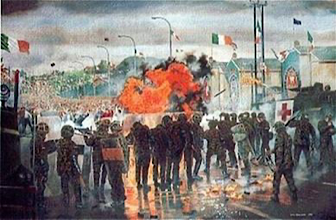
The unrest was triggered by the Orange Order’s permission to march its traditional route through the Garvaghy Road in Portadown, County Armagh, a Catholic/nationalist area, as part of the annual Drumcree parading dispute. The Orange Order, a Protestant fraternal organization, has marched this route since 1807 to commemorate the Battle of the Boyne. For decades, Catholic residents object to the route, seeing it as a sectarian provocation.
The decision to allow the march comes after death threats from loyalistparamilitaries to target Catholics if the parade is stopped. This concession outrages nationalists, who also resent the Royal Ulster Constabulary (RUC)’s aggressive policing of protesters.
On July 6, around 1,000 Orangemen march under a sealed-off Garvaghy Road, with about 1,500 RUC and British Army personnel present. The next day, mass protests erupt in areas like North Belfast, Lurgan, and west Belfast’s Lenadoon district. Rioters hurl stones, petrol bombs, and other projectiles at security forces, while Republican paramilitaries engage in gun battles with police.
Security forces responded with plastic bullets and other riot control measures, firing over 2,500 plastic bullets at rioters. A 13-year-old boy is critically injured after being struck by one. Hundreds of vehicles are hijacked, set on fire, and used to block roads in Belfast, Newry, Armagh, and Dungannon. The RUC and British Army have to withdraw entirely from some nationalist areas of Belfast.
One civilian is killed in the rioting and over 100 people are injured, including 62 RUC officers and at least three soldiers. One hundred seventeen arrests are made and some armoured vehicles are either damaged or destroyed. An indirectly related incident sees a loyalist Ulster Defence Association (UDA) member killed by a pipe bomb he is handling.
The riots highlight the fragility of peace efforts and deepen divisions over parading rights. The episode leads Secretary of State for Northern IrelandMo Mowlam to urge Orange leaders to reroute future marches. For the Provisional Irish Republican Army, the riots are its last major action in a 27-year campaign. It declares its final ceasefire on July 19, 1997.
The 1997 riots are the last widespread sectarian violence in Northern Ireland before the Good Friday Agreement, underscoring the unresolved nature of the Drumcree dispute and the challenges of achieving lasting peace.
(Pictured: “Drumcree, The Garvaghy Road July 1997” by military artist David Rowlands, oil on canvas, owned by the 1st Battalion (The Cheshires) The Mercian Regiment which depicts British soldiers during the rioting on Garvaghy Road)
Coalisland is a town in County Tyrone that has a tradition of militant republicanism; five residents are killed by British security forces before the first IRA ceasefire in 1994. In February 1992, four IRA volunteers are killed in a gun battle with the SAS during their escape after a machine gun attack on the RUC/British Army barracks there. Three months later, an IRA bomb attack on a British Army patrol at Cappagh, in which a paratrooper loses his legs, triggers a series of clashes between local residents and British troops on May 12 and 17. A number of civilians and soldiers are injured, a soldier’s backpack radio destroyed, and two British weapons stolen. The melee is followed by a 500-strong protest in the town and bitter exchanges between Republic of Ireland and British officials. Further scuffles between civilians and soldiers are reported in the town on March 6, 1994.
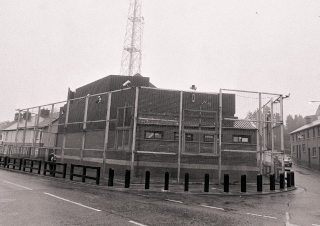
At 9:40 p.m. on Wednesday, March 26, 1997, a grenade is thrown at the joint British Army/RUC base at Coalisland, blowing a hole in the perimeter fence. The RUC reports that a 1 kg device hit the fence ten feet off the ground. Another source claims that the device is a coffee-jar bomb filled with Semtex. The grenade is thrown or fired by two unidentified men. At the time of the attack, there is an art exhibition at Coalisland Heritage Hall, also known as The Mill, from where the explosion and the gunshots that follow are clearly heard. The incident lasts less than two minutes.
Just one minute after the IRA attack, bypassers hear high-velocity rounds buzzing around them. A number of men, apparently SAS soldiers, get out of civilian vehicles wearing baseball caps with “Army” stamped on the front. A source initially describes them as members of the 14 Field Security and Intelligence Company. The men are firing Browning pistols and Heckler & Kochsubmachine guns. Witnesses say there are eight to ten gunshots, while a republican source claims that up to eighteen rounds are fired. Nineteen-year-old Gareth Doris is shot in the stomach and falls to the ground. He is allegedly returning from the local church and is in the company of a priest when he is shot. A local priest, Seamus Rice, is driving out of the church car park when his car is hit by bullets, smashing the windscreen.
Three minutes after the blast, hundreds of angry residents gather at the scene and confront the undercover soldiers. The soldiers fire live rounds at the ground and into the air to keep people back. The crowd keeps drawing back and moving forward again until 9:50 p.m., when the RUC arrives and begins firing plastic bullets at the protesters. Two women are wounded by plastic bullets and the undercover soldiers then flee in unmarked cars, setting off crackers or fireworks at the same time. Sinn FéincouncillorFrancie Molloy claims that the protesters forced the SAS to withdraw, saving Doris’s life in the process. Witnesses allegedly fear an undercover soldier brandishing a pistol would have killed the wounded Doris with a shot to his head.
Afterward, hundreds of residents are forced to leave their homes as security forces search the area near the base. This keeps tensions high, according to local republican activist Bernadette McAliskey. Two men are later questioned by the RUC about the attack.
The attack, along with two large bombings the same day in Wilmslow, England, raise concerns that the IRA is trying to influence the upcoming UK general election. Martin McGuinness describes the shooting as “murderous,” while independent councillor Jim Canning says that more than a dozen soldiers “were threatening to shoot anybody who moved […] while a young man lay shot on the ground.” Republican sources claim that this is another case of shoot-to-kill policy by the security forces. Ulster Unionist Party (UUP) MPKen Maginnis, however, praises the SAS for their actions.
Gareth Doris is admitted to South Tyrone Hospital in Dungannon, where he is arrested after undergoing surgery. He is later transferred to Musgrave Park Hospital in Belfast. He is later convicted for involvement in the bombing and sentenced to ten years in jail, before being released in 2000 under the terms of the Good Friday Agreement. Gareth is the cousin of Tony Doris, an IRA member killed in an SAS ambush in the nearby village of Coagh on June 3, 1991, and a cousin of Sinn Féin leader Michelle O’Neill. According to Sinn Féin councillor Brendan Doris, another cousin of Gareth, “He absolutely denies being involved in terrorist activity of any description.” Amnesty International raises its concerns over the shooting and the fact that no warning is given beforehand.
DNA evidence collected in the area of the shooting leads to the arrest of Coalisland native Paul Campbell by the Police Service of Northern Ireland (PSNI) in 2015, on the charges of being the other man with Doris during the attack. In February 2020, he is convicted by a Diplock court in Belfast. He denies the charges but receives a seven-and-a-half-year sentence. The prosecutor acknowledges that Campbell would have been released by this time under the provisions of the Good Friday Agreement but argues that that was a decision for the parole commission, not the court.
On July 5, 1997, on the eve of the 1997 nationalist riots in Northern Ireland, the British Army/RUC base is the scene of another attack, when an IRA volunteer engages an armoured RUC vehicle with gunfire beside the barracks. One female officer is wounded. The former RUC station at Coalisland is eventually shut down in 2006 and sold for private development in 2010.
(Pictured: Coalisland RUC/British Army base in Coalisland, County Tyrone, Northern Ireland)