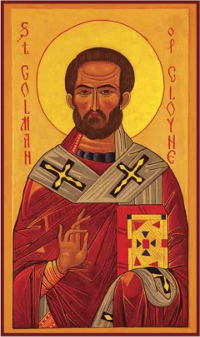
Saint Colmán of Cloyne, also known as Colmán mac Léníne, monk, founder, and patron of Cluain Uama, now Cloyne, County Cork, and one of the earliest known Irish poets to write in the vernacular, dies on November 24, 600.
Colmán is remembered as the founder of the monastery at Cluain Uama in Munster, which lay in the kingdom of the Uí Liatháin and the Uí Meic Caille, a sept of the former. The origin legend Conall Corc and the Corco Loígde claims that the land for the foundation is not given by the local king, but by Coirpre Cromm mac Crimthainn, who is king of Munster from the Eóganacht Glendamnach.
Cloyne appears to be his earliest settlement. The cathedral and round tower are situated on a limestone eminence in the midst of the valley, surrounded by rich meadows. In the rock is the cave extending in various branches underground to a great distance, from which the town derives its name. Here it is believed that Colmán took up his abode as a place of security. Colmán is also believed to have founded a monastery at what would become Killagha Abbey in County Kerry.
Colmán is credited with extraordinary poetic powers, being styled by his contemporaries “royal poet of Munster.” Several of his Irish poems are still extant, notably a metrical panegyric on Saint Brendan.
It is unclear whether Colmán is brought up as a Christian, but what is certain is that he is educated and becomes a bard or file, which requires a special education. As a member of the class of filí, he becomes attached to the court of Cashel where he remains until about the age of 48 years. In 570, he and Saint Brendan of Clonfert are said to have settled a dispute between rivals to the throne of Cashel and Aodh Caomh is acknowledged as king, the first Christian king of Cashel. The King is installed by Saint Brendan. During the time of the coronation Colmán and some others discover the lost shrine of Ailbhe of Emly. Brendan says that it is not right that the hands which have held this sacred relic should be defiled henceforth, thus it is that the son of Leinin offers himself to God. Brendan blesses him and gives him the name Colmán, which is a diminutive of Colm.
Colmán then goes to the school of Saint Iarlaithe of Tuam and after his studies he is next mentioned as preaching to the heathen population in the east of County Cork. He is described as a “religious and holy presbyter, who afterwards became a famous bishop.” The Prince of Déise, in the present county of Waterford, presents his child to Colmán for baptism. Colmán baptizes him Declán and urges his parents to educate him well in his faith. This child becomes Saint Declán of Ardmore.
Colmán is given churches in Erry and Killenaule by Coirpre Cromm mac Crimthainn, King of Munster (Cashel), as well as lands in Cloyne, County Cork. It may well be that the lands in Cloyne are conquered lands and to prevent the possibility of reconquest are given to the church. The Cloyne estate is large and contains some of the best land in the area.
After the king’s death (c. 580) Colmán somehow becomes involved in factional strife between Coirpre’s descendants in which some of them persecute him while others, the ancestors of the later dominant line, protect him.
His surviving verses date from the period 565 and 604, and are among the earliest examples of Irish writing in the Latin alphabet. He is commonly thought to have composed Luin oc laib, a poem in praise of Domnall mac Muirchertaig, king of Tara, and another poem on the death of Áed Sláine, king of the UÍ Néill. The latter poem has not survived complete.
Colmán dies on November 24, 600, and is likely buried is Cloyne, where he may have left a school of poetry in existence. The calendars are unanimous in dating his death on November 24, now his feast day.