seamus dubhghaill

Promoting Irish Culture and History from Little Rock, Arkansas, USA


Leave a comment

Birth of John Fitzpatrick, Trade Union Leader

John Fitzpatrick, Irish-born American trade union leader, is born in AthloneCounty Westmeath, on April 21, 1871. He is best remembered as the longtime head of the powerful Chicago Federation of Labor, from 1906 until his death in 1946.

Fitzpatrick attends grammar school in Ireland before coming to the United States in 1882, at the age of eleven, settling in Chicago. Following completion of his formal education, he goes to work as a horseshoer, becoming involved in the International Journeyman Horseshoers’ Union (IJHU), with which he remains affiliated for the next three decades.

Fitzpatrick serves variously as the President, Treasurer, and business agent for the Chicago local of the IJHU, being selected as a delegate to conventions of the union as well as its representative to the American Federation of Labor (AFL). This connection is instrumental in his appointment as the organizer of the Chicago Federation of Labor, city affiliate of the AFL, in 1902. Additionally, he is elected President of that organization in 1906 and remains in the capacity of President and Organizer throughout the ensuing half century.

Fitzpatrick is widely regarded as a progressive voice in the trade union movement, active in political fights beyond the ordinary hours-and-wages concerns which have traditionally dominated the union movement. He is active in the defense campaign on behalf of accused bomber Thomas Mooney, and is active in helping to organize packing house workers and steel workers in 1919.

During these campaigns, Fitzpatrick comes into close contact with radical trade union organizer William Z. Foster, founder of the Trade Union Educational League and outspoken advocate of the amalgamation of the hodge-podge of existing craft unions into unified, and thus more effective, industrial unions.

Fitzpatrick is also an advocate of independent labor politics and is one of the organizers of the Illinois Labor Party as well as its local affiliate, the Cook County Labor party. In November 1919, he runs for mayor of Chicago on the ticket of the Cook County Labor Party and receives a substantial vote of 60,000 of the 580,000 ballots cast. Bolstered by the degree of support which the new organization receives from voters, Fitzpatrick calls a national convention of local Labor Party movements, which is held in Chicago on November 22, 1919.

Fitzpatrick remains as President of the Chicago Federation of Labor until his death in 1946, with the exception of a single year, 1908, when Charles M. Dold serves as head of the organization.


Leave a comment

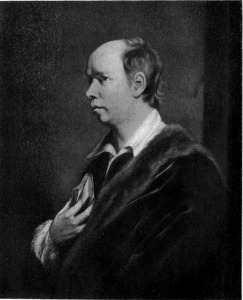
Death of Oliver Goldsmith, Novelist, Playwright & Poet

Oliver Goldsmith, Irish novelist, playwright, and poet best known for his novel The Vicar of Wakefield (1766), his pastoral poem The Deserted Village (1770), and his plays The Good-Natur’d Man (1768) and She Stoops to Conquer (1771, first performed in 1773), dies in London on April 4, 1774. He is thought to have written the classic children’s tale The History of Little Goody Two-Shoes (1765).

Goldsmith’s birth date and location are not known with certainty, although he reportedly tells a biographer that he was born on November 10, 1728. The location of his birthplace is either in the townland of Pallas, near BallymahonCounty Longford, where his father is the Anglican curate of the parish of Forgney, or at the residence of his maternal grandparents, at the Smith Hill House near Elphin, County Roscommon, where his grandfather Oliver Jones is a clergyman and master of the Elphin diocesan school, which is where Goldsmith studies. When Goldsmith is two years old, his father is appointed the rector of the parish of “Kilkenny West” in County Westmeath. The family moves to the parsonage at Lissoy, between Athlone and Ballymahon, and continues to live there until his father’s death in 1747.

In 1744 Goldsmith enters Trinity College, Dublin. His tutor is Theaker Wilder. Neglecting his studies in theology and law, he falls to the bottom of his class. In 1747, along with four other undergraduates, he is expelled for a riot in which they attempt to storm the Marshalsea Prison. He is graduated in 1749 as a Bachelor of Arts, but without the discipline or distinction that might have gained him entry to a profession in the church or the law. His education seems to have given him mainly a taste for fine clothes, playing cards, singing Irish airs, and playing the flute. He lives for a short time with his mother, tries various professions without success, studies medicine desultorily at the University of Edinburgh from 1752 to 1755, and sets out on a walking tour of FlandersFranceSwitzerland, and Northern Italy.

Goldsmith settles in London in 1756, where he briefly holds various jobs, including an apothecary‘s assistant and an usher of a school. Perennially in debt and addicted to gambling, Goldsmith produces a massive output as a hack writer for the publishers of London, but his few painstaking works earn him the company of Samuel Johnson, with whom he is a founding member of “The Club.” There, through fellow Club member Edmund Burke, he makes the acquaintance of Sir George Savile, who later arranges a job for him at Thornhill Grammar School. The combination of his literary work and his dissolute lifestyle leads Horace Walpole to give him the epithet “inspired idiot.” During this period, he uses the pseudonym “James Willington,” the name of a fellow student at Trinity, to publish his 1758 translation of the autobiography of the Huguenot Jean Marteilhe.

Goldsmith is described by contemporaries as prone to envy, a congenial but impetuous and disorganised personality who once planned to emigrate to America but failed because he missed his ship. At some point around this time he works at Thornhill Grammar School, later basing Squire Thornhill on his benefactor Sir George Savile and certainly spending time with eminent scientist Rev. John Mitchell, whom he probably knows from London. Mitchell sorely misses good company, which Goldsmith naturally provides in spades. Thomas De Quincey writes of him “All the motion of Goldsmith’s nature moved in the direction of the true, the natural, the sweet, the gentle.”

His premature death in 1774 is believed to have been partly due to his own misdiagnosis of a kidney infection. Goldsmith is buried in Temple Church in London. There is a monument to him in the centre of Ballymahon and also in Westminster Abbey with an epitaph written by Samuel Johnson.


Leave a comment

Christopher Nolan Wins Whitbread Book Award

christopher-nolan

Christopher Nolan, Irish poet and author who cannot move or speak because of an accident at birth, wins the Whitbread Book Award on January 19, 1987, for his autobiography Under the Eye of the Clock.

Nolan is born in Mullingar, County Westmeath, on September 6, 1965, the son of Joseph and Bernadette Nolan. Due to asphyxiation at birth, he is born with permanent impairment of his “nerve-signaling system, a condition he said is now labelled dystonia.” Because of these complications, he is born with cerebral palsy and can only move his head and eyes. To write, Nolan uses a special computer and keyboard. In order to help him type, his mother holds his head in her cupped hands while he painstakingly picks out each word, letter by letter, with a pointer attached to his forehead.

Upon becoming a teenager, Nolan receives his education from the Central Remedial Clinic school, Mount Temple Comprehensive School, and at Trinity College, Dublin. His first book is published when he is fifteen. He is also awarded an Honorary Doctorate of Letters in the UK, the medal of excellence from the United Nations Society of Writers, and a Person of the Year award in Ireland. At the age of fifteen, he publishes his collection of poems titled Dam-Burst of Dreams. He writes an account of his childhood, Under the Eye of the Clock, published by St. Martin’s Press, which wins him the UK’s Whitbread Book Award in 1987 at the age of 21. He soon drops out of Trinity College to write a novel entitled The Banyan Tree (1999).

Nolan spends more than a decade writing The Banyan Tree. According to The New York Times, the book is a multigenerational story of a dairy-farming family in Nolan’s native county of Westmeath. The story is seen through the eyes of the aging mother. It is inspired, he tells Publishers Weekly, by the image of “an old woman holding up her skirts as she made ready to jump a rut in a field.” A review of the book is done in The New York Times by Meghan O’Rourke. She reviews the book and relates it to James Joyce‘s A Portrait of the Artist as a Young Man; in the story the protagonist leaves his mother in Ireland while he moves on to travel the world. Nolan, however, gives the reader a version of the mother’s story. “And so, in the end, one suspects that he wants Minnie’s good-natured, commonplace ways to stand as their own achievement, reminding us that life continues in the places left behind.”

Christopher Nolan dies at age 43 in Beaumont Hospital in Dublin at 2:30 AM on February 20, 2009, after a piece of salmon becomes trapped in his airway. Irish president Mary McAleese, upon hearing the news, says, “Christopher Nolan was a gifted writer who attained deserved success and acclaim throughout the world for his work, his achievements all the more remarkable given his daily battle with cerebral palsy.”


Leave a comment

Death of Máel Sechnaill mac Domnaill

máel_seachnaill_II_sculpture

Máel Sechnaill mac Domnaill, King of Mide and High King of Ireland, dies on September 2, 1022, at Lough Ennell, County Westmeath. His great victory at the Battle of Tara against Amlaíb Cuarán in 980 results in Gaelic control of the Kingdom of Dublin.

Máel Sechnaill belongs to the Clann Cholmáin branch of the Uí Néill dynasty. He is the grandson of Donnchad Donn, great-grandson of Flann Sinna and great-great-grandson of the first Máel Sechnaill, Máel Sechnaill mac Máele Ruanaid. The Kings of Tara or High Kings of Ireland have for centuries alternated between the various Uí Néill branches. By Máel Sechnaill’s time this alternating succession passes between Clann Cholmáin in the south and the Cenél nEógain in the north, so that he succeeds Domnall ua Néill in 980.

In 980, Amlaíb Cuarán, King of Dublin, summons auxiliaries from Norse-ruled Scottish Isles and from Man and attacks Meath, but is defeated by Máel Sechnaill at Tara. Reginald, Olaf’s heir, is killed. Máel Sechnaill follows up his victory with a siege of Dublin which surrenders after three days and nights. When Maél Sechnaill takes Dublin in 980 he frees all the slaves then residing in the town.

In 997, at a royal meeting near Clonfert, Máel Sechnaill meets with his long-time rival Brian Boru, King of Munster. The two kings make a truce, by which Brian is granted rule over the southern half of Ireland, while Máel Sechnaill retains the northern half and high kingship. In honour of this arrangement, Máel Sechnaill hands over to Brian the hostages he has taken from Dublin and Leinster. The following year Brian hands over to Máel Sechnaill the hostages of Connacht. In the same year, Brian and Máel Sechnaill begin co-operating against the Norse of Dublin for the first time.

Late in 999, however, the Leinstermen, historically hostile to domination by either the Uí Néill overkings or the King of Munster, ally themselves with the Norse of Dublin and revolt against Brian. The Annals of the Four Masters records that Brian and Máel Sechnaill unite their forces and, according to the Annals of Ulster, they meet the Leinster-Dublin army at Glenmama on Thursday, December 30, 999. Glenmama, near Lyons Hill in Ardclough, County Kildare, is the ancient stronghold of the Kings of Leinster. The Munster-Meath army defeats the Leinster-Dublin army. Ó Corráin refers to it as a “crushing defeat” of Leinster and Dublin, while The dictionary of English history says the battle effectively “quelled” the “desperate revolt” of Leinster and Dublin. Most importantly, the defeat leaves the road to Dublin “free and unimpeded for the victorious legions of Brian and Mael Sechlainn.”

The system of alternating succession between the various Uí Néill branches is ended by Brian Boru’s so-called overthrow of Máel Sechnaill in 1002. It is a bloodless shift resulting from the failure of the Northern Uí Néill to support Máel Sechnaill against the aspirations of the extremely militarized overlord of Munster.

With the deaths of Brian Boru, his son, grandson, and many other Munster nobles at Clontarf in 1014, Máel Sechnaill succeeds in regaining the titular High Kingship, but the High Kingship, albeit with opposition, does not reappear until Diarmait mac Maíl na mBó of Leinster rises to power.

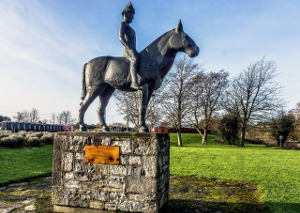
(Pictured: Sculpture of Máel Seachnaill in Trim, County Meath, by James McKenna)


Leave a comment

Birth of Tenor John McCormack

john-mccormack

John McCormack, an Irish tenor celebrated for his performances of the operatic and popular song repertoires and renowned for his diction and breath control, is born in Athlone, County Westmeath, on June 14, 1884.

McCormack receives his early education from the Marist Brothers in Athlone, and later attends Summerhill College in Sligo. He sings in the choir of the old St. Peters church in Athlone under choirmaster Michael Kilkelly. When the family moves to Dublin, he sings in the choir of St. Mary’s Pro-Cathedral where he is discovered by composer Vincent O’Brien. In 1903 he wins the coveted gold medal of the Dublin Feis Ceoil.

Fundraising activities on his behalf enable McCormack to travel to Italy in 1905 to receive voice training by Vincenzo Sabatini in Milan. In 1906, he makes his operatic début at the Teatro Chiabrera, Savona. The next year he begins his first important operatic performance at Covent Garden in Mascagni‘s Cavalleria rusticana, becoming the theatre’s youngest principal tenor.

In less than three years he is singing opera in the United States, as well as beginning a career on the recital stage that makes him one of the most successful singers of all time. In 1917 he becomes a citizen of the United States, his adopted country, where his concert appeal has proven to be nearly universal and unrelenting.

McCormack originally ends his career in 1938 at the Royal Albert Hall in London. However, one year after that farewell concert he is back singing for the Red Cross and in support of the war effort. He concertizes, tours, broadcasts, and records in this capacity until 1943 when failing health forced him to permanently retire.

Ill with emphysema, he purchases a house near the sea at Booterstown, County Dún Laoghaire–Rathdown, just south of Dublin. After a series of infectious illnesses, including influenza and pneumonia, McCormack dies on September 16, 1945. He is mourned by his countrymen, his English public who had taken him to their hearts as well, a vast number of his fellow citizens in the United States, and music lovers all over the world. He is buried in Deansgrange Cemetery.