
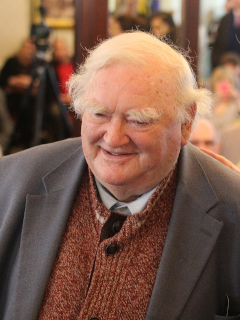
Timothy Patrick “Tim Pat” Coogan, Irish journalist, writer and broadcaster, is born in Monkstown, County Dublin, on April 22, 1935. He serves as editor of The Irish Press newspaper from 1968 to 1987. He is best known for such books as The IRA (1970) and On the Blanket: The H Block Story (1980), and biographies of Michael Collins and Éamon de Valera.
Coogan’s particular focus is on Ireland’s nationalist/independence movement in the 20th century, a period of unprecedented political upheaval. He blames the Troubles in Northern Ireland on “Paisleyism.”
Coogan is the first of three children born to Beatrice (née Toal) and Eamonn Coogan, a native of Kilkenny who is an Irish Republican Army (IRA) volunteer during the Irish War of Independence and later serves as the first Deputy Commissioner of the newly established Garda Síochána, then a Fine Gael TD for the Kilkenny constituency. His mother, the daughter of a policeman, is a Dublin socialite who is crowned Dublin’s Civic Queen of Beauty in 1927. She writes for the Evening Herald and takes part in various productions in the Abbey Theatre and Radio Éireann. He spends many summer holidays in the town of Castlecomer, County Kilkenny, his father’s hometown.
A former student of the Irish Christian Brothers in Dún Laoghaire and Belvedere College in Dublin, Coogan spends most of his secondary studies at Blackrock College in Dublin.
In 2000, Irish writer and editor Ruth Dudley Edwards is awarded £25,000 damages and a public apology by the High Court in London against Coogan for factual errors in references to her in his book Wherever Green is Worn: The Story of the Irish Diaspora (2000). In the book, he writes that Dudley Edwards had “groveled to and hypocritically ingratiated herself with the English establishment to further her writing career.” He also alleges that Dudley Edwards “had abused the position of chairwoman of the British Association for Irish Studies (BAIS) by trying to impose her political views on it” and that her commission to write True Brits had been awarded because of political favouritism.
When Taoiseach Enda Kenny causes confusion following a speech at Béal na Bláth by incorrectly claiming Michael Collins had brought Lenin to Ireland, Coogan comments, “Those were the days when bishops were bishops and Lenin was a communist. How would that have gone down with the churchyard collections?”
In November 2012, for reasons that are uncertain, the United States embassy in Dublin refuses to grant Coogan a visa to visit the United States. As a result, a planned book tour for his book The Famine Plot, England’s role in Ireland’s Greatest Tragedy (2012) is cancelled. After representations to then Secretary of State Hillary Clinton by United States Senator Chuck Schumer (D-NY) and Congressman Peter T. King (R-NY), he receives his visa.
Coogan has been criticised by the Irish historians Liam Kennedy and Diarmaid Ferriter, as well as Cormac Ó Gráda, for a supposed lack of thoroughness in his research and bias:
“Well, I waited in this book to hear some great revelation, and it just isn’t there. It’s anticlimactic. I could not see the great plot, and indeed there is no serious historian who … I can’t think of a single historian who has researched the Famine in depth – and Tim Pat has not researched it in depth” (The Famine Plot).
“Coogan is not remotely interested in looking at what others have written on 20th-century Irish history…. he does not appear interested in context and shows scant regard for evidence. He does not attempt to offer any sustained analysis in relation to the challenges of state building, the meaning of sovereignty, economic and cultural transformations, or comparative perspectives on the evolution of Irish society. There is no indication whatsoever that Coogan has engaged with the abundant archival material relating to the subject matter he pronounces on. There is no rhyme or reason when it comes to the citation of the many quotations he uses; the vast majority are not referenced. For the 300-page text, 21 endnotes are cited and six of them relate to Coogan’s previous books, a reminder that much of this tome consists of recycled material…. Tim Pat Coogan… he is a decent, compassionate man who has made a significant contribution to Irish life. But he has not read up on Irish history; indeed, such is the paucity of his research efforts that this book amounts to a travesty of 20th-century Irish history” (1916: The Mornings After).

 seamus dubhghaill