
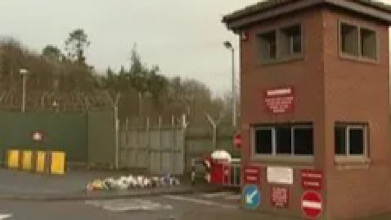
The Massereene Barracks shooting takes place at Massereene Barracks in Antrim, County Antrim, Northern Ireland, on March 7, 2009. Two off-duty British soldiers of the 38 Engineer Regiment are shot dead outside the barracks. Two other soldiers and two civilian delivery men are also shot and wounded during the attack. A dissident Irish republican paramilitary group, the Real Irish Republican Army (RIRA), claim responsibility.
The shootings are the first British military fatalities in Northern Ireland since 1997. Two days later, the Continuity Irish Republican Army shoot dead Stephen Carroll, a Police Service of Northern Ireland (PSNI) officer, the first Northern Ireland police officer to be killed by paramilitaries since 1998.
From the late 1960s until the late 1990s, Northern Ireland undergoes a conflict known as the Troubles, in which more than 3,500 people are killed. More than 700 of those killed are British military personnel, deployed as part of Operation Banner. The vast majority of these British military personnel are killed by the Provisional Irish Republican Army (IRA), which wages an armed campaign to force the British to negotiate a withdrawal from Northern Ireland. In 1997, the IRA calls a final ceasefire and in 1998 the Good Friday Agreement is signed. This is widely seen as marking the end of the conflict.
However, breakaway groups of dissident Irish republicans oppose the ceasefire and continue a low-level armed campaign against the British security forces in Northern Ireland. The main group involved is an IRA splinter group known as the Real IRA. In 2007, the British Army formally ends Operation Banner and greatly reduces its presence in Northern Ireland.
The low-level dissident republican campaign continues. In January 2009, security forces have to defuse a bomb in Castlewellan, County Down, and in 2008 three separate incidents see dissident republicans attempt to kill PSNI officers in Derry, Castlederg and Dungannon. In all three cases, PSNI officers are seriously wounded. Two of the attacks involve firearms while the other involves an under-car booby-trap bomb.
At about 9:40 p.m. on the evening of Saturday, March 7, four off-duty British soldiers of the Royal Engineers walk outside the barracks to receive a pizza delivery from two delivery men. As the exchange is taking place, two masked gunmen in a nearby car open fire with PM md. 63 assault rifles. The firing lasts for more than 30 seconds with more than 60 shots being fired. After the initial burst of gunfire, the gunmen walk over to the wounded soldiers lying on the ground and fire again at close range, killing two of them. Those killed are Sappers Mark Quinsey from Birmingham and Patrick Azimkar from London. The other two soldiers and two deliverymen are wounded. The soldiers are wearing desert fatigues and were to be deployed to Afghanistan the following day. A few hours later, the stolen car involved is found abandoned near Randalstown, eight miles (13 km) from the barracks.
A Dublin-based newspaper, the Sunday Tribune, receives a phone call from a caller using a recognised Real IRA codeword. The caller claims responsibility for the attack on behalf of the Real IRA, adding that the civilian pizza deliverymen were legitimate targets as they were “collaborating with the British by servicing them.”
The shootings are the first British military fatalities in Northern Ireland since Lance Bombardier Stephen Restorick was shot dead by the Provisional IRA in February 1997, during the Troubles. The attack comes days after a suggestion by Northern Ireland’s police chief, Sir Hugh Orde, that the likelihood of a “terrorist” attack in Northern Ireland is at its highest level in several years.
Civilian security officers belonging to the Northern Ireland Security Guard Service are criticised for not opening fire during the incident, as a result of which plans are made to retrain and rearm them.
The morning after the attack, worshippers come out of St. Comgall’s Church after mass and keep vigil near the barracks. They are joined by their priest and clerics from the town’s other churches. On March 11, 2009, thousands of people attend silent protests against the killings at several venues in Northern Ireland.
The killings are condemned by all mainstream political parties in Northern Ireland, as well as the Irish government, the United States government and Pope Benedict XVI. Sinn Féin condemns the killings, but is criticised for being less vehement than others in its condemnation.
On March 14, 2009, the PSNI arrests three men in connection with the killings, one of whom is former IRA prisoner Colin Duffy. He had broken away from mainstream republicanism and criticised Sinn Féin’s decision to back the new PSNI. On March 25, 2009, after a judicial review of their detention, all the men are ordered to be released by the Belfast High Court. Duffy is immediately re-arrested on suspicion of murder. On March 26, 2009, Duffy is charged with the murder of the two soldiers and the attempted murder of five other people. The following day he appears in court for indictment and is remanded in custody to await trial after it is alleged that his full DNA profile had been found on a latex glove inside the vehicle used by the gunmen. There is also soil found in the car they drove that matches the soil on the ground in front of the barracks.
Brian Shivers, a cystic fibrosis sufferer, is charged with the soldiers’ murders and the attempted murder of six other people. He is also charged with possession of firearms and ammunition with intent to endanger life. He is arrested in Magherafelt, County Londonderry, in July 2009.
In January 2012, Shivers is convicted of the soldiers’ murders, but Duffy is acquitted. In January 2013, Shivers’s conviction is overturned by Northern Ireland’s highest appeals court. A May 2013 retrial finds Shivers not guilty. He is cleared of all charges and immediately released from jail. The judge questions why the Real IRA would choose Shivers as the gunman, with his cystic fibrosis and his engagement to a Protestant woman.
The barracks are shut down in 2010 as part of the reduction of the British Army presence in Northern Ireland.
 seamus dubhghaill