
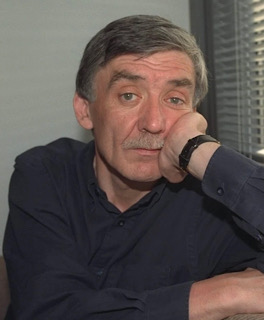
Sean O’Callaghan, a member of the Provisional Irish Republican Army (IRA), who from the late 1970s to the mid-1980s works against the organisation from within as a mole for the Irish Government with the Garda Síochána‘s Special Detective Unit, is born in Tralee, County Kerry, on October 10, 1954.
O’Callaghan is born into a family with a Fenian paramilitary history. His paternal grandfather had taken the Anti-Treaty side during the Irish Civil War, and his father had been interned by the Irish Government at the Curragh Camp in County Kildare for IRA activity during World War II.
By the late 1960s, O’Callaghan ceases to practise his Catholic faith, adopts atheism and has become interested in the theories of Marxist revolutionary politics, which finds an outlet of practical expression in the sectarian social unrest in Northern Ireland at the time, centered on the activities of the Northern Ireland Civil Rights Association. In 1969, communal violence breaks out in Northern Ireland and believing that British imperialism is responsible, he joins the newly founded Provisional IRA at the age of 17.
Soon afterward, O’Callaghan is arrested by local Gardaí after he accidentally detonates a small amount of explosives, which cause damage to the homes of his parents and their neighbours. After demanding, and receiving, treatment as a political prisoner, he quietly serves his sentence.
After becoming a full-time paramilitary with the IRA, in the early to mid-1970s O’Callaghan takes part in over seventy operations associated with Irish Republican political violence including bomb materials manufacture, attacks on IRA targets in Northern Ireland, and robberies to provide funding for the organisation.
In 1976, O’Callaghan ends his involvement with the IRA after becoming disillusioned with its activities. He later recalls that his disenchantment with the IRA began when one of his compatriots openly hoped that a female police officer who had been blown up by an IRA bomb had been pregnant so they could get “two for the price of one.” He is also concerned with what he perceives as an undercurrent of ethnic hatred in its rank and file toward the Ulster Scots population. He leaves Ireland and moves to London. In May 1978, he marries a Scottish woman of Protestant unionist descent. During the late 1970s, he runs a successful mobile cleaning business. However, he is unable to fully settle into his new life, later recalling, “In truth there seemed to be no escaping from Ireland. At the strangest of times I would find myself reliving the events of my years in the IRA. As the years went on, I came to believe that the Provisional IRA was the greatest enemy of democracy and decency in Ireland.”
In 1979, O’Callaghan is approached by the IRA seeking to recruit him again for its paramilitary campaign. In response, he decides to turncoat against the organisation and becomes an agent within its ranks for the Irish Government. He decides to become a double agent even though he knows that even those who hate the IRA as much as he now does have a low opinion of informers. However, he feels it is the only way to stop the IRA from luring teenagers into their ranks and training them to kill.
Soon after being approached by the IRA to re-join, O’Callaghan returns to Tralee from London, where he arranges a clandestine meeting with an officer of the Garda Special Detective Unit in a local cemetery, at which he expresses his willingness to work with it to subvert the IRA from within. At this point, he is still opposed to working with the British Government. A few weeks later, he makes contact with Kerry IRA leader Martin Ferris and attends his first IRA meeting since 1975. Immediately afterward, he telephones his Garda contact and says, “We’re in”.
During the 1981 hunger strike in the Maze Prison, O’Callaghan attempts to start his own hunger strike in support of the Maze prisoners but is told to desist by the IRA for fear it will detract focus from the prisoners. He successfully sabotages the efforts of republicans in Kerry from staging hunger strikes of their own.
In 1984, O’Callaghan notifies the Garda of an attempt to smuggle seven tons of AK-47 assault rifles from the United States to Ireland aboard a fishing trawler named Valhalla. The guns are intended for the arsenal of the Provisional IRA’s units. As a result of his warning, a combined force of the Irish Navy and Gardaí intercept the boat that received the weaponry, and the guns are seized. The seizure marks the complete end of any major attempt by the IRA to smuggle guns out of the United States.
In 1983, O’Callaghan claims to be tasked by the IRA with placing 25 lbs. of Frangex in the Dominion Theatre in London, in an attempt to kill Prince Charles and Princess Diana who are due to attend a charity pop music concert there. A warning is phoned into the Garda, and the Royal couple are hurriedly ushered from the theatre by their police bodyguard during the concert. The theatre had been searched before the concert and a second search following the warning reveals no device.
In 1985, O’Callaghan is elected as a Sinn Féin councillor for Tralee Urban District Council, and unsuccessfully contests a seat on Kerry County Council.
After becoming disillusioned with his work with the Irish Government following the murder of another of its agents within the IRA, which it had failed to prevent despite O’Callaghan’s warnings of the threat to him, and sensing a growing threat to himself from the organisation which had become suspicious of his own behaviour, he withdraws from the IRA and leaves Ireland to live in England, taking his wife and children with him. His marriage ends in a divorce in 1987, and on November 29, 1988, he walks into a police station in Tunbridge Wells, Kent, England, where he presents himself to the officer on duty at the desk, confesses to the murder of Ulster Defence Regiment (UDR) Greenfinch (female member) Eva Martin and the murder of D.I. Peter Flanagan during the mid-1970s, and voluntarily surrenders to British prosecution.
Although the Royal Ulster Constabulary (RUC) offers him witness protection as part of the informer policy, O’Callaghan refuses it and is prosecuted under charges of two murders and 40 other crimes, to all of which he pleads guilty, committed in British jurisdiction with the IRA. Having been found guilty, he is sentenced to a total of 539 years in prison. He serves his sentence in prisons in Northern Ireland and England. While in jail, he publishes his story in The Sunday Times. He is released after being granted the royal prerogative of mercy by Queen Elizabeth II in 1996.
In 1998, O’Callaghan publishes an autobiographical account of his experiences in Irish Republican paramilitarism, entitled The Informer: The True Life Story of One Man’s War on Terrorism (1998).
In 2002, O’Callaghan is admitted to Nightingale Hospital, Marylebone, an addiction and rehab center where he undergoes a rehabilitation program for alcohol dependency. His identity and past activities are not revealed to the other patients. He lives relatively openly in London for the rest of his life, refusing to adopt a new identity. He is befriended in the city by the Irish writer Ruth Dudley Edwards, and works as a security consultant, and also occasional advisor to the Ulster Unionist Party (UUP) on how to handle Irish republicanism in general, and Sinn Féin in particular.
In 2006, O’Callaghan appears in a London court with regard to an aggravated robbery that occurs in which he is the victim.
In 2015, O’Callaghan publishes James Connolly: My Search for the Man, the Myth & his Legacy (2015), a book containing a critique of the early 20th century Irish revolutionary James Connolly, and what he considers to be his destructive legacy in Ireland’s contemporary politics.
O’Callaghan dies by drowning after suffering a heart attack at the age of 63 while in a swimming pool in Kingston, Jamaica, on August 23, 2017, while visiting his daughter. A memorial service is held in his memory on March 21, 2018, at St. Martin’s-in-the-Fields, a Church of England parish church at the northeast corner of Trafalgar Square in the City of Westminster, London. The service is attended by representatives from Ulster Unionist parties and the Irish Government.


 seamus dubhghaill