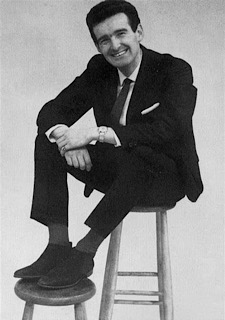
Tom Dunphy, the charismatic lead vocalist of the Royal Showband and later the bassist of the Big 8, dies on July 29, 1975, in a tragic road accident.
Dunphy is traveling in a Ford Granada on the Longford side of Carrick-on-Shannon, County Leitrim, when his car skids on a wet surface while rounding a bend. It collides with an oncoming cement lorry. The crash occurs about five miles from Drumsna, near Annaduff, where he is en route to meet fellow band members for the Mary from Dungloe Festival in County Donegal. Band member Noel Ryan, who is a passenger in the car, escapes with little more than a concussion.
The Royal Showband, formed in 1957, is one of Ireland’s most popular showbands in the 1960s, known for large-scale dance events with audiences often exceeding 2,000. Dunphy sings lead on their hit “Come Down the Mountain, Katie Daly.” In 1971, he and Brendan Bowyer leave the Royal Showband to form the Big 8, a successful showband supergroup.
The accident cuts short a promising career and leaves a void in the Irish music scene. In 1978, a memorial site is erected near the crash location in Annaduff, maintained by local volunteers. Annual tributes have been held, including a Mass at St. Mary’s Church and musical events in Drumshanbo, often attended by family, fellow musicians, and fans from across Ireland and abroad.
Dunphy is remembered for his “sincere wit, charm and personality” that endears him to dancing enthusiasts nationwide. He performs alongside international stars such as Elvis Presley, Tom Jones, the Beatles, and Cliff Richard. His death marks the symbolic end of the showband era in Ireland.
Today, Dunphy’s life and career are commemorated in counties Waterford and Leitrim, with ongoing efforts to preserve his memory through plaques, events, and archival work.
Parke joins the British Army Medical Services (AMS) in February 1881 as a surgeon, first serving in Egypt during the final stages of the ʻUrabi revolt in 1882. As a senior medical officer at a field hospital near Cairo, he is responsible for treating battle casualties as well as the deadly cholera epidemic that afflicts 20% of British troops stationed there. In late 1883, he returns to Ireland, where he is stationed at Dundalk with the 16th The Queen’s Lancers. He arrives in Egypt once again in 1884 as a part of the Nile Expedition sent in relief of General Charles Gordon, who is besieged in Khartoum by Mahdists in neighbouring Sudan. The expedition arrives too late, and Gordon is killed. Parke later negatively recounts this experience in an 1892 journal article titled How General Gordon Was Really Lost. Following the expedition, he spends the next few years stationed in Alexandria, where he notably introduces fox hunting to Egypt, becoming master of the Alexandria Hunt Club.
In January 1887, while in Alexandria, Parke is invited by Edmund Musgrave Barttelot to accompany him on the Emin Pasha Relief Expedition. The expedition is led by Henry Morton Stanley, and journeys through the African wilderness in relief of Emin Pasha, an Egyptian administrator who had been cut off by Mahdist forces following the Siege of Khartoum. He is initially rejected by Stanley upon his arrival in Alexandria but is invited by telegram a day later to join the expedition in Cairo. On February 25, 1887, the expedition sets off from Zanzibar for the Congo.
The expedition lasts for three years and faces great difficulty, with the expedition of 812 men suffering from poor logistical planning and leadership. The rainforest is much larger than Stanley expected, leading much of the party to face starvation and disease. The expedition has to resort to looting native villages for food, escalating the conflict between the two groups. Parke, for his part, saves the lives of many in the party, including Stanley, who suffers from acute abdominal pain and a bout of sepsis. Stanley describes Parke’s care as “ever striving, patient, cheerful and gentle…most assiduous in his application to my needs, and gentle as a woman in his ministrations.” Parke also treats Arthur Jephson for fever, and nurses Robert H. Nelson through starvation. Furthermore, after a conflict with the natives, he has to save William Grant Stairs by orally sucking the poison out of an arrow wound.
During the expedition, Parke purchases from an Arab slaver a Mangbetu Pigmy girl, who serves as his nurse and servant for over a year.
After returning to Ireland, Parke receives an Honorary Fellowship of the Royal College of Surgeons in Ireland and is awarded gold medals from the British Medical Association (BMA) and the Royal Geographical Society. He publishes several books, including My Personal Experiences in Equatorial Africa (1891) and A Guide to Health in Africa.