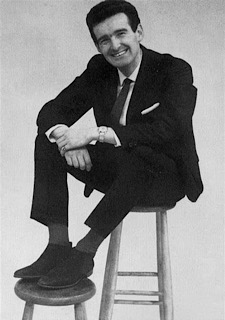
Tom Dunphy, the charismatic lead vocalist of the Royal Showband and later the bassist of the Big 8, dies on July 29, 1975, in a tragic road accident.
Dunphy is traveling in a Ford Granada on the Longford side of Carrick-on-Shannon, County Leitrim, when his car skids on a wet surface while rounding a bend. It collides with an oncoming cement lorry. The crash occurs about five miles from Drumsna, near Annaduff, where he is en route to meet fellow band members for the Mary from Dungloe Festival in County Donegal. Band member Noel Ryan, who is a passenger in the car, escapes with little more than a concussion.
The Royal Showband, formed in 1957, is one of Ireland’s most popular showbands in the 1960s, known for large-scale dance events with audiences often exceeding 2,000. Dunphy sings lead on their hit “Come Down the Mountain, Katie Daly.” In 1971, he and Brendan Bowyer leave the Royal Showband to form the Big 8, a successful showband supergroup.
The accident cuts short a promising career and leaves a void in the Irish music scene. In 1978, a memorial site is erected near the crash location in Annaduff, maintained by local volunteers. Annual tributes have been held, including a Mass at St. Mary’s Church and musical events in Drumshanbo, often attended by family, fellow musicians, and fans from across Ireland and abroad.
Dunphy is remembered for his “sincere wit, charm and personality” that endears him to dancing enthusiasts nationwide. He performs alongside international stars such as Elvis Presley, Tom Jones, the Beatles, and Cliff Richard. His death marks the symbolic end of the showband era in Ireland.
Today, Dunphy’s life and career are commemorated in counties Waterford and Leitrim, with ongoing efforts to preserve his memory through plaques, events, and archival work.
An attack is made on the RIC barracks in the town, and the British military garrison in Waterford quickly dispatches forty troops in four Crossley tenders. However the ambush has been badly planned with the result that the British troops are able to make a determined counterattack. Two IRA volunteers, Thomas O’Brien and Michael McGrath, are reportedly taken away and shot by members of the Devon Regiment. Two other volunteers are wounded. One British soldier and one Black and Tan are wounded.
A memorial is later erected on the ambush site. In later years, local Gaelic Athletic Association (GAA) fields are named after the two dead IRA men.
(Pictured: Members of the Irish Republican Army East Waterford Brigade)
On the foundation of the Sunday Tribune in 1980, Kennedy joins it as the paper’s political correspondent. The paper’s publisher, John Mulcahy, had become familiar with her when she had contributed to his journal Hibernia. When the Tribune briefly ceases production, she moves to the Sunday Press.
In 1982, Kennedy’s telephone, along with those of two other journalists, is tapped by former Minister for JusticeSeán Doherty. Early in 1987, Kennedy successfully sues the incumbent Charles Haughey-led Fianna Fáil government for illegally tapping her phone. The revelation in 1992 that Haughey had ordered the phone taps leads to his resignation as Taoiseach.
Kennedy stands in the 1987 Irish general election as a candidate for the newly formed Progressive Democrats party in Dún Laoghaire. She comes third in the poll, winning 9.4% of the first-preference vote. She is one of fourteen Progressive Democrats TDs elected to Dáil Éireann in that election — a feat the party never achieves again. She is appointed the party’s spokesperson for foreign affairs. She stands again in the 1989 Irish general election and wins 9% of the first-preference vote but fails to retain her seat.
Following her election defeat, Kennedy returns to The Irish Times, then edited by Conor Brady, whom she had worked with at the Tribune when he was the editor. She avoids party-political journalism for several years, but she returns to covering politics in the early 1990s and becomes The Irish Times‘ political editor in 1999. She becomes the newspaper’s first female editor upon the departure of Conor Brady in October 2002. One of her rivals for the editor’s chair is the paper’s high-profile columnist, Fintan O’Toole.
Kennedy is paid more than the editor of Britain’s top non-tabloid newspaper The Daily Telegraph, which has a circulation of about nine times that of The Irish Times. Later columnist Fintan O’Toole tells the Sunday Independent, “We as a paper are not shy of preaching about corporate pay and fat cats but with this there is a sense of excess. Some of the sums mentioned are disturbing. This is not an attack on Ms. Kennedy, it is an attack on the executive level of pay. There is double standard of seeking more job cuts while paying these vast salaries.”
In September 2006, Kennedy approves the publication of an article in The Irish Times giving confidential details of investigations being made into payments purported to have been made in 1993 to Taoiseach Bertie Ahern. She refuses, upon request of the investigating Mahon Tribunal, to provide details of the source of the printed information. She responds that the documents have since been destroyed. Her refusal causes the Tribunal to seek High Court orders compelling her to provide details of the source. On October 23, 2007, the High Court grants the orders compelling her to go before the Tribunal and answer all questions. In its judgment, the High Court, criticising her decision to destroy the documents, says it is an “astounding and flagrant disregard of the rule of law.” In 2009, however, the Supreme Court of Ireland overturns this ruling, holding that the High Court had not struck the correct balance between the journalists’ right to protect their source and the tribunal’s right to confidentiality.
Kennedy announces on March 12, 2011, her intention to retire from The Irish Times by September, after a nine-year term as editor. She actually retires in June, and is succeeded by news editor, Kevin O’Sullivan, who succeeds her as editor on June 23, 2011.
In August 2012, Kennedy is appointed Adjunct Professor of Journalism at the University of Limerick. She has been awarded five honorary doctorates from Irish universities.