
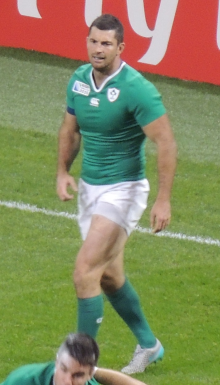
Robert Kearney, former rugby union player, is born on a dairy farm on March 26, 1986, on the Cooley Peninsula in County Louth. He plays for 15 years for Leinster followed by a six-month stint in Australia, playing for Perth based side Western Force. He also plays over a decade for the Ireland national rugby union team with whom he earns 95 caps and goes on two British & Irish Lions tours in 2009 and 2013. As a youth he also plays rugby union for Clongowes Wood College and Gaelic football for Louth in the All-Ireland Minor Football Championship.
Kearney is the third of five children. He has an older brother, Richard, a younger brother Dave (who plays for Leinster) and a sister, Sara, the youngest of the five children. His elder brother Ross dies at the age of six following an accident in 1988. He is a seventh cousin of former U.S. President Joe Biden.
Like many of his peers, Kearney gets involved in athletics at an early age. The dominant sport in the area is Gaelic football. As a youth, he plays Gaelic for Naomh Muire, and in the Cooley Kickhams underage setup, before graduating to the Cooley senior football team at the age of 17 in 2004 and also Louth at minor level.
Kearney attends Clongowes Wood College in County Kildare for his secondary education. After his Leaving Certificate he moves to University College Dublin (UCD) on a sports scholarship, where he plays for the rugby team. He graduates in April 2010 with a Bachelor of Arts degree in economics. In 2005 he helps the U-20s team win the McCorry Cup, beating Dublin University Football Club (DUFC) in the final. In 2018, he is awarded the UCD Alumni Award in Sport.
Kearney plays for Leinster at both schoolboy and U-19 level before going on to represent them as a senior. He scores a hat-trick of tries on his debut for Leinster in a pre-season friendly win over Parma.
Kearney makes his Celtic League debut for Leinster in 2005 in a 22–20 defeat away to the Ospreys. He makes 32 appearances in the competition, scoring eight tries, with three penalties during a period in September 2006, when usual place kicker, Felipe Contepomi, is injured. He plays in his first Heineken Cup game in a 19–22 defeat against Bath at the Royal Dublin Society (RDS) on October 22, 2005. It is the first of ten appearances scoring ten tries in the process. He is part of Leinster’s Heineken Cup winning team in 2009 but misses the 2011 final due to injury. On May 21, 2012, the day after Leinster wins their second straight Heineken Cup, he is announced as the ERC Player of the Year for 2012. During the 2011–12 campaign he starts all nine European matches scoring six tries. He is crowned Leinster player of the year for the 2011–12 season. He confirms his departure from Leinster on September 24, 2020.
In late September 2020, it is confirmed that Kearney has signed a one-year contract with Australian side Western Force. He makes his Force debut in an 11–27 defeat to the Brumbies on February 19, 2021. He announces his retirement from rugby after one season with Western Force in Super Rugby AU and Super Rugby Trans-Tasman. Following his retirement, he returns to Louth GAA club Cooley Kickhams where he begins training in August 2021 for the first time since 2005.
Kearney represents Ireland at schoolboy and U-19 level, and tours with Ireland A in the 2006 Churchill Cup. He is first called into the Irish training squad for 2005’s autumn internationals but does not play. He is named in the Irish squad to the 2007 summer tour of Argentina and earns his first cap against Argentina on June 2, 2007, in a 16–0 defeat. During the 2008 Six Nations Championship he scores two tries, one against Scotland and one against England. He is a member of the victorious Ireland team that wins the 2009 Six Nations Championship, Triple Crown and Grand Slam. One of the most famous incidents in his career is a high tackle incident involving Italy‘s Andrea Masi in the first minute of a game. The incident is taken as an indication of the danger posed by Kearney in attack. He misses almost a year – from November 2010 until August 2011 – due to a knee injury that requires surgery.
In the 2011 Rugby World Cup, Kearney is selected but is injured for the first game against the United States. However, he plays in all the other matches which take Ireland through to the quarterfinals, in which they are knocked out by Wales, 22–10. He is selected in the Ireland squad for the 2012 Six Nations Championship and named in the starting team to play Wales in the opening match. He plays in all the other games, which see Ireland finish third in the table. He is also in the first Irish rugby team in 39 years to beat Australia on Australian soil, in the 2018 summer series. He is named in the Ireland squad for the 2019 Rugby World Cup in Japan, starting three of Ireland’s five matches and splitting time at fullback with Jordan Larmour.
Kearney is named in the British & Irish Lions squad for the 2009 tour to South Africa. He makes his Lions test debut as a substitute in the 26–21 first test defeat in Durban. Due to an injury to Lee Byrne, he is selected again for the second test in Pretoria. He scores the only try for the Lions in a 28–25 defeat. He then plays in the final test in Johannesburg which the Lions win 28–9. On April 30, 2013, he is named in his second British & Irish Lions squad.
Kearney marries Jess Redden in 2021, and their son is born in 2023.

 seamus dubhghaill