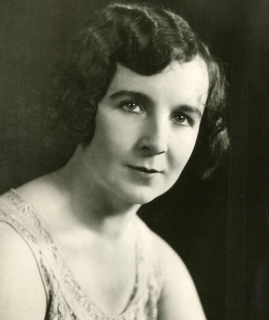
Born Alice Izabella, she is one of ten children born to grocer Moses Crowe and Therese Eglinton. From an early age, she shows an interest in the theatre, and regularly attends productions in both the Gaiety and Abbey theatres. Having completed her education, she joins a convent but soon after abandons the idea of becoming a nun. In October 1921, she enters the Abbey School of Acting. She has a career with the Abbey Theatre from 1921 to 1970.
Upon her entry to the Abbey School of Acting, Crowe makes her debut in 1921 in the play The Revolutionist, taking the lead role of Nora Mangan. She plays her last role of Miss Hatty in Grogan and the Ferret, after which she retires. During nearly five decades, she stars in many plays, some of which include The Marriage of Columbine (1921) and Juno and the Paycock (1924). Between 1931 and 1953, she appears in the Abbey Theatre productions of plays by Irish playwrightTeresa Deevy including A Disciple (1931), Katie Roche (1936, 1937, 1949, 1953), Temporal Powers (1932, 1937) and The Reapers (1930).
Also in 1964, Crowe appears in the Aldwych Theatre‘s production of Juno and the Paycock in London. She works in the Abbey for the vast majority of her career, except for when she is on a six-month tour for Peg O’ My Heart, touring Northern Ireland and England.
In 1924, when the play Grasshopper is being produced, Crowe meets her husband, Peter Judge, also known as F. J. McCormick. They are married in 1925 and the marriage produces a daughter and a son.
Richards is born to John William Richards, a lawyer, and Adelaide Roper, suffragist who had chained herself to the railings in St. Stephen’s Green. She goes to school at Alexandra College, Dublin, and after that she attends a finishing school in Paris. Though her family is not in the arts, her godmother is Beatrice Elvery. Shes attends Elvery’s salons with her parents as a child. She meets W. B. Yeats when she is sixteen. Her niece, Geraldine Fitzgerald, daughter of her sister, Edith Catherine Richards, is also one of Ireland’s pre-eminent actresses.
Richards’s acting career starts while attending the Dublin drama league and she is asked at short notice to replace Eileen Crowe in Juno and the Paycock, playing the role of Mary Boyle in the Abbey Theatre production. Richards gets the role of Nora Clithero in the 1926 production of The Plough and the Stars, Seán O’Casey‘s next production. This role means that she ends up with police protection for the duration of the run due to the disturbances the play engenders. Another important role is to take on playing the lead in The Player Queen by Yeats. Maire O’Neill had previously made the role her own and Yeats had let no one perform the part since then so taking on such a challenge is intimidating. Richards continues to take on leading roles with the Abbey Theatre but in 1926 she also begins to direct.
On December 28, 1928, Richards marries playwright Denis Johnston in St. Anne’s Church in Dublin. She tours the United States with the Abbey players in 1932 and with the Irish Players in the mid 1930s. A role in 1938 in Molly Keane‘s Spring Meeting starring Gladys Cooper and A. E. Matthews takes her to Broadway in New York City. War in Europe breaks out while the run is still going on and Richards is advised to stay in the United States. However, by then she has two children, producer Micheal and novelist Jennifer Johnston, so she returns to Dublin. There she runs her own theater company at the Olympia Theatre with Nigel Heseltine. Her marriage to Johnston, broken in 1938, ends with divorce in February 1945.
In 1961 Ireland launches its first television service, Raidió Teilifís Éireann. Richards is one of the first producers, recommended to the station by Hilton Edwards. She is one of the few women in the new station. The first Irish play produced during the opening week is directed by her and she is nominated for a Best Actress award in another production, Inquiry at Lisieux. She works as producer on a wide number of programs for the station including documentaries, soap operas and religious programming. Both Tolka Row and The Riordans are produced by her as well as Denis Johnston’s The Moon on the Yellow River, George Bernard Shaw‘s Arms and the Man and John Millington Synge‘s Riders to the Sea.
Richards retires from her RTÉ career in the early 1970s though she continues to raise funds for the Gate Theatre through the Edwards–MacLiammóir Playhouse Society. In 1983, for her 80th birthday, the Abbey puts on a party for her which includes a special rendition of “Nora” from The Plough and the Stars. Richards is the last living member of the original 1926 cast. The song is repeated at her funeral in 1985. She died in Ballybrack, County Dublin, on January 19, 1985. Her funeral is held in St. Anne’s Church in Dublin and she is cremated in Glasnevin Cemetery.


 seamus dubhghaill