
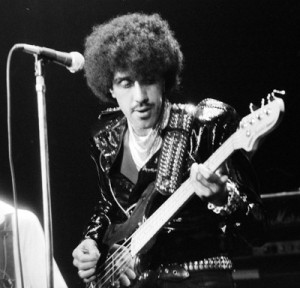
Philip Parris “Phil” Lynott, Irish musician, singer, songwriter, and a founding member, principal songwriter, lead vocalist, and bassist of Thin Lizzy, dies on January 4, 1986, in Salisbury, Wiltshire, England.
Born in West Bromwich, Staffordshire, England on August 20, 1949, Lynott goes to live with his grandmother, Sarah Lynott, in Crumlin, Dublin, when he is four years old. He is introduced to music through his uncle Timothy’s record collection and becomes influenced by Motown and The Mamas and the Papas.
Growing up in Dublin in the 1960s, Lynott fronts several bands as a lead vocalist, most notably teaming up with bassist Brendan ‘Brush’ Shiels to form Skid Row in early 1968. It is during this period that Lynott learns to play the bass guitar.
Toward the end of 1969, Lynott, now confident enough to play bass himself in a band, teams with Brian Downey, Eric Bell, and Eric Wrixon to form Thin Lizzy. The band’s first top ten hit comes in 1973 with a rock version of the well-known Irish traditional song “Whiskey in the Jar.” With the release of the Jailbreak album in 1976, Lynott and Thin Lizzy become international superstars on the strength of the album’s biggest hit, “The Boys Are Back in Town.” The song reaches the Top 10 in the United Kingdom, No. 1 in Ireland, and is a hit in the United States and Canada.
Having finally achieved mainstream success, Thin Lizzy embarks on several consecutive world tours. However, the band suffers from personnel changes. By the early 1980s, Thin Lizzy is starting to struggle commercially and Lynott starts showing symptoms of drug abuse, including regular asthma attacks. After the resignation of longtime manager Chris O’Donnell, Lynott decides to disband Thin Lizzy in 1983.
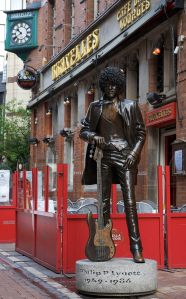
In 1984, Lynott forms a new band, Grand Slam, with Doish Nagle, Laurence Archer, Robbie Brennan, and Mark Stanway. The band tours various clubs but suffers from being labeled a poor version of Thin Lizzy due to the inclusion of two lead guitarists. Grand Slam disbands at the end of the year due to a lack of money and Lynott’s increasing addiction to heroin.
Lynott’s last years are dogged by drug and alcohol dependency leading to his collapse on December 25, 1985, at his home in Kew. He is taken to Salisbury Infirmary where he is diagnosed as suffering from septicemia. His condition worsens by the start of the new year, and he is put on a respirator. He dies of pneumonia and heart failure due to septicemia in the hospital’s intensive care unit on January 4, 1986, at the age of 36.
Lynott’s funeral is held at St. Elizabeth of Portugal Church, Richmond, London, on January 9, 1986, with most of Thin Lizzy’s ex-members in attendance, followed by a second service at Church of the Assumption, Howth, on January 11. He is buried in St. Fintan’s Cemetery, Sutton, Dublin.


