
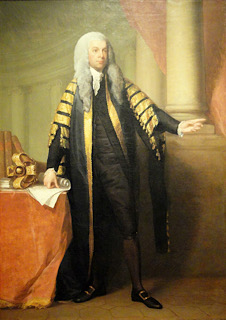
John Foster, 1st Baron Oriel, an Anglo-Irish politician and peer, dies on August 23, 1828.
Foster is born in 1740, the son of Anthony Foster, of Dunleer, County Louth, Chief Baron of the Irish Exchequer, and Elizabeth Burgh, and inherits Collon House in County Louth, which he greatly improves.
Foster serves as Chancellor of the Exchequer of Ireland three times — in 1784–1785, 1804–1806, and 1807–1811 — and is the last Speaker of the Irish House of Commons from 1785 until the Acts of Union 1800. He is a prominent figure in Irish politics, representing County Louth for most of his career, and is known for his opposition to the Union, which he sees as politically and personally damaging.
After the Union, in 1801 Foster is returned to the new United Kingdom parliament as a member for County Louth and serves until 1821, when he is created 1st Baron Oriel of Ferrard, County Louth, in the peerage of the United Kingdom. He also holds the title of Privy Councillor (Ireland) in 1799 and later Privy Councillor (UK) in 1786.
Foster marries Margaretta Amelia Burgh in 1764. They have several children, including Thomas Henry Skeffington, 2nd Viscount Ferrard, and Anne Dorothea Foster.
Foster’s tenure as Chancellor of the Exchequer and Speaker is marked by significant financial legislation, including measures that transform Ireland’s agricultural economy by promoting arable farming over pasture. His refusal to surrender the Speaker’s mace after the Union becomes a symbolic act of resistance.
Foster dies on August 23, 1828, leaving behind a legacy as one of the most influential Anglo-Irish statesmen of his era.
(Pictured: The Right Honorable John Foster by Gilbert Stuart, c. 1790-1791 – Nelson-Atkins Museum of Art)

