seamus dubhghaill

Promoting Irish Culture and History from Little Rock, Arkansas, USA


Leave a comment

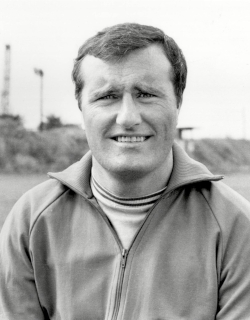
Birth of Noel Cantwell, Irish Footballer & Cricketer

Noel Euchuria Cornelius Cantwell, Irish football player and sometime cricketer, is born at 2 Illen Villas, Mardyke Walk, Cork, County Cork, on February 28, 1932.

Cantwell is one of five sons and a daughter of Michael Cantwell, a master tailor, and his wife Hannah (née Daly). He is educated at St. Joseph’s national school and the Presentation Brothers College in Cork. He plays as a full-back for Western Rovers, Cork Athletic, West Ham United and Manchester United.

While at West Ham, Cantwell features in the London XI side that competes in the 1955–58 Inter-Cities Fairs Cup final on May 1, 1958. He captains the Hammers to winning the Division Two championship in the 1957–58 season thereby leading the club into the topflight for the first time since 1932.

In November 1960, Cantwell joins Manchester United for £29,500 which at the time is a record for a full-back. He helps the club win the 1965 and 1967 league titles and captains United when winning the 1963 FA Cup Final – just as his fellow countryman Johnny Carey had done in United’s previous FA Cup win fifteen years earlier.

Cantwell also serves as Chairman of the Professional Footballers’ Association.

During his International career (1953-67), Cantwell wins 36 full International caps for the Republic of Ireland, typically playing at left full-back and on several occasions at centre-forward. He makes his debut against Luxembourg in October 1953, with his final appearance coming away to Turkey in February 1967. He scores fourteen goals including five from penalties and also captains the Republic on several occasions including a match against England at Wembley Stadium.

In his first managerial role at Coventry City, Cantwell has the onerous task of following Jimmy Hill who had taken the club into the First Division for the first time in their history. He narrowly keeps the Sky Blues in the top in his first two seasons before taking them to a sixth-place finish in 1969–70, earning them qualification for the Inter-Cities Fairs Cup (a year before it is replaced by the UEFA Cup).

Cantwell departs Highfield Road on March 12, 1972, but within seven months is back in English football as manager of Peterborough United. He helps Peterborough win the Fourth Division title in his first full season as manager, before leaving on May 10, 1977, to manage the New England Tea Men.

Cantwell returns to Peterborough on November 19, 1986, for a second stint as manager, remaining in this role until he becomes general manager on July 12, 1988. He is general manager at London Road for a year until he quits football to become licensee of the New Inn at Peterborough, where he remains for ten years until he retires in 1999. He also is landlord of the Bull and Swan in Stamford, Lincolnshire.

Cantwell also plays cricket for Cork Bohemians Cricket Club and Ireland as a left-handed batsman and a right-arm medium bowler. He plays five times for Ireland, making his debut in what is his sole first-class match versus Scotland at Edinburgh in 1956, scoring 31 and 17. His last match for Ireland is against Lancashire in July 1959.

Cantwell dies from cancer at Addenbrooke’s Hospital, Cambridge, not far from his home in Peterborough, on September 8, 2005. He is survived by his wife Maggie, a native of Belfast, and two daughters, Liz and Kate. A 22-year-old son, John Robert, is killed in a car crash thirteen years earlier.

Cantwell’s former teams each hold a moment of silence for him before their next matches.

Leave a comment

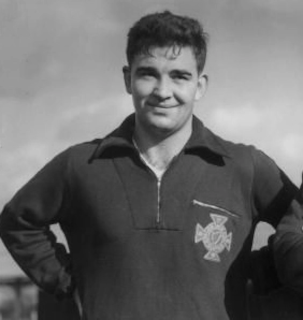
Birth of Jackie Blanchflower, Northern Irish Footballer

John “Jackie” Blanchflower, Northern Irish footballer, is born on March 7, 1933, in Belfast, Northern Ireland. He graduates from Manchester United‘s youth system and plays for the club on 117 occasions, winning two league titles, before his career is cut short due to injuries sustained in the Munich air disaster. He is also capped 12 times at senior level by Northern Ireland.

Blanchflower is the younger brother of Danny Blanchflower, the captain of the Tottenham Hotspur side that dominates English football in the early 1960s.

Blanchflower’s first appearance in a professional game is for Manchester United on November 24, 1951, against Liverpool, away at Anfield. He becomes a regular first team player in the 1953–54 season, when he plays in 27 out of 42 league games and scores 13 goals as an inside-forward.

Blanchflower helps the club win the league title in 1956 and again in 1957. Nicknamed “Twiggy” by his teammates, he is renowned for his versatility. He begins his career as a left-half before the emergence of Duncan Edwards in this position, at which time he switches to the forward positions. The Manchester United manager, Matt Busby, recognises his intelligent positioning sense and aerial power and chooses to play him at centre-half by the 1955–56 season, with John Doherty and Billy Whelan now competing for his former position. He faces fierce competition for the solitary centre-half place due to the presence of Mark Jones. He covers in goal in the 1957 FA Cup Final while Ray Wood receives treatment for an injury suffered in a collision with Peter McParland, who scores both of Aston Villa‘s goals as United loses 2–1. Blanchflower also plays in some of United’s first European Cup fixtures.

Blanchflower scores 27 goals during his time with Manchester United, most of them during his time as a forward.

On February 6, 1958, the Manchester United team that had travelled to Belgrade for the second leg of a European cup tie have their chartered plane stop in Munich to refuel. Weather conditions cause the plane to crash when the pilot attempts to take-off from Munich airport and 23 of the 44 people on board are killed. Blanchflower is severely injured, suffering from a fractured pelvis and arms and legs, and crushed kidneys, and his right arm is nearly severed. He is in hospital for two months and, although not a Catholic, is read the last rites but survives.

Blanchflower tries to return to football, but never makes a full recovery. Doctors advise him not to return to football because of fears he would damage his kidney and, a year later, he retires from football. The Munich air disaster means that he had played his last game of football when still only 24 years old, having earned 12 caps for Northern Ireland, played well over 100 times for Manchester United and won two league championship medals.

Blanchflower marries his wife Jean in 1956 and eventually pursues studies in finance and begins a career as an accountant. He later becomes an after-dinner speaker and is a regular on the after-dinner circuits until his death from cancer on September 2, 1998. He is 65 years old, and just two weeks prior to his death he attended the Munich air disaster testimonial match at Old Trafford.

He is survived by his three children; Krista, Senior (born 1958), Laurie (born 1961) and Andrew (born 1963), as well as his wife, Jean, who dies in 2002 following a long illness.