seamus dubhghaill

Promoting Irish Culture and History from Little Rock, Arkansas, USA


Leave a comment

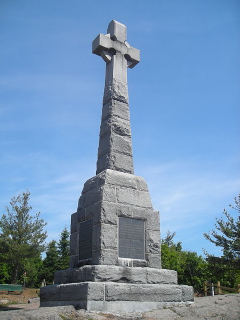
Great Famine Monument Dedicated at Grosse Île, Quebec

On August 15, 1909, the Ancient Order of Hibernians dedicate a monument to victims of the Great Famine at Grosse Île, Quebec, Canada.

Grosse Île, in the Gulf of Saint Lawrence, acts as a quarantine station for Irish people fleeing the Great Famine between 1845 and 1849. It is believed that over 3,000 Irish people died on the island and over 5,000 are buried in the cemetery there.

In 1847, 100,000 Irish people travel to Grosse Île to escape starvation, unaware of the hardships they would encounter upon arrival. The first coffin ship – named for their crowded and deadly conditions – arrives on May 17, 1847, the ice still an inch thick on the river. Of that ship’s 241 passengers, 84 are stricken with fever and 9 have died on board. With the hospital only equipped for 150 cases of fever, the situation quickly spins out of control. More and more ships arrive at Grosse Île each day, sometimes lining up for miles down the St. Lawrence River throughout the summer. On these coffin ships the number of passengers stricken by fever increases exponentially.

Between 1832 and 1937, Grosse Île’s term of operation, the official register lists 7,480 burials on the island. In 1847 alone, 5,424 burials take place, the majority being Irish immigrants. In that same year, over 5,000 Irish people on ships bound for Canada are listed as having been buried at sea.

When the monument is unveiled in 1909, more than 60 years have passed since the more than 5,000 Irish men, women, and children were buried on the island, but the ancestors and relatives of those victims have not forgotten them. Through the hard work of the Ancient Order of Hibernians, thousands of dollars are collected to erect a fitting memorial to those innocent victims of man’s inhumanity to man. The symbol they choose to use is a Celtic cross. Designed by Jeremiah Gallagher, a member of the Ancient Order of Hibernians in Quebec, the cross is carved from granite and stands 48 feet high atop its pedestal.

The monument bears an inscription in Irish commemorating the victims of the epidemic and condemning colonial rule. In English, it reads: “Children of the Gael died in their thousands on this island having fled from the laws of foreign tyrants and an artificial famine in the years 1847-48. God’s blessing on them. Let this monument be a token and honor from the Gaels of America. God Save Ireland.”

To ensure that no one traveling up or down the St. Lawrence River fails to see the monument, it is placed on Telegraph Hill, the highest point on the island. The monument is unveiled by the Papal Legate before a crowd of 9,000, including several hundred French Canadians, some perhaps from families that had adopted one or more of the over 600 Irish orphans whose parents were left behind on Gross Île. The cross stands as a beacon to those who pass up and down the busy waterway, reminding them not only of the tragedy that once happened on that island but also of the ultimate triumph of those who survived.

Today, the island is a National Historic Site that serves as a Famine memorial. It is dedicated in 1996 after a four-year-long campaign to protect the mass gravesite.

Leave a comment

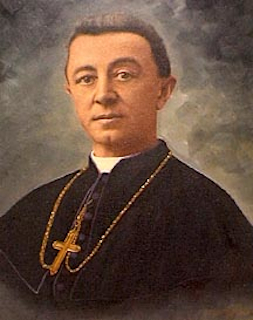
Birth of James Augustine Healy, Bishop of Portland, Maine

james-augustine-healy

James Augustine Healy, American Roman Catholic priest and the second bishop of Portland, Maine, is born on April 6, 1830, in Macon, Georgia to a multiracial slave mother and Irish immigrant father. He is the first bishop in the United States of any known African descent. When he is ordained in 1854, his multiracial ancestry is not widely known outside his mentors in the Catholic Church.

Healy is the eldest of ten siblings of Michael Morris Healy, an Irish immigrant planter from County Roscommon, and his common law wife Eliza Smith (sometimes recorded as Clark), a multiracial enslaved African American. He achieves many “firsts” in United States history. He is credited with greatly expanding the Catholic church in Maine at a time of increased Irish immigration. He also serves Abenaki people and many parishioners of French-Canadian descent who were traditionally Catholic. He speaks both English and French.

Beginning in 1837, like many other wealthy planters with mixed-race children, Michael Healy starts sending his sons to school in the North. James, along with brothers Hugh and Patrick, goes to Quaker schools in Flushing, New York, and Burlington, New Jersey. Later they each attend the newly opened College of the Holy Cross in Worcester, Massachusetts. He graduates as valedictorian of the college’s first graduating class in 1849.

Following graduation, Healy wishes to enter the priesthood. He cannot study at the Jesuit novitiate in Maryland, as it is a slave state. With the help of John Bernard Fitzpatrick, he enters a Sulpician seminary in Montreal. In 1852, he transfers to study at Saint-Sulpice Seminary in Paris, working toward a doctorate and a career as a seminary professor. After a change of heart, he decides to become a pastor. On June 10, 1854, he is ordained at Notre-Dame de Paris as a priest to serve in Boston, Massachusetts. He is the first African American to be ordained a Roman Catholic priest although at the time he identifies as and is accepted as white Irish Catholic.

When Healy returns to the United States, he becomes an assistant pastor in Boston. He serves the archbishop, who helps establish his standing in the church. In 1866 he becomes the pastor of St. James Church, the largest Catholic congregation in Boston. In 1874 when the Boston legislature is considering taxation of churches, he defends Catholic institutions as vital organizations that help the state both socially and financially. He also condemns certain laws that are generally enforced only on Catholic institutions. He founds several Catholic charitable institutions to care for the many poor Irish immigrants who had arrived during the Great Famine years.

Healy’s success in the public sphere leads to his appointment by Pope Pius IX to the position of second bishop of Portland, Maine. He is consecrated as Bishop of Portland on June 2, 1875, becoming the first African American to be consecrated a Catholic bishop. For 25 years he governs his large diocese, supervising also the founding of the Diocese of Manchester, New Hampshire, when it is split from Portland in 1885. During his time in Maine, which is a period of extensive immigration from Catholic countries, he oversees the establishment of 60 new churches, 68 missions, 18 convents, and 18 schools. During that period, he also serves his Abenaki and French-Canadian parishioners.

Healy is the only member of the American Catholic hierarchy to excommunicate men who joined the Knights of Labor, a national union, which reaches its peak of power in 1886.

Two months before his death on August 5, 1900, Healy is called as assistant to the Papal throne by Pope Leo XIII, a position in the Catholic hierarchy just below that of cardinal.