seamus dubhghaill

Promoting Irish Culture and History from Little Rock, Arkansas, USA


Leave a comment

The Ebrington Barracks Bombing

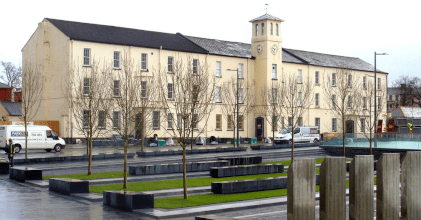
On April 6, 2000, the Real Irish Republican Army lowers a device consisting of 5 lbs. of homemade explosives over the perimeter fence of Ebrington Barracks at Browning Drive in the Waterside area of Derry, County Derry, Northern Ireland, using ropes, and the bomb subsequently explodes damaging the fence and the guardhouse. The explosion takes place around 6:30 a.m.

There are no reports of any casualties and army technical experts are at the scene shortly after the blast.

Gregory Campbell, security spokesman for the anti-agreement Democratic Unionist Party, visits the scene and says the blast bears similarities to an incident at Ballykelly, twelve miles away, in February 2000. He adds, “In Ballykelly there was a breach of the security fence, with the bomb planted near sleeping quarters. Here it was beside a former guardhouse. It appears to have been outside the perimeter.”

Campbell also claims that in recent months the base’s watchtowers had not been manned. “I get the impression that security has become a bit lax since the ceasefire,” he says. “This is confirmation of what we all knew was coming, a determined effort by paramilitary groups.”

Campbell continues, “When you look at the past few months it is very obvious that these groups – if they are splinter groups, if they are people who are leaving the Provisional IRA to join these dissidents or if the Provisional IRA is giving a wink and a nod to these dissidents – it is as plain as the nose on your face these people are developing terrorist capabilities.”

“When there is a device at a security cordon and another device inside another camp 12 miles down the road from here it is very obvious they are working towards a major attack with loss of life. Within a few months we are going to be faced with a major onslaught,” Campbell adds.

Meanwhile, Ulster Unionist Party (UUP) leader David Trimble, speaking in advance of a House of Commons debate warning of damaging consequences if the government presses on with moves to rename the Royal Ulster Constabulary, says it appears that the blast at the barracks in Derry is part of a wider campaign of low level terrorist activity by dissident republicans. Speaking on BBC Radio Trimble says, “There have been a number of incidents recently which have been attributed to dissident republicans. This may be another one. And there is reason to believe that dissident republicans are trying to launch a sustained campaign.”

(From: “Explosion at army camp,” BBC News, http://www.news.bbc.co.uk/, Thursday, April 6, 2000)

Leave a comment

Final Republican & Loyalist Prisoners Released from Maze Prison

maze-prison-release

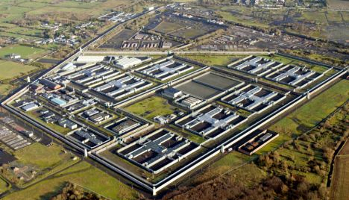
The final seventy-eight republican and loyalist prisoners are released from the Maze Prison in Northern Ireland on July 28, 2000 as the final phase of the Good Friday peace accord scheme to release 428 inmates early.

Some of the most prolific bombers and gunmen involved in the Troubles have been imprisoned in the Maze, originally called Long Kesh, since it opened in 1971.

One of the freed republicans, Seán Lynch, describes what he saw as the real and symbolic importance of the Maze. “We had achieved the status of political prisoners even if the British Government never admitted it. The prison struggle was a microcosm of the larger struggle.”

Founder member of the Ulster Defence Association, Thomas McKeown, released in 1990 is one of over 10,000 loyalists sent to the prison. He reflects, “We had it pretty easy. We made replica weapons and instruments from wood and conducted military parades and drill every morning. There were also political classes and other sorts of education.”

After the H-block hunger strikes of the 1980s there are numerous escape attempts and by 1994 the authorities have given in to many of the prisoners’ demands for freedom of association and high levels of autonomy. A total of 2,700 incidents of officers being threatened or attacked are reported. A granite memorial outside the gates bears the names of the 29 prison guards murdered since the prison opened in 1971.

On September 29, 2000, the remaining four prisoners at the Maze are transferred to other prisons in Northern Ireland and the Maze Prison is closed. Redundancy packages are arranged for staff. These are accepted by 300 who left in June 2000.

The future of the buildings is uncertain, but some republicans want it to be turned into a museum to commemorate their struggle.

A monitoring group is set up on January 14, 2003 to debate the future of the 360-acre site. There are many proposals, including a museum, a multi-purpose sports stadium and an office, hotel and leisure village. In January 2006, the government unveils a masterplan for the site incorporating many of these proposals, including a 45,000 seat national multi-sport stadium for association football, rugby and Gaelic games. In October 2006, demolition work begins in preparation for construction on the site, however, in January 2009 plans to build the new multi-purpose stadium are cancelled, with Minister of Culture, Arts and Leisure Gregory Campbell citing a lack of support and concerns for a net loss to the economy.

Discussion is still ongoing as to the listed status of sections of the old prison. The hospital and part of the H-Blocks are currently listed buildings, and will remain as part of the proposed site redevelopment as a “conflict transformation centre” with support from republicans such as Martin McGuinness and opposition from unionists, who consider that this risks creating “a shrine to the IRA.”

In January 2013, plans are approved by the Northern Ireland Minister of the Environment, Alex Attwood, for the site to be redeveloped as showgrounds as the result of an application by the Royal Ulster Agricultural Society with the objective of relocating Balmoral Show from its current location in Belfast. The site is now known as Balmoral Park.

In October 2019, the European Union withdraws £18m that had been approved to develop a peace centre, due to disagreements between Sinn Féin and the Democratic Unionist Party.

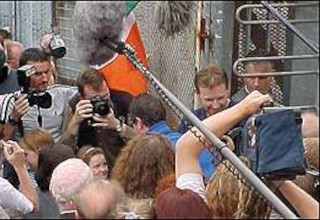
(Pictured: IRA prisoners walk out through the Maze turnstile, BBC News Online, July 28, 2000)


Leave a comment

Demolition of HM Prison Maze Begins

maze-prison

Bulldozers begin demolishing Northern Ireland‘s notorious HM Prison Maze, previously known as Long Kesh Detention Centre, on October 31, 2006. The prison once housed the most dangerous guerrillas from both sides of the province’s sectarian conflict.

Among the inmates at Maze are ten Irish nationalist hunger strikers who starved themselves to death in 1981. The prison has been empty since 2000, after the release of most guerrilla prisoners under the Good Friday Agreement, which ushered in relative peace after 30 years of fighting in which 3,600 people died.

A sports stadium, equestrian center, hotel, and shopping center are originally proposed for the 360-acre site in County Antrim. In January 2009, however, Sports Minister Gregory Campbell rules out the plan for a multi-sports stadium which has divided political and sporting opinion, opting instead to explore alternatives with the soccer, rugby, and Gaelic Athletic Association (GAA) authorities.

Northern Ireland first and deputy first ministers, Peter Robinson and Martin McGuinness, announce in 2010 that an agreement has been reached on building a peace and conflict resolution facility at the Maze site. It will also host the Royal Ulster Agricultural Society’s annual show. On February 2, 2012, European funding of £18m is approved for building the contentious conflict resolution centre.

Planning permission for the peace centre on the site of the former prison is granted on April 18, 2013. However, in June the Orange Order calls on unionist politicians to halt the peace centre plan, objecting to its location on the former prison site.

On August 15, 2013, Peter Robinson calls a halt to the peace centre plan. In a letter to Democratic Unionist Party (DUP) members, he says it would be wrong to proceed without a consensus about how it will operate. As a result, in October 2013 the European Union funding programme withdraws its £18m offer in financial support for the Maze peace centre.

That the Maze Prison development remains unrealised 16 years after the site’s closure testifies to the complexities involved. That the prospect of redevelopment has never been taken off the table affirms the ineluctable power ideas of profit still hold.