
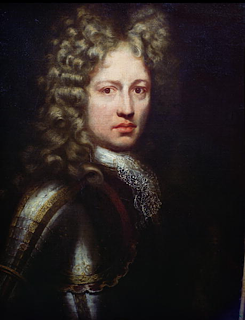
Patrick Sarsfield, 1st Earl of Lucan, an Irish army officer, is killed at Huy, Belgium, on August 21, 1693, while serving in the French Royal Army. He is now best remembered as an Irish patriot and military hero.
Originally of English descent, Sarsfield is born into a wealthy Catholic family around 1655. His father, Patrick, is an Irish landowner and soldier, and his mother is Anne O’Moore, daughter of Rory O’Moore, a Gaelic noble who plays a leading part in the Irish Rebellion of 1641.
There are few surviving records of Sarsfield’s early life, although it is generally agreed he is brought up on the family estates at Tully. While some biographies claim he is educated at a French military college, there is no evidence for this.
In the 1670 Secret Treaty of Dover, Charles II agrees to support a French attack on the Dutch Republic, and supply 6,000 troops for the French army. When the Franco-Dutch War begins in 1672, Sarsfield is commissioned into his brother-in-law James Scott, 1st Duke of Monmouth‘s regiment. Although England leaves the war in 1674, the brigade continues to serve in the Rhineland, under Henri de La Tour d’Auvergne, Viscount of Turenne. Sarsfield transfers into a regiment commanded by Irish Catholic Sir George Hamilton.
Sarsfield fights at Entzheim, Turckheim and Altenheim. He and Hamilton are standing next to Turenne when he is killed by a chance shot at Salzbach in July 1675. He remains in France until the war ends in 1678, then returns to London to join a new regiment being recruited by Thomas Dongan, 2nd Earl of Limerick. However, the Popish Plot then results in Sarsfield and other Catholics being barred from serving in the military.
This leaves Sarsfield short of money, and he becomes involved in an expensive legal campaign to regain Lucan Manor from the heirs of his brother William, who dies in 1675. This ultimately proves unsuccessful amid allegations of forged documents, and in 1681 he returns to London, where he makes two separate attempts to abduct an heiress and is lucky to escape prosecution. When Charles’s Catholic brother James becomes king in 1685, Sarsfield rejoins the army and fights in the decisive Battle of Sedgemoor, which ends the Monmouth Rebellion. James is keen to promote Catholics, whom he views as more loyal, and by 1688 Sarsfield is colonel of a cavalry unit.
After Richard Talbot, 1st Earl of Tyrconnell, is appointed Lord Deputy of Ireland in 1687, he begins creating a Catholic-dominated Irish army and political establishment. Aware of preparations for invasion by his nephew and son-in-law William of Orange, James sends Sarsfield to Dublin in September to persuade Tyrconnell to provide him with Irish troops. This proves unsuccessful, and in November James is deposed by the Glorious Revolution. Sarsfield takes part in the Wincanton Skirmish, one of the few military actions during the invasion. He remains in England until January when he is allowed to join James in France.
Accompanied by French troops and English exiles, James lands in Ireland in March 1689, beginning the Williamite War in Ireland. Sarsfield is promoted brigadier, elected to the 1689 Irish Parliament for County Dublin, and commands cavalry units in the campaign in Ulster and Connacht. When an Irish brigade is sent to France in October, French ambassador Jean-Antoine de Mesmes proposes Sarsfield as its commander. He notes that while “not…of noble birth […], (he) has distinguished himself by his ability, and (his) reputation in this kingdom is greater than that of any man I know […] He is brave, but above all has a sense of honour and integrity in all that he does”.
James rejects this, stating that although unquestionably brave, Sarsfield is “very scantily supplied with brains.” His role at the Battle of the Boyne is peripheral, although the battle is less decisive than often assumed, Jacobite losses being around 2,000 from a force of 25,000. James returns to France, leaving Tyrconnell in control. He is the leader of the “Peace Party,” who want to negotiate a settlement preserving Catholic rights to land and public office. Sarsfield heads the “War Party,” who feel they can gain more by fighting on. It includes the Luttrell brothers, Nicholas Purcell and English Catholic William Dorrington, a former colleague from Monmouth’s Regiment.
The position of the War Party is strengthened by the Declaration of Finglas, which offers the rank and file amnesty but excludes senior officers. French victories in the Low Countries briefly increases hopes of a Stuart restoration, and the Jacobites establish a defensive line along the River Shannon. Sarsfield cements his reputation with an attack on the Williamite artillery train at Ballyneety, widely credited with forcing them to abandon the first siege of Limerick. The Jacobites also retain Athlone, offset by the loss of Kinsale and Cork, which make resupply from France extremely difficult.
With Tyrconnell absent in France, Sarsfield takes control and in December 1690, arrests several leaders of the peace faction. He then bypasses James by asking Louis XIV directly for French support, and requesting the removal of Tyrconnell and the army commander James FitzJames, 1st Duke of Berwick, James’ illegitimate son. The latter, who later describes Sarsfield as “a man […] without sense”, albeit “very good-natured,” leaves Limerick for France in February.
Tyrconnell returns in January 1691, carrying letters from James making Sarsfield Earl of Lucan, an attempt to placate an “increasingly influential and troublesome figure.” A large French convoy arrives at Limerick in May, along with Charles Chalmot de Saint-Ruhe, appointed military commander in an attempt to end the conflict between the factions. Saint-Ruhr and 7,000 others die at Aughrim in July 1691, reputedly the bloodiest battle ever on Irish soil. Sarsfield’s role is unclear: one account claims he quarrels with Saint-Ruhe and is sent to the rear with the cavalry reserves.
The remnants of the Jacobite army regroup at Limerick. Tyrconnell dies of a stroke in August, and in October, Sarsfield negotiates terms of surrender. He is criticised for this, having constantly attacked Tyrconnell for advocating the same thing, while it is suggested the Williamite army is weaker than he judged. However, the collapse of the Shannon line and surrender of Galway and Sligo leaves him little option. Without French supplies, the military position is hopeless, and defections mean his army is dissolving.
The military articles of the Treaty of Limerick preserve the Jacobite army by allowing its remaining troops to enter French service. About 19,000 officers and men, including Sarsfield, choose to leave in what is known as the Flight of the Wild Geese. Sarsfield’s handling of the civil articles is less successful. Most of its protections are ignored by the new regime, although Sarsfield possibly views it as temporary, hoping to resume the war.
On arrival in France, Sarsfield becomes Major-General in the army of exiles, an appointment James makes with great reluctance. In addition to other acts of perceived insubordination, Sarsfield allegedly tells William’s negotiators at Limerick “change but kings with us, and we will fight it over again.” After the planned invasion of England is abandoned in 1692, the exiles become part of the French army, and Sarsfield a French maréchal de camp.
Sarsfield fights at Steenkerque in August 1692, and is fatally wounded at the Battle of Landen in 1693, dying at Huy on August 21, 1693. Despite several searches, no grave or burial record has been found, although a plaque at St. Martin’s Church, Huy, has been set up in commemoration and an announcement in 2023 states that, pending exhumation and identification, his remains have been located. Like much else, his reputed last words, “Oh that this had been shed for Ireland!” are apocryphal.

 seamus dubhghaill