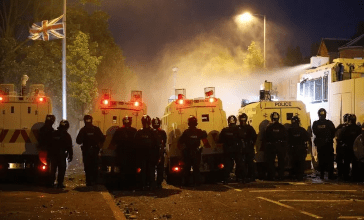
Major rioting and civil disorder break out in Ardoyne, north Belfast, Northern Ireland, on July 12, 2001. In some of the worst rioting in years, 113 police officers are injured in clashes which follow a July 12 parade. Police are attacked when trying clear the path for about 100 Orangemen returning from the parade to go along a main road passing the Catholic Ardoyne area.
In the seven-hour riot which involves about 250 nationalist youth, two blast bombs and 263 petrol bombs are exploded, while a dozen vehicles are hijacked, and 48 plastic bullets are shot by the police. Riot police also use water cannons. There are also incidents in east Belfast, Derry and Ballycastle, but the clashes in Ardoyne are by far the most serious.
The Royal Ulster Constabulary (RUC) says the riots are orchestrated by the Provisional Irish Republican Army, a claim denied by Sinn Féin, who believe the RUC’s heavy response escalates tensions. The incident also intensifies a row over the use of plastic bullets. Forty-eight of them are fired by the RUC in Ardoyne, and Sinn Féin claims fifty of them hit civilians, ten of which are badly injured. Chief ConstableRonnie Flanagan strongly rejects calls from the Northern Ireland Human Rights Commission (NIHRC) to halt its use in riots. Nationalist politicians see the ban on plastic bullets as a vital reform to make Catholics trust the police force more. Gerry Kelly from Sinn Féin says that the RUC “started the riot in Ardoyne. They are a sectarian force, using a very lethal weapon predominantly against nationalists and they should not be allowed to do so.”
A few days later another riot breaks out involving petrol bombs and acid being thrown by loyalists at police in north and west Belfast. Loyalists claim shots are fired at them from the Catholic Short Strand. A buffer zone is created by riot police in North Queen Street. Well-known Ulster Defence Association (UDA) members are spotted. From September 2001 the area sees fresh violence during the Holy Cross dispute and on the 23rd, with rioting also occurring in October and November.
The Holy Cross dispute begins on June 19, 2001, and continues into 2002 in the Ardoyne area of north Belfast. During the 30-year conflict known as the Troubles, Ardoyne becomes segregated – Ulster Protestants and Irish Catholics living in separate areas. This leaves Holy Cross, a Catholic primary school for girls, in the middle of a Protestant area. During the last week of school in June 2001 before the summer break, Protestant loyalists begin picketing the school, claiming that Catholics are regularly attacking their homes and denying them access to facilities.
On Tuesday, June 19, Royal Ulster Constabulary (RUC) officers have to protect children and parents entering the school after they are attacked by loyalist stone throwers. Police describe the attack as “vicious.” Following the incident, a blockade of the school develops, with loyalists standing across the road and RUC officers keeping the children and their parents away.
The following day, the school is forced to close when loyalists block the entrance. During the evening, up to 600 loyalists and nationalists clash with each other and with the police. Shots are also fired at the police and over 100 petrol bombs are thrown. During the riots the police fire a number of the new ‘L21 A1’ plastic baton rounds for the first time. Thirty-nine RUC officers are injured. Nine shots in total are fired – six from loyalists and three from republicans. The trouble comes after an explosion at the rear of Catholic homes next to a peace line. Both loyalist and nationalist politicians blame each other for the violence. This is the first of many large riots to take place in Belfast within more than a year.
The morning blockade continues on Thursday, June 21. About 60 of the school’s 230 pupils enter the school through the grounds of another school. Senior Sinn Féin member Gerry Kelly says, “It’s like something out of Alabama in the 1960s.” Three Protestant families leave their homes in Ardoyne Avenue, saying they are afraid of a nationalist attack. During the evening and night there are serious disturbances in the area around the school. Loyalists fire ten shots and throw six blast bombs and 46 petrol bombs at police lines. Two Catholic homes are attacked with pipe bombs, and a child is thrown against a wall by one of the blasts. Twenty-four RUC officers are hurt.
On Friday, June 22, a number of schoolchildren again have to enter the school through the grounds of another school. This is the last day of school before the summer break.
Talks between the protesters and the schoolchildren’s parents take place over the summer, but no agreement is reached. On August 20, a paint bomb is thrown at the home of a Protestant man in Hesketh Park, smashing a window and causing paint damage to furniture. The man had taken part in the loyalist protest.
The picket resumes on September 3, when the new school term begins. For weeks, hundreds of loyalist protesters try to stop the schoolchildren and their parents from walking to school through their area. Hundreds of riot police, backed up by the British Army, escort the children and parents through the protest each day. Some protesters shout sectarian abuse and throw stones, bricks, fireworks, blast bombs and urine-filled balloons at the schoolchildren, their parents and the police. Death threats are made against the parents and school staff by the Red Hand Defenders, a loyalist paramilitary group. The protest is condemned by both Catholics and Protestants, including politicians. Some likened the protest to child abuse and compare the protesters to North Americanwhite supremacists in the 1950s. During this time, the protest sparks bouts of fierce rioting between Catholics and Protestants in Ardoyne, and loyalist attacks on police. On November 23, the loyalists end the protest after being promised tighter security for their area and a redevelopment scheme. The security forces remain outside the school for several months.
In January 2002, a scuffle between a Protestant and a Catholic outside the school sparks a large-scale riot in the area and attacks on other schools in north Belfast. The picket is not resumed, and the situation remains mostly quiet. The following year, the BBC airs a documentary-drama about the protests.


 seamus dubhghaill