seamus dubhghaill

Promoting Irish Culture and History from Little Rock, Arkansas, USA


Leave a comment

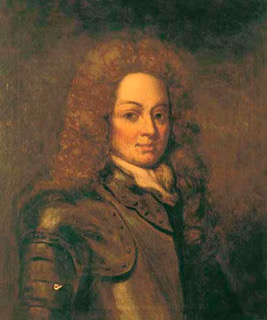
Birth of Sir Arthur Rawdon, Soldier & Horticulturist

Sir Arthur Rawdon, 2nd Baronet, soldier, and horticulturalist, is born on October 17, 1662. He builds a large part of Moira, County Down in the seventeenth century. Known as the “Father of Irish Gardening” and “The Cock of the North,” he is a keen botanist, and brings over 400 different species of plants to Moira from Jamaica.

Rawdon plays an active role in the Williamite War in Ireland. Following the Glorious Revolution he is involved in the raising of the Army of the North, a Protestant force opposed to the Jacobite Irish Army.

Rawdon’s father is Sir George Rawdon, 1st Baronet. His mother is George’s second wife, Dorothy, daughter of Edward Conway, 2nd Viscount Conway. He is a Member of Parliament for County Down, and a general in the army of King William III of England. Besieged at Derry, he falls ill, but manages to escape, though his military career is at an end.

Rawdon marries Ellen Graham, daughter of Sir James Graham of Congleton in Cheshire. They have at least two children, John and Isabella.

Rawdon inherits the lands at Moira after his father dies. He rebuilds a mansion, surrounded by trees, sheep and huge gardens. On this estate, he builds the first hothouse in Europe.

Rawdon is a botanist and imports 400 plant species from Jamaica, earning the name “Father of Irish Gardening.” His garden has a labyrinth, ponds, and canals. The trees include the “Locust of Virginia” which is 30 feet high and has a trunk of at least a foot and a half in diameter. For two generations the garden is maintained.

Rawdon dies on October 17, 1695, his thirty-third birthday, and John succeeds to the baronetcy and estate as a minor. The plant collections, perhaps inevitably, decline after his death, though his wife and sisters share his interest in natural history. Some of his plant specimens are still preserved in Hans Sloane‘s herbarium in the Natural History Museum, London.

Today in Moira many places are named after Sir Arthur Rawdon, including Rawdon Court, off Main Street. Off Meeting Street there is Rawdon Place which is a housing street. Parts of the remains of his mansion are still visible.


Leave a comment

Death of Sheila Pim, Crime Novelist & Horticulturalist

Sheila Pim, Irish crime novelist and horticulturalist, dies in Dublin on December 16, 1995.

Pim is born in Dublin on September 21, 1909, to a Quaker father and English mother. She is a twin, but her brother dies. She is sent to the French School in Bray, County Wicklow, before being sent to Lausanne, Switzerland to finishing school. She then goes on to Girton College, Cambridge to study modern languages, intending to graduate with a degree in French and Italian. Her mother’s ill health and ultimate death in 1940, causes her to return to Ireland to look after her and she remains there taking care of her father, who dies in 1958, and an older incapacitated brother, Tom.

But these are good years for Pim with time to write, and during the 1950s and early 1960s she writes no fewer than seven novels, mostly crime fiction in a lighthearted style. During this time, she is a member of Irish PEN. She is also an avid amateur horticulturalist and writes for the magazine My Garden. Her more serious undertaking is a biography of the Irish plant collector Augustine Henry, The Wood and the Trees: A Biography of Augustine Henry (Macdonald, London). Her brother Tom dies in an accident in 1964 leaving Pim with no further responsibilities. This allows her to spend significant time researching through Henry’s papers. The book is published in 1966.

When Pim has completed the biography, she focuses on philanthropy. She dedicates her time to the Friends Historical Society and is particularly interested in helping out in the traveller community. She supports a young group of children and their grandfather. They bring her considerable joy. The Royal Horticultural Society of Ireland awards her the Society’s Medal of Honour and makes her an honorary life member for her services to the study of horticulture.

In Pim’s later years increasing deafness makes socialising difficult for her, but she still keeps up with the world of books, the theatre and painting. She reads The Irish Times from cover to cover every day, and her reading includes the Bible, Marcel Proust (in French) and the stories of Roddy Doyle.

Pim’s deafness finally forces her to move into sheltered housing in Dublin where she dies on December 16, 1995.