
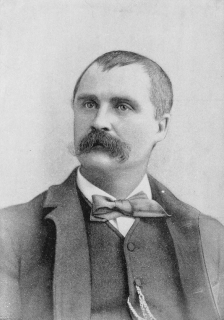
John Boyle O’Reilly, Irish American poet, journalist, author and activist, dies on August 10, 1890, in Hull, Massachusetts, due to accidental poisoning. His literature and work with civil rights have been celebrated throughout the years.
O’Reilly is born on June 28, 1844, at Dowth Castle to William David O’Reilly (1808–1871) and Eliza O’Reilly (née Boyle) (1815–1868) near Drogheda. His father is a headmaster. He is the third of six children. A year after his birth, the Great Famine begins, an event that shapes his life and beliefs. Most of his closest family manage to survive the famine, however many of his classmates lose their lives to the famine.
O’Reilly moves to his aunt’s residence in England as a teenager and becomes involved in journalism and shortly after becomes involved in the military. He leaves the military, however, in 1863 after becoming angry with the military’s treatment of the Irish and returns to Ireland the same year.
In 1864 O’Reilly joins the Irish Republican Brotherhood under an assumed name and is part of the group for two years until he and many others are arrested by authorities in early 1866. After a trial that same year he is sentenced to death, but the sentence is later commuted to 20 years’ penal servitude. In 1867 he is transported to Western Australia and moves to the town of Bunbury where he escapes two years later. He is assisted in escaping by a Fr. Patrick McCabe from Arnaghan, Gowna, County Cavan.
Following his escape O’Reilly moves to Boston, Massachusetts and embarks on a successful writing and journalism career that produces works such as Moondyne (1879) and Songs from the Southern Seas (1873), and poems such as The Cry of the Dreamer and The White Rose and In Bohemia (1886). He becomes a prominent spokesperson for the Irish community and culture through his editorship of the Boston newspaper The Pilot, his prolific writing and his lecture tours.
O’Reilly marries Mary Murphy (1850-1897), a journalist who writes for the Young Crusader under the name of Agnes Smiley, on August 15, 1872, and has four daughters. In the final four years of his life, he suffers various health issues.
On August 9, 1890, O’Reilly takes an early boat to his residence in Hull, Massachusetts. He has been suffering from bouts of insomnia during this time. That evening he takes a long walk with his brother-in-law, John R. Murphy, hoping that physical fatigue will induce the needed sleep. Later on that night he takes some of his wife’s sleeping medicine, which contains chloral hydrate.
In the early morning hours of August 10 his wife wakes up to find O’Reilly unconscious, sitting in a chair with one hand resting on the table near a book and a cigar in the other. She sends a servant for the family’s physician, Dr. Litchfield, and he spends nearly an hour trying to revive him, but O’Reilly dies shortly before 5:00 AM. Public announcements attribute O’Reilly’s death to heart failure but the official death register claims “accidental poisoning.” His memorial service held at Tremont Temple in Boston is a major public event.
The song “Van Diemen’s Land” on U2‘s Rattle and Hum (1988) album refers to and is dedicated to O’Reilly.
 seamus dubhghaill