seamus dubhghaill

Promoting Irish Culture and History from Little Rock, Arkansas, USA


1 Comment

Bernadette Devlin McAliskey Assassination Attempt

Bernadette Devlin McAliskey, Northern Ireland civil rights campaigner and former Westminster Member of Parliament (MP), is shot by members of the Ulster Freedom Fighters, a cover name of the Ulster Defence Association (UDA), who burst into her home at Coalisland, County Tyrone on January 16, 1981. She survives the assassination attempt.

The three men shoot McAliskey nine times in the chest, arm and thigh as she goes to wake up one of her three children. Her husband, Michael, is also shot twice at point blank range. British soldiers are watching the McAliskey home at the time but fail to prevent the assassination attempt. It is claimed that Devlin’s assassination was ordered by British authorities, and that collusion was a factor. An army patrol of the 3rd Battalion, Parachute Regiment enter the house and wait for half an hour. McAliskey claims they are waiting for the couple to die.

Another group of soldiers then arrive and transport them by helicopter to a nearby Dungannon hospital for emergency treatment and then to the Musgrave Park Hospital, Military Wing, in Belfast, under intensive care. Their condition is initially said to be serious, but not life-threatening.

The attackers, Ray Smallwoods, Tom Graham, both from Lisburn, and Andrew Watson from Seymour Hill, Dunmurry, are captured by members of the Parachute Regiment, who are on patrol nearby when they hear the shots and are taken in for questioning by the police and subsequently jailed. All three are members of the South Belfast UDA. Smallwoods is the driver of the getaway car. Police say it is a professional attack. The gunmen cut the telephone wires to the house before breaking down the front door with a sledgehammer.

McAliskey had played a leading role in the campaign for Republican prisoners in the HM Prison Maze, who are demanding “prisoner of war” or political status. They want to be held separately from loyalist supporters in the Maze. Four other members of the campaign for the H-block inmates have been murdered.

Seven Maze prisoners went on hunger strike before Christmas in support of their demands for political status. The strike is called off on December 12 after Taoiseach Charles Haughey convinces the inmates their families want them to start eating again.

Leave a comment

Death of George Best, Northern Irish Footballer

CREATOR: gd-jpeg v1.0 (using IJG JPEG v80), quality = 80

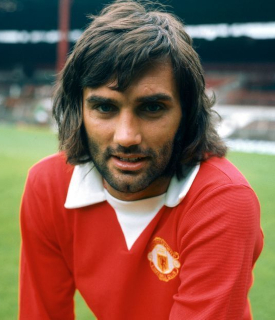
George Best, Northern Irish professional footballer, dies on November 25, 2005 due to complications from the immunosuppressive drugs he required following a 2002 liver transplant.

Best is born on May 22, 1946 and grows up in Cregagh, east Belfast. In 1957, he passes the eleven-plus and goes to Grosvenor High School, but he soon plays truant as the school specialises in rugby. He then moves to Lisnasharragh Secondary School, reuniting him with friends from primary school and allowing him to focus on football. He plays for Cregagh Boys Club. He grows up supporting Glentoran F.C. and Wolverhampton Wanderers F.C..

Best spends most of his club career at Manchester United. Named European Footballer of the Year in 1968, he is regarded as one of the greatest players of all time. A highly skillful winger, considered by several pundits to be one of the greatest dribblers in the history of the sport, he receives plaudits for his playing style, which combines pace, skill, balance, feints, two-footedness, goalscoring and the ability to get past defenders.

In international football, Best is capped 37 times for Northern Ireland between 1964 and 1977. A combination of the team’s performance and his lack of fitness in 1982 means that he never plays in the finals of a major tournament. He considers his international career as being “recreational football,” with the expectations placed on a smaller nation in Northern Ireland being much less than with his club. He is regarded as one of the greatest players never to have played at a World Cup. The Irish Football Association describes him as the “greatest player to ever pull on the green shirt of Northern Ireland.”

With his good looks and playboy lifestyle, Best becomes one of the first media celebrity footballers, earning the nickname “El Beatle” in 1966, but his extravagant lifestyle leads to various personal problems, most notably alcoholism, which he suffers from for the rest of his life. These issues affect him on and off the field, often causing controversy. Although conscious of his problems, he is publicly not contrite about them. He says of his career, “I spent a lot of money on booze, birds [women] and fast cars – the rest I just squandered.” After football, Best spends some time as a football analyst, but his financial and health problems continue into his retirement.

Best is diagnosed with severe liver damage in March 2000. His liver is said to be functioning at only 20%. In 2001, he is admitted to hospital with pneumonia. In August 2002, he has a successful liver transplant at King’s College Hospital in London.

On October 3, 2005, Best is admitted to intensive care at the private Cromwell Hospital in London, suffering from a kidney infection caused by the side effects of immunosuppressive drugs used to prevent his body from rejecting his transplanted liver. In the early hours of November 25, 2005, treatment is stopped. Later that day he dies, aged 59, as a result of a lung infection and multiple organ failure. He is interred beside his mother in a private ceremony at Roselawn Cemetery, overlooking east Belfast.