seamus dubhghaill

Promoting Irish Culture and History from Little Rock, Arkansas, USA


Leave a comment

Death of Frederick William Hall, Victoria Cross Recipient

Frederick William Hall, VC, Irish Canadian recipient of the Victoria Cross, the highest and most prestigious award for gallantry in the face of the enemy that can be awarded to British and Commonwealth forces, dies on April 24, 1915, at Poelcappelle, Belgium.

Hall is born in Kilkenny, County Kilkenny, on February 21, 1885. His father is a British Army soldier from London. He emigrates to Canada around 1910, and lives on Pine Street in Winnipeg, Manitoba. He is 30 years old, and a company sergeant major (CSM) in the 8th (Winnipeg Rifles) Battalion, Canadian Expeditionary Force during World War I when he performs a deed for which he is awarded the Victoria Cross.

It is on the night of April 23, 1915, during the Second Battle of Ypres in Belgium that Hall discovers a number of men are missing. On the ridge above he can hear the moans of the wounded men. Under cover of darkness, he goes to the top of the ridge on two separate occasions and returns each time with a wounded man.

By nine o’clock on the morning of April 24 there are still men missing. In full daylight and under sustained and intense enemy fire, Hall, Cpl. Payne and Pvt. Rogerson crawl out toward the wounded. Payne and Rogerson are both wounded but return to the shelter of the front line. When a wounded man who is lying some 15 yards from the trench calls for help, Company Sergeant-Major Hall endeavors to reach him in the face of very heavy enfilade fire by the enemy. He then makes a second most gallant attempt and is in the act of lifting up the wounded man to bring him in when he falls, mortally wounded in the head. The soldier he is attempting to help is also shot and killed.

Hall’s name can be found on the Menin Gate Memorial to the Missing war memorial in Ypres, Belgium, honouring 56,000 troops from Britain, Australia, Canada and India whose final resting place in the Ypres salient is unknown.

In 1925, Pine Street in Winnipeg is renamed Valour Road because three of Canada’s Victoria Cross recipients resided on the same 700 block of that street: Frederick Hall, Leo Clarke and Robert Shankland. It is believed to be the only street in the British Commonwealth to have three Victoria Cross recipients to live on it, let alone the same block. A bronze plaque is mounted on a street lamp at the corner of Portage Avenue and Valour Road to tell the tale of these three men.

Leave a comment

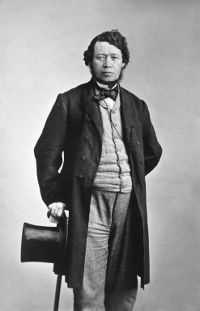
Birth of Thomas D’Arcy McGee, Canadian Politician

Thomas D’Arcy Etienne Hughes McGee, Irish Canadian politician, Catholic spokesman, journalist, poet, and a Father of Canadian Confederation, is born on April 13, 1825, in Carlingford, County Louth.

McGee grows up a Catholic Irishman who hates the British rule of Ireland and works for a peasant revolution to overthrow British rule and secure Irish independence. He escapes arrest and flees to the United States in 1848, where he reverses his political beliefs. He becomes disgusted with American republicanism and democracy, and becomes intensely conservative in his politics and in his religious support for the Pope.

McGee moves to Canada in 1857 and works hard to convince the Irish Catholics to cooperate with the Protestant British in forming a Confederation that will make for a strong Canada in close alliance with Britain. His fervor for Confederation garners him the title “Canada’s first nationalist.” He fights the Fenians in Canada, who are Irish Catholics who hate the British and resemble his younger self politically. McGee succeeds in helping create the Canadian Confederation in 1867.

On April 7, 1868, McGee, having participated in a parliamentary debate that goes on past midnight, walks back to the boarding house where he is staying. McGee is opening the door to Trotter’s Boarding House in Ottawa when he is shot by someone waiting for him on the inside. Several people run to the scene, however there is no sign of the assassin. It is later determined that McGee is assassinated with a shot from a handgun by Patrick J. Whelan. He is to date the only Canadian victim of political assassination at the federal level.

McGee is given a state funeral in Ottawa and interred in a crypt at the Cimetière Notre Dame des Neiges in Montreal. His funeral procession in Montreal draws an estimated crowd of 80,000 out of a total city population of 105,000.

Patrick J. Whelan, a Fenian sympathiser and a Catholic, is accused, tried, convicted, and hanged for the crime on February 11, 1869, in Ottawa. The jury is decisively swayed by the forensic evidence that Whelan’s gun had been fired shortly before the killing, together with the circumstantial evidence that he had threatened and stalked McGee. Historian David Wilson points out that forensic tests conducted in 1972 show that the fatal bullet is compatible with both the gun and the bullets that Whelan owned. Wilson concludes, “The balance of probabilities suggests that Whelan either shot McGee, or was part of a hit-squad, but there is still room for reasonable doubt as to whether he was the man who actually pulled the trigger.”

The government of Canada’s Thomas D’Arcy McGee Building stands near the site of the assassination. The case is dramatised in the Canadian play Blood on the Moon by Ottawa actor/playwright Pierre F. Brault. The assassination of McGee is also a major component of Away, a novel about Irish immigration to Canada by Canadian novelist Jane Urquhart.


Leave a comment

Birth of Boxer Jimmy McLarnin

jimmy-mclarnin

James Archibald McLarnin, Irish Canadian professional boxer who became a two-time welterweight world champion and an International Boxing Hall of Fame inductee, is born on December 19, 1907, in Hillsborough, County Down. He has been referred to as the greatest Irish boxer of all time. BoxRec ranks him as the 11th best pound-for-pound fighter of all-time, the second best Canadian boxer of all time after Sam Langford, and the third greatest welterweight of all time.

When McLarnin is three years old the family emigrates to Saskatchewan, Canada via Liverpool. The McLarnins start out as a wheat farmers, but years later, following a particularly harsh winter, the family moves to Vancouver where they open a second-hand clothing store in Vancouver’s east end.

McLarnin is prodigious athlete, his main sports are football, baseball and boxing. He takes up boxing at the age of 10 after getting into a fight defending his newspaper-selling pitch. Former professional boxer Charles “Pop” Foster recognizes McLarnin’s talent at the age of 13. He constructs a makeshift gym for McLarnin to train in, sure that he will one day be the champion of the world. The two of them remain close, and when Foster dies, he leaves everything he has to McLarnin.

Following a successful start to his career in Vancouver, McLarnin grows aggrieved at the low pay he is receiving for bouts and decides to move to San Francisco. There his youthful appearance makes it difficult to get a fight until he lies about his age. It is for this reason that McLarnin is known as the “Baby-faced Assassin.” Despite his youthful appearance, McLarnin has incredible power with both fists, his right being particularly feared. Towards the end of his career he is forced to become more of a scientific boxer to reduce further injuries to his hands.

McLarnin loses his first title shot on May 21, 1928 in New York City against world lightweight champion Sammy Mandell. However, he does go on to beat him twice in the following two years. It is five years before McLarnin gets another title shot, during which time he knocks out gifted Jewish contenders Al Singer, Ruby Goldstein, and Sid Terris.

McLarnin’s second title shot comes against welterweight champion Young Corbett III. McLarnin wins by knockout after only 2 minutes 37 seconds. Following his title success, he fights an epic three-fight series with Barney Ross. The first fight, on May 28, 1934, is won by Ross, but McLarnin regains his title in their next match four months later. In the deciding fight on May 28, 1935, McLarnin loses his title for the final time in a narrow decision.

McLarnin retires in November 1936 still at the top of his game, having won his last two fights against all-time greats Tony Canzoneri and Lou Ambers. His record is 54 wins, 11 losses, and 3 draws in 68 contests. He never returns to the ring despite large incentives for him to do so. Unlike many boxers, he invested his money wisely and retires a wealthy man. He opens an electrical goods store, and also does some acting, golfing, and lecturing.

In 1996 The Ring votes McLarnin the fifth-greatest welterweight of all time.

Jimmy McLarnin dies on October 28, 2004 at the age of 96 in Richland, Washington. He is interred in the Forest Lawn Memorial Park in Glendale, California.