seamus dubhghaill

Promoting Irish Culture and History from Little Rock, Arkansas, USA


Leave a comment

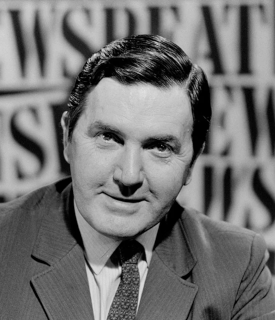
Death of Frank Hall, Broadcaster, Journalist, Satirist & Film Censor

Frank Hall, Irish broadcaster, journalist, satirist and film censor, dies in Dublin on September 21, 1995. He is best remembered for his satirical revue programme Hall’s Pictorial Weekly.

Born in Newry, County Down, on February 24, 1921, Hall receives little more than a primary education as he leaves school at the age of twelve to work in a local shop. He later works as a waiter in London before moving to Dublin. On his return he joins the art department of the Irish Independent. He subsequently works with the Evening Herald where he writes a column on dance bands.

After that, Hall moves to RTÉ where he works in the newsroom. From 1964 to 1971 he presents Newsbeat, a regional news programme. He also presents The Late Late Show for the opening of the 1964 season, but his lack of success in that seat leads to the return of the previous presenter, Gay Byrne. When Newsbeat ends, he starts writing and presenting Hall’s Pictorial Weekly, a political satire show that runs for over 250 episodes until 1980. A successor show, Hall and Company, runs from 1980 until his retirement from television in 1986. He serves as spokesperson for the Irish jury in the Eurovision Song Contest 1965 and 1966.

Hall wins two Jacob’s Awards, in 1966 and 1975, for his work on Newsbeat and Hall’s Pictorial Weekly respectively.

In 1978, Hall is appointed Ireland’s national film censor. During his period as censor, he is known for his strict application of Irish censorship and his defence of family values. Among the films banned by him is Monty Python’s Life of Brian, which he describes as “offensive to Christians and to Jews as well, because it made them appear a terrible load of gobshites.”

Hall has a long running affair with a young colleague from RTÉ, though married to Aideen Kearney at the time. It is also widely accepted that he has a daughter in 1956 with RTÉ presenter Frankie Byrne, although this is disputed at the time by his family members. His relationship with Frankie Byrne is placed in the public domain in a Mint Productions programme, Dear Frankie, screened on RTÉ in January 2006. In 2010, a play written by Niamh Gleeson, also entitled Dear Frankie, opens in the Liberty Hall theatre. Later in 2012, it opens again in the Gaiety Theatre, going on to play in theatres across the country.

Hall dies of a heart attack in Dublin on September 21, 1995. He is buried in Dardistown Cemetery in Northside, Dublin.

Leave a comment

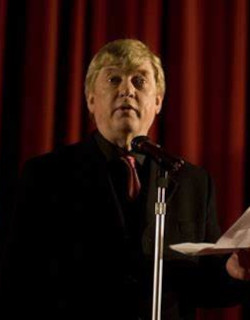
Death of Michael Dwyer, Journalist & Film Critic

Michael Dwyer, journalist and film critic who writes for The Irish Times for more than 20 years, dies following a lengthy illness on January 1, 2010. He previously fills this role for the Sunday Tribune, The Sunday Press and the magazine In Dublin.

Born on May 2, 1951, Dwyer is originally from Saint John’s Park in Tralee, County Kerry. His mother, Mary, outlives him. He has two sisters, Anne and Maria. As a young man in the early 1970s he takes part in the Tralee Film Society, for which he provides notes to The Kerryman. At this time, he is employed by the County Library in Tralee. He begins working for In Dublin followed by the Sunday Tribune and The Sunday Press.

Dwyer first travels to the Cannes Film Festival in 1982 and attends every one until 2009, months before his death. In 1985, he co-founds the Dublin Film Festival and directs it until the mid-1990s. In 2002, he co-founds the Dublin International Film Festival, of which he is the chairman. In later life he serves on the board of the Irish Museum of Modern Art.

In the 1990s, Dwyer presents the film show Freeze Frame for public service broadcaster RTÉ. The show results from a friendship he had formed with Alan Gilsenan and Martin Mahon of Yellow Asylum Films. He is also known for his appearances on the radio shows Morning Ireland and The Marian Finucane Show. The editor of The Irish Times, Geraldine Kennedy, speaking after Dwyer’s death, says he was an “enthusiastic advocate” of both national and international cinema and had once said he was “one of those lucky people in life who was able to pursue his interests and call them work.”

Dwyer becomes unwell following a trip to the Cannes Film Festival in May 2009. He takes a break from writing for The Irish Times, returning in December 2009 to contribute his first, and what is to be his last ever, piece in six months to weekly entertainment supplement The Ticket. The article is a review of cinema in 2009 and of the 2000s, and in his contribution, he references the ill health which had haunted him for much of the previous year and which had prevented him from viewing any cinema releases between June and September.

Dwyer dies at the age of 58 on January 1, 2010. His partner of 24 years, Brian Jennings, survives him. Irish Minister for Arts, Sport and Tourism Martin Cullen says Dwyer was “the most singular, significant influence on cinema in Ireland for more than three decades.” President of the Labour Party Michael D. Higgins says his work was “incalculable […] he was an activist in promoting a knowledge and appreciation of film in all its forms.” Ireland’s former Director of Film Classification at the Irish Film Classification Office John Kelleher says it was “a huge loss for the world of Irish film.” There are tributes from Gabriel Byrne, Daniel Day-Lewis, Brendan Gleeson, Jonathan Rhys Meyers, Cillian Murphy and Jim Sheridan. The Irish Times publishes tribute pieces on his life.

A ceremony takes place at the Church of the Holy Name in Ranelagh where Dwyer lived. The event is attended by notable politicians, journalists, artists, actors, writers and musicians. RTÉ newsreader Aengus Mac Grianna, a colleague of Jennings, reads a tribute to Dwyer. Daniel Day-Lewis gives a very special tribute at the church service to his dear friend of over 20 years, calling for the Jameson International Dublin Film Festival to be renamed in Dwyer’s honour.

Dwyer is cremated after the funeral on January 5, 2010.