Fiach mac Aodha Ó Broin (anglicised as Feagh or Fiach MacHugh O’Byrne), the son of the chief of the O’Byrnes of the Gabhail Raghnaill, is executed in Farranerin, County Wicklow, on May 8, 1597.
His sept, a minor one, claims descent from the 11th century King of Leinster, Bran Mac Máel Mórda, and is centered at Ballinacor North in Glenmalure, a steep valley in the fastness of the Wicklow Mountains. Their chiefs style themselves as Lords of Ranalagh. The territory of the Gabhail Rabhnaill stretches from Glendalough south to the Forest of Shillelagh in Wexford and west to the borders of present-day County Carlow, an area of some 150,000 acres.
By the time of his death in 1579, O’Byrne’s father, Hugh MacShane O’Byrne, has brought his sept to prominence much to the discomfort of the senior branch of the clan, the Crioch Branagh. The Gabhaill Rabhaill has allied themselves to several leading clans in Leinster and are related by blood and marriage to the Kavanaghs, O’ Tooles, O’Connors and the O’Moores.
O’Byrne makes a name for himself as an enemy of the English. Resenting the greed and cruelty of the Elizabethan adventurers and settlers, he raids their villages and kills them or drives them out. He is appalled at the ruthless cruelty of the seneschals (Stewarts) Thomas Masterson and Sir Henry Harrington and in 1580 goes into open rebellion when Masterson summarily execute many Kavanagh clansmen.
Other clans join with O’Byrne and when James Eustace, 3rd Viscount Baltinglass, angered by the treatment of the Catholic Old English also rebells, O’Byrne joins with him. The English are appalled at this, already Munster is in turmoil as the Earl of Desmond is in rebellion and in the north the O’ Neills are moving also against the English.
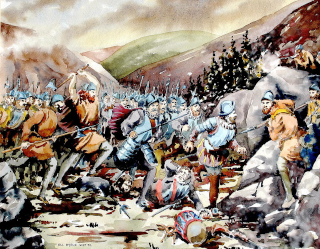
An army of 3,000 men is sent into the Wicklow Mountains but O’Byrne and Eustace are waiting for them in Glenmalure. Over 800 English lose their lives at the Battle of Glenmalure and the rest flee back to Dublin. The following year the English offer terms, Eustace refuses and flees to Spain but O’Byrne and the other clan chiefs accept the terms and are pardoned.
In the following years, O’Byrne keeps a low profile. He makes no overt moves against the English, instead of holding them at bay and even giving them hostages.
In 1592, Hugh Roe O’Donnell, with brothers Art and Henry MacShane O’Neill, escapes from Dublin Castle. The breakout has been planned with the help of Hugh O’Neill, Earl of Tyrone, and the escapees fled to the safety of Glenmalure. It is a severe winter and Art dies from exposure and is buried in O’Byrne land but O’Byrne is able to transport Hugh Roe and Henry away to safety.
In January 1594, the English decide to move against O’Byrne, claiming that he is involved in treason. The Lord Deputy of Ireland Sir William Russell manages to take Ballinacor but O’Byrne and his wife Rose escape.
The English spend a long time collecting heads and plundering, they spare few. In April, Russell again goes hunting for O’Byrne who once again escapes. His wife, however, is captured and sentenced to be burned to death. The sentence is not carried out.
O’Byrne is once again forced to seek terms which he is granted for renewable 3 monthly terms. He stays quiet until September 1596 when his son successfully attacks a munitions transport and is able to overrun the English garrison that had been placed in Ballinacor.
Lord Deputy Russell spends the next year unsuccessfully scouring the country for O’Byrne. However O’ Byrne’s luck eventually runs out. A traitor in his camp gives information to Russell that O’Byrne will be in Ballinacorr on May 8, 1597. The Lord Deputy is able to surprise him and capture him in a cave. There he is hacked to death and decapitated with his own sword.
The head of O’Bryne is put on a spike at Dublin Castle then later sent to London to Queen Elizabeth. Angry that it would be even sent to England, she disdains to accept the head of such a base “Robin Hood.”
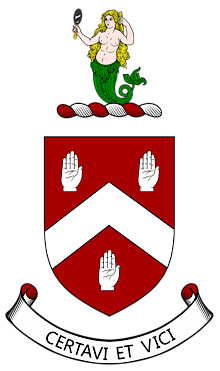
(From: “Feagh MacHugh O’Byrne 1543-1597” by Pádraig Mac Donnchadha, YourIrish.com, http://www.yourirish.com | Pictured: The armorial achievements (coat of arms, crest and motto) recorded by the Chief Herald of Ireland and the Ulster King of Arms as being awarded to Fiach MacHugh O’Byrne)