seamus dubhghaill

Promoting Irish Culture and History from Little Rock, Arkansas, USA


Leave a comment

Birth of Catherine Drew, Journalist & Writer

Catherine Drew, Anglo-Irish journalist and writer, is born in Broughshane, County Antrim, on May 27, 1832.

Drew’s parents are the Rev. Thomas Drew and Isabella (née Dalton) Drew. She is the third of the couple’s eight daughters and four sons, although most of her siblings die young. She spends her childhood in Belfast, where her father is the rector of Christ Church in Durham Street from 1833 to 1859. In 1866, she moves to 60 Upper Sackville Street, Dublin, to live with her brother, the architect Thomas Drew.

From here she appears to begin her journalist career, writing articles for the Irish Builder, going on to eventually become its assistant editor. She goes on to write for Belfast’s News Letter, and following advice from its proprietor James Alexander Henderson, she moves to London in 1871 becoming the paper’s London correspondent. She writes two columns, Metropolitan gossip and Ladies’ letter, which are among some of the earliest regular columns written specifically for women, providing society news for her readers in Belfast. Articles by her also appear in The Literary WorldThe British Architect and London Society.

Drew is one of the founding members of the Ladies’ Press Association, and campaigns for greater rights for women journalists. She becomes a prominent figure in the Institute of Journalists, representing the Institute at several international congresses. She is serving as the vice-president of the Institute at the time of her death. She also works on its Orphan Fund for many years, an initiative she originally suggests in 1891.

In 1894, Drew is one of the signatories of the Frances Power Cobbe memorial campaigning for greater recognition and rights for women journalists, alongside Millicent Fawcett and Jessie Boucherett. She writes a number of novels, including Harry Chalgraves’s Legacy (1876) and The Lutanistes of St. Jacobi’s (1881). In March 1885, she gives a lecture titled Dress, Economic and Technical at the Loan Exhibition of Women’s Industries in Bristol, which later appears as a pamphlet.

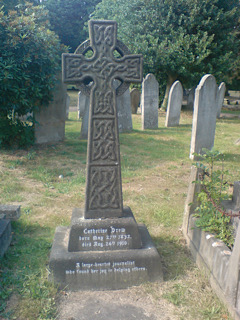
Drew dies at her home in Holland Street, Kensington, on August 26, 1910, and is buried at the Royal Borough of Kensington and Chelsea Cemetery, Hanwell. Lady Drew, her sister-in-law, erects a Celtic cross memorial there in her honour. She bequeaths a jewel-studded gold bracelet to the Institute of Journalists, which had been presented to her by the Institute to mark her retirement in 1908. It is worn by women presidents or the wives of male presidents, and is known as the “Drew Bracelet.”


Leave a comment

Birth of Helen Blackburn, Feminist & Women’s Rights Activist

Helen Blackburn, feminist and campaigner for women’s rights, especially in the field of employment, is born in Knightstown, County Kerry, on May 25, 1842. She is also an editor of The Englishwoman’s Review.

Blackburn is the daughter of Bewicke Blackburn, a civil engineer from County Kerry, and Isabella Lamb of County Durham in North East England. When her family moves to London in 1859, she soon comes into contact with the women of the Langham Place Group, especially Jessie Boucherett and Emily Faithfull.

Over the years Blackburn and Boucherett work together in a number of endeavours. Both are editors of The Englishwoman’s Review. Together they establish the Women’s Employment Defence League in 1891 to defend women’s working rights against restrictive employment legislation. Together they also edit The Condition of Working Women and the Factory Acts, 1896.

Blackburn joins the National Society for Women’s Suffrage in 1872 and is secretary of the executive committee of the Society from 1874 to 1880. She subsequently holds similar positions in a number of related organisations. She also takes opportunities to study, taking a class in Roman Law at University College London in 1875, and later (1886–88) classes at University College, Bristol. In the early 1890s, she assists Charlotte Carmichael Stopes in her writing of British Freewomen: Their Historical Privilege by supplying her own notes on the subject, then by purchasing the whole of the first edition in 1894. She retires in 1895 to care for her aged father, though later returns to take up her work.

Blackburn inspires and funds two collections. The first is an art collection in 1885 that includes pictures and work done by professional women to show the result of women’s industry. She is insistent that this does not include voluntary or amateurish work but rather show the products of female professionals. This loan exhibition includes portraits of leading women like Florence Nightingale and Mary Carpenter. This is donated to the University of Bristol, but recent enquiries indicate that this work is now lost. Her second collection is focused on a book collection by women. The books are from her collection, friends and from secondhand sources. Bookplates are commissioned and two bookcases which are decorated with paintings of Lydia Becker and Caroline Ashurst Biggs who had been the previous chairs of the Central Committee of the National Society for Women’s Suffrage. These bookcases are given to Girton College, Cambridge and are extant. In 1880 she is secretary of the West of England Suffrage Society in Bristol and is the main organizer of a large demonstration.

Blackburn’s long-term connection with the women’s movement allows her to write her history of the Victorian women’s suffrage campaign, Women’s suffrage: a record of the women’s suffrage movement in the British Isles, with biographical sketches of Miss Becker, finished in 1902, shortly before her death the following year, at Greycoat Gardens, Westminster, on January 11, 1903. She is buried at Brompton Cemetery. She leaves her archives and the decorated book collection to Girton College, Cambridge. Her will also makes provisions for establishing a loan fund for training young women.

A collaboration with Nora Vynne, published in 1903, titled Women under the Factory Act, criticises legislators for treating women as if they have not the intelligence of animals. Blackburn and Vynne argue that women should be allowed to take risks with their health in the workplace or they may find themselves always in need to protection as if they are incapable. The book is noted for its accuracy, but The Economic Journal recognises its authors as Freedom of Labour Defence members and suspects that it may have political motives arguing for the “equality of men and women.”

Blackburn’s name and picture, as well as those of 58 other women’s suffrage supporters, are on the pedestal of the statue of Millicent Fawcett in Parliament Square, London, unveiled in 2018.