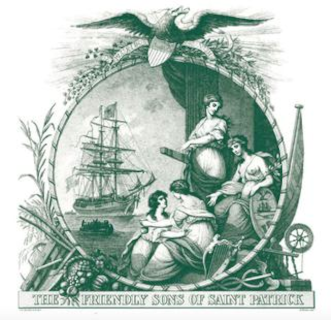
Originally founded as a charitable organization with the intent of aiding migrants from Ireland, the organization has since developed a focus on encouraging “greater interest in ties of friendship between America and Ireland,” in addition to sponsoring scholarships, cultural events, charity activities, and educational endowments.
On March 17, 1784, a group of New York City‘s Irish officers who had served in the Continental Army form the Society of the Friendly Sons of St. Patrick in the City of New York. Its founder and first president is Daniel McCormick, a merchant who is one of the first directors of the Bank of New York.
Branches of the Society have also been founded in cities such as Cincinnati, Detroit, Providence, San Diego and Spokane. The Cincinnati branch has an active glee club which has performed hundreds of benefit and goodwill performances for over 25 years.
Each branch operates independently. Originally all-male, the Philadelphia branch first admits women in 2016. The New York branch admits women to its annual pre-St. Patrick’s Day fundraising dinner for the first time in 2018, and votes to amend its by-laws on January 10, 2020, in order to permit women to apply for membership.
The McMahon murders occur on March 24, 1922 when six Catholic civilians are shot dead at the home of the McMahon family in Belfast. Police officers break into their house at night and shoot all eight males inside, in an apparent sectarian attack. The victims are businessman Owen McMahon, four of his sons, and one of his employees. Two others are shot but survive, and a female family member is assaulted. The survivors say that most of the gunmen wore police uniforms and it is suspected that they were members of the Ulster Special Constabulary (USC). It is believed to be a reprisal for the Irish Republican Army‘s (IRA) killing of two policemen the previous day.
The McMahon killings are believed to be a reprisal for the IRA’s killing of two USC policemen in Belfast. On March 23, 1922, USC officers Thomas Cunningham and William Cairnside are patrolling Great Victoria Street in the city centre when they are approached by a group of IRA members and shot dead. Two Catholics, Peter Murphy (61) and Sarah McShane (15), are shot dead in a suspected reprisal attack several hours later in the Catholic Short Strand area by unidentified gunmen. The McMahon family has no connection to any paramilitary violence.
At about 1:00 a.m. on March 24, 1922, two men wearing police uniforms seize a sledgehammer from a Belfast Corporation workman, who is guarding a building site at Carlisle Circus. A curfew is in place at the time, due to the daily violence in the city. At nearby Clifton Avenue they meet three other men and the party of five proceed to the home of Owen McMahon. Eight males and three females are in the house that night. The males are Owen, his six sons, and Edward McKinney, a parish just north of Buncrana in Inishowen, County Donegal. He works for the McMahons as a barman. The women are Owen’s wife Eliza, her daughter and her niece. At about 1:20 a.m., the gang uses the sledgehammer to break down the door of the McMahon residence.
Owen’s wife, Eliza, says that four of the men wore police caps and carried revolvers while another wore civilian clothes. John McMahon, one of Owen’s sons, says, “Four of the five men were dressed in the uniform of the RIC but, from their appearance, I know they are Specials, not regular RIC.” All of the men hide their faces. The four men in police uniform rush up the stairs and herd the males into the dining room. The women are taken into another room. When Owen asks why his family is being singled-out, one of the gunmen says it is because he is “a respected papist.” The gunmen say “you boys say your prayers,” before opening fire. The shooting continues for five minutes. Five of the men are killed outright and two are wounded, one fatally.
Owen McMahon (50), Gerard McMahon (15), Frank McMahon (24), Patrick McMahon (22) and Edward McKinney (25) are killed outright while Bernard McMahon (26) dies later. The youngest McMahon son, 12-year-old Michael, survives the attack by hiding behind furniture and pretending to be hit. John McMahon (30) survives despite serious gunshot wounds. Eliza McMahon raises the alarm by opening the drawing room window and shouting “Murder! Murder!” A matron at an adjoining nursing home is alerted and phones the police and an ambulance.
It is alleged that a group of policemen operating out of Brown Square Barracks in the Shankill Road area are behind the killings. This has never been proved, but historian Eamon Phoenix, of Stranmillis University College in Belfast, has said there is “strong circumstantial evidence” that District InspectorJohn Nixon was responsible. Historian Tim Pat Coogan believes the police were responsible. An inquiry is carried out by the Department of Defence of the Irish Free State, but not by the Northern Irish authorities. A 1924 Free State report alleges that twelve policemen, whom the report identifies by name, had carried out the McMahon murders, as well as several other attacks on Catholics.
The killings cause outrage among Belfast’s Catholic population and over 10,000 people attend the funerals of those killed.
David Lloyd George and Winston Churchill, worried that the violence could collapse the new Northern Ireland administration, organise a meeting in London between Irish republican leader Michael Collins and Sir James Craig, Prime Minister of Northern Ireland, both to try to stop the IRA violence which Collins has been tacitly encouraging and supporting, and to pressure Craig to provide more protection for Catholics. Craig denies the nationalist assertion that the McMahon killings were part of an anti-Catholic pogrom on behalf of state forces.
No one is ever prosecuted for the killings but District Inspector John Nixon of the Royal Irish Constabulary (RIC) is strongly suspected of being responsible. Nixon is later forced to step down from the Royal Ulster Constabulary, the force that succeeds the RIC in June 1922, albeit on full pension, in 1924 after being heard giving (in breach of police regulations) a political speech to an Orange Order meeting saying that, “not an inch of Ulster should be yielded” to the Free State.


 seamus dubhghaill