seamus dubhghaill

Promoting Irish Culture and History from Little Rock, Arkansas, USA


Leave a comment

Death of Paddy O’Byrne, Radio Broadcaster & Actor

Paddy O’Byrne, Irish radio broadcaster and actor who becomes one of the best-known radio personalities in South Africa, dies on December 4, 2013, in Mullingar, County Westmeath.

O’Byrne is born on December 8, 1929, in Killiney, a suburb of Dublin, the son of John O’Byrne, KC, and Marjorie (née McGuire). He attends St. Mary’s College, Dublin, Castleknock College and University College Dublin (UCD), where he earns a degree in Legal and Political Science. In 1952, he is called to the King’s Inns. In 1954, he abandons a legal career in favour of the performing arts, joining the George Mitchell Singers in London but has a “day job” working for an insurance company. During the summer season in Llandudno, Wales, he meets and later marries a singer and dancer from Dublin named Vicky Fitzpatrick. They have three children, Jane, John, and Dominic.

O’Byrne emigrates to the Union of South Africa in 1958. In 1961, he wins a competition called The Voice of South Africa, thereby gaining a contract with the South African Broadcasting Corporation and a new career. As is commonly the case at the time, both among Irish actors abroad as well as many South Africans in the theatre and broadcast media, he uses Received Pronunciation for his professional speaking voice.

In 1980, when the radio station Talk Radio 702 is launched in Johannesburg, O’Byrne is the first announcer heard on it. He also works for Radio Today and Radio Veritas, a Roman Catholic station, in Johannesburg and for Fine Music Radio in Cape Town. He also works for the BBC on Radio 2 and Capital Radio in the United Kingdom, during the 1970s and 1980s.

O’Byrne is also an actor, and narrates five films, while in South Africa. He is one of a series of actors who play the science-fiction character Mark Saxon in the original radio drama No Place to Hide, originally created by South African author Monty Doyle.

O’Byrne and his family move to Mullingar in 2001, but he continues to do broadcasts for Irish classical-music radio station RTÉ lyric fm, and his programmes for Fine Music Radio are recorded there and transmitted to South Africa for broadcast. He retires in 2004.

In 2010, at the MTN Radio Awards Gala, in Johannesburg, O’Byrne is honoured for his contribution to South African broadcasting, being named one of the inaugural inductees into the Radio Hall of Fame.

O’Byrne narrates two movies from The Gods Must Be Crazy film series, as well as Animals Are Beautiful People.

O’Byrne dies in Mullingar at the age of 83 on December 4, 2013.

Leave a comment

Adoption of the Constitution of the Irish Free State

The Constitution of the Irish Free State (Irish: Bunreacht Shaorstát Eireann) is adopted by Act of Dáil Éireann sitting as a constituent assembly on October 25, 1922. In accordance with Article 83 of the Constitution, the Irish Free State Constitution Act 1922 of the British Parliament, which comes into effect upon receiving the royal assent on December 5, 1922, provides that the Constitution will come into effect upon the issue of a Royal Proclamation, which is done on December 6, 1922. In 1937 the Constitution of the Irish Free State is replaced by the modern Constitution of Ireland following a referendum.

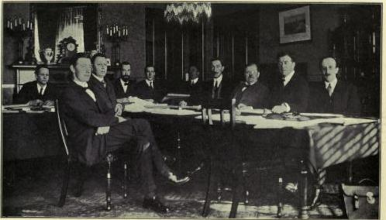
Shortly after the British evacuate their troops from Dublin Castle in January 1922, Michael Collins sets about establishing a committee to draft a new constitution for the nascent Irish Free State which would come into being in December 1922. Collins chairs the first meeting of that committee and at that point is its chairman, but is assassinated before the constitution is finalised. Darrell Figgis, the vice-chairman becomes acting Chair. The committee produces three draft texts, designated A, B and C. Draft A is signed by Figgis, James McNeill and John O’Byrne. Draft B is signed by James G. Douglas, C.J. France and Hugh Kennedy and it differs substantially from draft A only in proposals regarding the Executive. Draft C is the most novel of the three. It is signed by Alfred O’Rahilly and James Murnaghan, and provides for the possibility of representation for the people of the northern counties in the Dáil in the event of that area opting out of the proposed free state.

On March 31, 1922, an act of the United Kingdom Parliament called the Irish Free State (Agreement) Act 1922 is passed. It gives the force of law to the Anglo-Irish Treaty, which had been negotiated between the British government and Irish leaders in 1921. It also provides by for the election of a body to be called the “House of the Parliament,” sometimes called the “Provisional Parliament,” to which the Provisional Government establishes under that act will be responsible. The act gives no power to the Provisional Parliament to enact a constitution for the Irish Free State. In due course, “the House of the Parliament,” provided for by that act, is elected and meets on September 9, 1922, and calling itself Dáil Éireann, proceeds to sit as a constituent assembly for the settlement of what becomes the Constitution of the Irish Free State.

The Constitution establishes a parliamentary system of government under a form of constitutional monarchy, and contains guarantees of certain fundamental rights. It is intended that the constitution would be a rigid document that, after an initial period, could be amended only by referendum. However, amendments are made to the Constitution’s amendment procedure, so that all amendments can be and are in fact made by a simple Act of the Oireachtas (parliament).

Following a change of government in 1932 and the adoption of the Statute of Westminster 1931, a series of amendments progressively removes many of the provisions that had been required by the Anglo-Irish Treaty.

(Pictured: The Constitution Committee meeting at the Shelbourne Hotel, Dublin, 1922)