seamus dubhghaill

Promoting Irish Culture and History from Little Rock, Arkansas, USA


Leave a comment

The Belfast Shipyard Expulsions

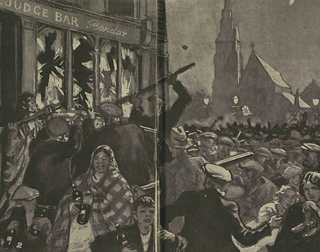
On July 21, 1920, the Belfast Shipyard Expulsions take place as thousands of Catholic workers and socialists in Belfast’s shipyards are attacked and driven from their jobs following Edward Carson’s speech on the Twelfth at Finaghy during the annual industrial holiday. This day marks the first day back at work after the holiday, and the violence erupts in the shipyards, particularly in the Harland & Wolff yards.

The disturbances are part of a wider Belfast pogrom in 1920, rooted in sectarian tensions between unionist and nationalist communities. The Twelfth of July celebrations in Finaghy have been a focal point for nationalist and socialist mobilisation, and Carson’s speech is seen by many Catholic workers as inflammatory, stoking fears of reprisals.

The targeted groups of the expulsions include Catholic workers, trade unionists, and socialist activists, many of whom are from the working class “plebeian” strata. Reports describe beatings, assaults, and intimidation in the shipyards, with workers being pushed out of their posts or forced to leave premises. The expulsions disrupt shipbuilding operations, as skilled labour is removed from the workforce overnight. The events reinforce sectarian divisions, with unionist groups and some employers using the violence to assert control over the workforce.

By July 1920, newspapers are the main source of news, with current affairs often appearing on later pages. Coverage in papers such as the Belfast News Letter, Belfast Telegraph, The Irish Times, and Freeman’s Journal describe the expulsions as part of a broader outbreak of violence, but without the front-page headlines typical of later conflicts. The absence of radio broadcasts means that news is spread through print, handbills, and word of mouth.

The July 21, 1920, expulsions are a turning point in the sectarian conflict in Belfast, marking a shift from political mobilisation to direct, violent confrontation in the industrial heart of the city. They reflect the deep entrenchment of sectarianism in the shipbuilding industry and foreshadow further violence in the years leading up to the Irish Civil War.

Leave a comment

Death of Paddy O’Byrne, Radio Broadcaster & Actor

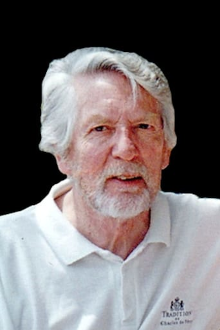
Paddy O’Byrne, Irish radio broadcaster and actor who becomes one of the best-known radio personalities in South Africa, dies on December 4, 2013, in Mullingar, County Westmeath.

O’Byrne is born on December 8, 1929, in Killiney, a suburb of Dublin, the son of John O’Byrne, KC, and Marjorie (née McGuire). He attends St. Mary’s College, Dublin, Castleknock College and University College Dublin (UCD), where he earns a degree in Legal and Political Science. In 1952, he is called to the King’s Inns. In 1954, he abandons a legal career in favour of the performing arts, joining the George Mitchell Singers in London but has a “day job” working for an insurance company. During the summer season in Llandudno, Wales, he meets and later marries a singer and dancer from Dublin named Vicky Fitzpatrick. They have three children, Jane, John, and Dominic.

O’Byrne emigrates to the Union of South Africa in 1958. In 1961, he wins a competition called The Voice of South Africa, thereby gaining a contract with the South African Broadcasting Corporation and a new career. As is commonly the case at the time, both among Irish actors abroad as well as many South Africans in the theatre and broadcast media, he uses Received Pronunciation for his professional speaking voice.

In 1980, when the radio station Talk Radio 702 is launched in Johannesburg, O’Byrne is the first announcer heard on it. He also works for Radio Today and Radio Veritas, a Roman Catholic station, in Johannesburg and for Fine Music Radio in Cape Town. He also works for the BBC on Radio 2 and Capital Radio in the United Kingdom, during the 1970s and 1980s.

O’Byrne is also an actor, and narrates five films, while in South Africa. He is one of a series of actors who play the science-fiction character Mark Saxon in the original radio drama No Place to Hide, originally created by South African author Monty Doyle.

O’Byrne and his family move to Mullingar in 2001, but he continues to do broadcasts for Irish classical-music radio station RTÉ lyric fm, and his programmes for Fine Music Radio are recorded there and transmitted to South Africa for broadcast. He retires in 2004.

In 2010, at the MTN Radio Awards Gala, in Johannesburg, O’Byrne is honoured for his contribution to South African broadcasting, being named one of the inaugural inductees into the Radio Hall of Fame.

O’Byrne narrates two movies from The Gods Must Be Crazy film series, as well as Animals Are Beautiful People.

O’Byrne dies in Mullingar at the age of 83 on December 4, 2013.