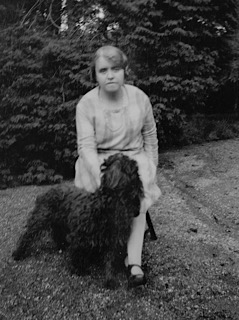
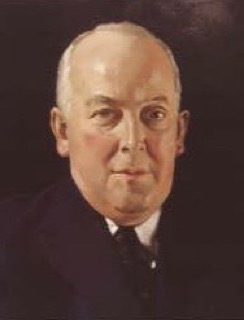
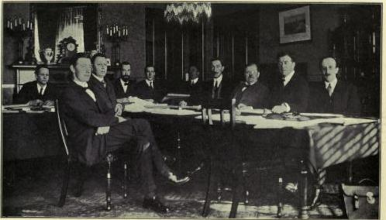
MacCormack (sometimes spelled McCormack) is born in 1892, the daughter of Constance MacCormack, and niece of Evelyn Gleeson. Following the death of her father in 1902, the family lives with Gleeson at her home, at Runnemede, Sandyford Road, Dublin, with her mother and siblings, Grace (1898–1982) and Edward (1889–1906). With her sister, she works in the Dun Emer Guild from a young age, particularly after the Yeats sisters, Lily and Elizabeth, leave Dun Emer to form Cuala Industries.
MacCormack also does some acting, theatre set design and is an author. She appears in Joseph Plunkett‘s 1912 play The Dance of Osiris at the Hardwicke Theatre, and designs the sets. She often acts under the name Catia or Caitia Nic Cormac. She also designs sets for the Irish National Theatre Society, Theatre Company of Ireland and the Dublin Drama League.[5]
Some of MacCormack’s most notable works are the tapestries for the Honan Chapel, Cork, in 1917, the vestments for St. Patrick’s Catholic Church, San Francisco in 1923, and a carpet presented to Pope Pius XI in 1931. The carpet is commissioned in an effort by Ireland’s ambassador to the Vatican, Charles Bewley, to secure Ireland as the host of the 31st International Eucharistic Congress. It is designed by MacCormack and takes workers in the Guild almost four months to hand weave at a cost of £450. As “The Pope’s Carpet” it is exhibited in Clerys department store on O’Connell Street in Dublin from January 19 to 30, 1931.
MacCormack designs the poster for the 1927 “Grand Pageant of Dublin History.” She also develops a set of designs for judicial robes for W. T. Cosgrave in 1924, drawing on the Brehon style sketches of which are held in University College Dublin Archives. In 1911 and 1920, she exhibits at the Oireachtas Art Exhibitions, and with the Water Colour Society of Ireland throughout the 1920s. She is also an illustrator, beginning with Christmas card designs for Dun Emer in the 1910s. She illustrates John Hackett Pollock’s 1919 The wisdom of the world: A book of wonder-tales, published by Colm Ó Lochlainn‘s Candle Press under Pollock’s pseudonym An Philibín. She edits a volume for Ó Lochlainn in 1920, The Book of St Ultan; a collection of pictures and poems by Irish artists and writers, proceeds of which go to Saint Ultan’s Hospital. As well as editing, she contributes illustrations and two poems to the volume.
After her aunt’s death in 1944, MacCormack continues to run Dun Emer Guild until its store on Harcourt Street closes around 1964.
MacCormack dies on June 26, 1975. A large collection of theatre ephemera collected by MacCormack is sold in 2008. The Kitty MacCormack Archive is held by the Jackie Clarke Archive, and the National Library of Ireland also holds a collection of her theatre ephemera and letters. A dress designed by MacCormack for Clare Kennedy, the wife of Hugh Kennedy, is on display as part of The Way We Wore, an exhibition in National Museum of Ireland at Collins Barracks, Dublin.
Clery is the son of Arthur Clery (who also uses the names Arthur Patrick O’Clery and Arthur Ua Cléirigh), a barrister, and Catherine Moylan. His father, who practises in India, publishes books on early Irish history.
Clery’s principal themes include the difficulties of Roman Catholic graduates seeking professional employment, dramatic criticism (he hails Lady Gregory‘s play Kincora as the Abbey Theatre‘s first masterpiece but is repulsed by the works of John Millington Synge), Catholic-Protestant rivalry, tension within the Dublin professional class, and the vagaries of the Gaelic revival movement.
Clery advocates partition on the basis of a two nations theory, first advanced in 1904–1905, possibly in response to William O’Brien‘s advocacy of securing Home Rule through compromise with moderate Unionists. Several of his articles on the subject are reprinted in his 1907 essay collection, The Idea of a Nation.
Clery derives this unusual view for a nationalist from several motives, including a belief that arguments for Irish nationalists’ right to self-determination can be used to justify Ulster Unionists’ right to secede from Ireland, fear that it might be impossible to obtain Home Rule unless Ulster is excluded, and distaste for both Ulster Protestants and Ulster Catholics, whom he sees as deplorably anglicised. He remains a partitionist for the rest of his life. He is not particularly successful as a barrister, but on the establishment of University College Dublin (UCD) in 1909, he is appointed to the part-time post of Professor of the Law of Property.
Clery does not take his seat and does not contest the September 1927 Irish general election since new legislation obliges candidates to pledge in advance that they will take their seat. He is one of the lawyers who advises Éamon de Valera that the Irish Free State is not legally obliged to pay the Land Annuities which had been agreed in the Anglo-Irish Treaty of 1922.
Clery was a close friend of Tom Kettle, with whom he founds a dining club, the “Cui Bono.” Hugh Kennedy is also a lifelong friend. As Auditor of the L & H, he tries to prevent James Joyce from reading a paper praising Henrik Ibsen, asserting that “the effect of Henrik Ibsen is evil,” but Joyce succeeds in reading it after he argues his case with the college president. The principal influence on Clery is the Irish Ireland editor D. P. Moran, to whose weekly paper, The Leader, Clery becomes a frequent contributor. In addition to The Idea of a Nation, he publishes Dublin Essays (1920) and (as Arthur Synan) The coming of the king.
Cox is the younger of two sons of Dr. Michael Cox, physician originally of Roscommon and Sligo, and Elizabeth Cox (née Nolan). Like his father, he supports the Irish Parliamentary Party (IPP) and maintains an interest in a wide range of subjects outside his chosen career throughout his life. He attends Belvedere College (1900-09), where he often obtains first place in his class and wins the Union prize for essay writing three years in a row (1905–07). He is the first auditor of the Belvedere Debating Society and is succeeded in the post by George O’Brien, who remains his lifelong friend. In 1909, he wins both a Royal University of Ireland (RUI) scholarship and an entrance exhibition to University College Dublin (UCD), a college of the new National University of Ireland (NUI).
Working for an arts degree at UCD, then housed at 86 St. Stephen’s Green, Cox overcomes an innate shyness to cultivate a reputation as a skillful and humorous orator in the Literary and Historical Society (L&H), where he befriends both Kevin O’Higgins and John A. Costello. He has immense respect for both men, and they remain firm friends. The respect is reciprocal, and during their subsequent careers O’Higgins and Costello often have occasion to seek Cox’s wise counsel. In 1912, Cox defeats Costello for the auditorship of the L&H by 112 votes to 63, and in the same year attains a first-class honours BA. His role as auditor means that he is involved with UCD for a further year. He attends lectures at the Incorporated Law Society while at the same time he pursues both the LL. B course, a one-year postgraduate law degree, and an MA at UCD. By the end of 1913 he has achieved first place in the LL. B and first-class honours in his MA. In addition, he has become auditor of the Solicitors’ Apprentices’ Debating Society.
After university Cox is apprenticed to a solicitor, Francis Joseph Scallan, who runs a firm in partnership with his brother, John Louis Scallan. On qualifying in 1915, he remains with the firm as an assistant solicitor until 1920, when he forms a partnership with another solicitor, John McAreavey. The firm is called Arthur Cox & Co. and has its offices at 5 St. Stephen’s Green. Initially the new firm’s clients are predominantly made up of those for whom he worked at his previous firm, and friends from his university days. Through George O’Brien he meets Sir Horace Plunkett, president of the Irish Agricultural Organisation Society (IAOS), a connection of enormous benefit, which sees the firm both become solicitor to the IAOS and gain a large number of clients through its membership.
Despite his relative youth, Cox is held in high esteem by those attempting to construct the apparatus of the newly independent Irish Free State in 1922. This is clear when he provides Hugh Kennedy, law officer to the provisional government and future Chief Justice of Ireland, with a lengthy opinion on the status of the Anglo–Irish Treaty, in the context of drafting a constitution for the new state. He is conscious of the need to counter claims that the treaty does not go far enough in acknowledging Irish nationhood; and he advises that the first article of the new constitution should explicitly state that the sovereignty of the new state derives from the Irish people. This is ultimately done in the preamble of the Constitution of the Irish Free State (1922).
In 1923, Cox is appointed solicitor to Siemens-Schuckert, the German engineering firm, and helps to negotiate the terms of an agreement with the Irish government for the construction of a hydro-electric station at Ardnacrusha, County Clare. In 1926, the Electricity (Supply) Act is passed, on which he advises. Although he experiences much success in these years, he is very much affected by the death of his friend Kevin O’Higgins, who is shot and dies from his injuries on July 10, 1927. He visits O’Higgins on his deathbed. Arthur Cox & Co. expands rapidly in its early years, and in 1926 Cox and McAreavey purchase new premises at 42–3 St. Stephen’s Green. Four years later he buys his partner out of the firm.
Given his friendships with various members of the original Free State administration, and the amount of work he receives from it, government work for Cox dries up when Fianna Fáil comes to power in 1932. However, the protectionist corporate policies and implementing legislation of the new administration bring new opportunities. The legislation places severe restrictions on foreign companies owning and operating enterprises in Ireland. He develops a reputation for assisting corporate clients to circumnavigate the restrictive laws. Along with his friend James Beddy, chief executive of the Industrial Credit Corporation, he realises that foreign investment is essential to the growth of the Irish economy. He introduces many clients to Beddy, and between them they find ways to assist the firms in investing in various enterprises without breaching the law. During this period, he cements his reputation as the foremost corporate lawyer in Ireland. This is evident when James Marmion Gilmor Carroll appoints him, as one of only two non-family members, to the board of the tobacco manufacturers P. J. Carroll & Co. He plays a key role in transforming the archaic practices of the firm by persuading Carroll to recruit Kevin McCourt as executive director. He and McCourt later convince Carroll to employ his nephew, Don Carroll, who plays a key role in the modernisation and diversification of the firm. In 1960 He and Carroll negotiate the sale of 40 per cent of the company to Rothmans International.
Despite his reputation as a corporate lawyer, Cox also represents non-corporate clients, some of whom include well-known personalities. In 1946, he agrees to assist Hungarian film-maker Gabriel Pascal in attempting to persuade the Irish government to establish an Irish film studio, with a view to filming the plays of George Bernard Shaw. He puts much time and energy into trying to convince the government to provide finance for the venture, but to no avail.
In 1942, Cox is elected to the council of the Incorporated Law Society and becomes president of the society for the 1951-52 term, presiding over the celebrations to commemorate the centenary of the society’s charter of incorporation. In 1951, he also becomes chairman of the company law reform committee, which produces its report, known as “the Cox report,” in 1958. Renowned for his eccentricities, he is almost as well known for his shabby mode of dress as he is for his incisive mind and immense capacity for work. His reputation is also based on a strict adherence to discretion and confidentiality. This is clear in 1948 when his old friend John A. Costello, having been offered the office of Taoiseach in the first inter-party government, turns to him for advice on whether he should accept the post. In 1954, Costello nominates him to the 8th Seanad.
In October 1953, the London firm of Nicholl Manisty & Co. retains him to represent British Prime Minister Sir Winston Churchill in a libel action brought by BrigadierEric Dorman O’Gowan, arising from comments in Churchill’s The Second World War: The Hinge of Fate. Churchill also relies on the advice of his friend Sir Hartley Shawcross, leader of the English bar, who makes several visits to Dublin to meet Cox and counsel (including John A. Costello). Cox and Shawcross believe it necessary to reach some form of settlement to avoid Churchill having to appear in court. The action is therefore withdrawn in return for an undertaking that certain corrections will be made.
On August 5, 1940, Cox marries Brigid O’Higgins (née Cole), widow of his friend Kevin O’Higgins. Prior to this he lives with his mother at 26 Merrion Square. He had purchased Carraig Breac in Howth in 1936 and moves there on his marriage. His commitment to his work means that he often works seven days a week and he therefore keeps a flat on Mespil Road, Dublin, from 1940. In 1959, he sells Carraig Breac and moves to 8 Shrewsbury Road, Dublin.
On February 14, 1961, Brigid Cox dies. Soon after, Cox decides to retire from his profession and study for the priesthood. He is intent on becoming a Jesuit and discusses his intentions with the Archbishop of Dublin, John Charles McQuaid, who agrees to ordain him after two years of private tuition at the Jesuit theologate at Milltown Park, Dublin. On being accepted by the Jesuits, he makes arrangements to settle his worldly affairs by selling his home on Shrewsbury Road and leaving his practice to the existing partners. He enters Milltown Park on October 15, 1961, and is ordained on December 15, 1963. His impact on Irish life over the previous forty years is evident by the presence at his ordination of John A. Costello, W. T. Cosgrave, Seán T. O’Kelly, and James Dillon, among others.
Following ordination Cox is appointed to serve at the Jesuit mission in Monze, Northern Rhodesia (Zambia). He arrives at Monze in August 1964 and is appointed extraordinary chaplain to the local convent and hospital. On June 8, 1965, he suffers head injuries in a car accident while traveling to Namwada in Zambia. Taken to Choma hospital, he initially appears to be relatively unscathed but collapses and dies on June 11, 1965. He is found to have suffered from a cerebral haemorrhage and a fractured skull. He is buried in the grounds of the Jesuit retreat house in Chikuni, Zambia.
Many of the Cox family papers are housed at the UCD archives.
(From: “Cox, Arthur Conor Joseph” by Shaun Boylan, Dictionary of Irish Biography, http://www.dib.ie, October 2009)
Shortly after the British evacuate their troops from Dublin Castle in January 1922, Michael Collins sets about establishing a committee to draft a new constitution for the nascent Irish Free State which would come into being in December 1922. Collins chairs the first meeting of that committee and at that point is its chairman, but is assassinated before the constitution is finalised. Darrell Figgis, the vice-chairman becomes acting Chair. The committee produces three draft texts, designated A, B and C. Draft A is signed by Figgis, James McNeill and John O’Byrne. Draft B is signed by James G. Douglas, C.J. France and Hugh Kennedy and it differs substantially from draft A only in proposals regarding the Executive. Draft C is the most novel of the three. It is signed by Alfred O’Rahilly and James Murnaghan, and provides for the possibility of representation for the people of the northern counties in the Dáil in the event of that area opting out of the proposed free state.
On March 31, 1922, an act of the United Kingdom Parliament called the Irish Free State (Agreement) Act 1922 is passed. It gives the force of law to the Anglo-Irish Treaty, which had been negotiated between the British government and Irish leaders in 1921. It also provides by for the election of a body to be called the “House of the Parliament,” sometimes called the “Provisional Parliament,” to which the Provisional Government establishes under that act will be responsible. The act gives no power to the Provisional Parliament to enact a constitution for the Irish Free State. In due course, “the House of the Parliament,” provided for by that act, is elected and meets on September 9, 1922, and calling itself Dáil Éireann, proceeds to sit as a constituent assembly for the settlement of what becomes the Constitution of the Irish Free State.
The Constitution establishes a parliamentary system of government under a form of constitutional monarchy, and contains guarantees of certain fundamental rights. It is intended that the constitution would be a rigid document that, after an initial period, could be amended only by referendum. However, amendments are made to the Constitution’s amendment procedure, so that all amendments can be and are in fact made by a simple Act of the Oireachtas (parliament).