Thompson is the youngest child of the social historians and peace activists E. P. Thompson and Dorothy Towers. She has lived in Ireland since 1981 and many of her books are set there. She trains racehorses in the UK and United States and travels extensively in India before settling in 1984 in Inagh, County Clare, in the west of Ireland with her partner Conor Minogue. They have two daughters, Cliodhna and Dearbhla. She is an accomplished fiddler with an interest in Irish traditional music, which is reflected in The New Policeman (2005).
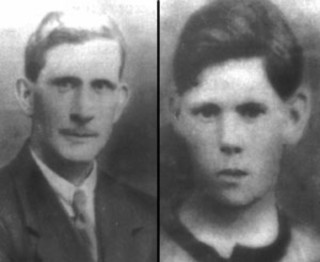
Patrick Loughnane, aged 29, is a local IRA leader and Sinn Féin secretary. He was also active in the local Gaelic Athletic Association (GAA). His younger brother Harry, aged 22, is president of the local Sinn Féin club and a goalkeeper with Beagh Hurling Club.
While working on the family farm in Shanaglish, County Galway, the two brothers are arrested by the Auxiliaries. Not a word is heard from the boys until a week after their arrest when a group of Auxiliaries call Mrs. Loughnane to inform her that her sons had escaped capture. This raises fear and suspicion among the brothers’ family and friends and a search is organised. Ten days after they had been arrested, their bodies are found in a muddy pond near Ardrahan.
Exactly what happened to the two brothers will never be known, however, witnesses, including others arrested at the same time tell a tale of merciless brutality. After being arrested the brothers are beaten for hours in Gort Bridewell and then tied to the tailgate of a lorry, bound to each other, and dragged along the roads to Drumharsna Castle, the headquarters of the Black and Tans, where they are beaten again. At 11:00 PM that night they are taken from Drumharsna Castle to Moy O’Hynes wood where they are shot. Witnesses recount on Saturday morning, Harry is still alive and is heard moaning. On Sunday morning, the Auxiliaries take the bodies to Umbriste near Ardrahan where they are set on fire. After failing to bury the bodies because of the rocky ground they throw them into a muddy pond and, to make their discovery more difficult, throw dirty oil into the water.
After the bodies are discovered, they are examined by a local doctor. The letters “IV” are carved into the charred flesh in several places, two of Harry’s fingers are missing, his right arm is broken and hung over his shoulder. Both of Patrick’s legs and wrists are broken. The doctor believes it possible that hand grenades had been put into their mouths and exploded.
A memorial to the two brothers is later built on the spot where they died.
Fahy is born in Kinvara, County Galway, on September 29, 1854 into a family of seventeen, eight of whom survive. His father, Thomas, comes from the Burren area and his mother, Celia Marlborough, is born near Gort, County Galway.
In 1896, Fahy becomes president of the emerging Conradh na Gaeilge (Gaelic League) in London, a position he holds until 1908. He is also a long time member of the London Irish Literary Society. Described as a small, brisk man, his enthusiasm and energy knows no bounds. His most memorable poems and songs include “The Ould Plaid Shawl,” “The Queen of Connemara,” the original “Galway Bay,” and “The Tide Full In.” His publications include The Child’s Irish Song Book (1881), The Irish Reciter (1882), Irish History in Rhyme (1882) and Irish Songs and Poems (1887).
Fahy retires from the Civil Service at the age of 65. He dies at the age of 81 on April 1, 1935.



 seamus dubhghaill