
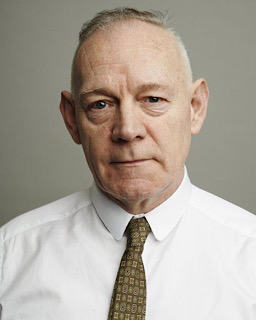
Gerard Mannix Flynn, an Irish Independent politician, author and playwright, is born in Dublin on May 4, 1957. He is serving as a Dublin City Councillor since May 2009. In addition to his work on Dublin City Council, he has also written the novel Nothing To Say in 1983 and the play James X in 2002.
At the age of eleven, Flynn is sent to St. Joseph’s Industrial School in Letterfrack, County Galway, for eighteen months. He is subjected to sexual and physical abuse there. He also spends time in Marlborough House Detention Centre, Daingean, County Offaly, St. Patrick’s Institution, Dublin, and is given five years at the age of fifteen and sent to Mountjoy Prison.
Flynn publishes the novel Nothing To Say in 1983. It is subsequently translated into German, Italian, and Polish. He founds his arts company, Farcry Productions, in 2004, which produces visual art, performance and installation work around taboo issues such as child sexual abuse, violence, and addiction.
In 2004, James X performed by Flynn wins The Irish Times Irish Theatre Award. An earlier version of this play entitled Talking to the Wall previously wins the Edinburgh Fringe award.
Flynn appears in the films Cal, When the Sky Falls and Excalibur and works as an actor in Scotland, London, Austria, and Dublin for twenty years.
Flynn is first elected to Dublin City Council in the 2009 Irish local elections as an independent candidate representing the South-East Inner City electoral area. He is re-elected to the revised Pembroke-South Dock electoral area in the 2014 Irish local elections.
Flynn tables a motion to move the Temple Bar Cultural Trust, a State company set up in 1991 as a regeneration agency for Temple Bar, under the direct control of Dublin City Council. The trust is subsequently found to be in breach of corporate governance and accountability in a number of public reports. He also expresses critical views of the way public money is spent as part of a Grafton Street regeneration project in Dublin.
Flynn supports tougher regulation around the amplification of busking on public streets, which leads to his office being vandalised in February 2015. He is involved in a number of challenges to cycle lane provision, with a High Court challenge against the Strand Road cycle lane COVID-19 mobility trial and is a spokesperson for a group opposed to this cycle lane trial. Critics accuse him of consistently voting against policies that would provide more active travel infrastructure and in favour of policies which negatively impact pedestrians and cyclists. His legal challenges to cycling provision have the potential to revert a number of cycle lanes which have been created back to servicing predominantly cars.
In 2015, Flynn resigns from the Dublin City Council Arts SPC over what he perceives as a lack of cohesive overall policy, strategy, and vision.
In 2016, Flynn protests against the Artane Band, due to its association with the Artane Industrial School. The band responds saying it has had no association with the former industrial school. His peaceful protest, which includes him protesting on a window sill in his Dublin City Council office, is criticised by some as “attention seeking” and a “publicity stunt full stop.”
In 2019, Flynn is involved in a protest march against plans to open the state’s largest homeless shelter in his ward. Protesters march northbound on Aungier Street blocking traffic and shouting slogans against the Peter McVerry trust for providing the services in conjunction with Dublin City Council. In 2020, he takes further legal action against the council, who are working in conjunction with the Peter McVerry Trust, so that he can ensure the homeless facilities will not be built in the area.
Flynn contests the 2011, 2016 and 2020 Irish general elections to Dáil Éireann unsuccessfully. He stands unsuccessfully as an independent candidate at the 2021 Dublin Bay South by-election, getting 879 first-preference votes (3.3%).
A 2019 documentary by Flynn, Land Without God, about the effects of clerical abuse on Flynn and his family, receives special mention for the Dublin Human Rights Film Award at the Dublin International Film Festival.

