
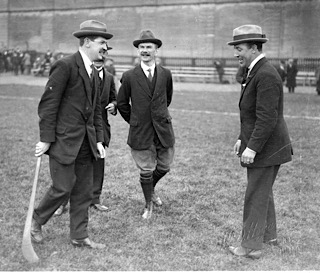
Luke O’Toole, Irish Gaelic games administrator, is born on June 21, 1873, in Ballycumber, Tinahely, County Wicklow.
O’Toole is the second son among five children of John O’Toole and Bridie O’Toole (née Doran). Of farming stock on both sides, he is educated at the local national school at Ballycumber and at a Dublin secondary school. When in the mid-1890s he moves to Dublin, he joins the Benburb Gaelic Football Club at Donnybrook, where his teammates include the future nationalist parliamentarian Thomas M. Kettle, who is killed in 1916 near Ginchy, France, during World War I. The proprietor of two newsagents’ shops near his home in Mount Pleasant Square, he soon becomes his club’s delegate to the Dublin county committee of the Gaelic Athletic Association about 1899. Founded in 1884 by Michael Cusack, the GAA by the late 1890s is insolvent and almost moribund, having been riven by rival nationalist factions. However, a group of younger officials which includes O’Toole is determined not to allow the Association to die, and at its annual congress in Thurles on September 22, 1901, stages what is in effect a palace coup. Alderman James Nowlan of Kilkenny, County Kilkenny, a labour activist and Gaelic League enthusiast, is elected president, and in a contest for the post of secretary, O’Toole defeats Cusack.
O’Toole holds the post of chief officer of the GAA until his death almost thirty years later. During this period, despite major political and military turmoil, including the world war, the Irish War of Independence, and the Irish Civil War, he is instrumental in turning the Association into the biggest Irish sports body, and some leading members, such as Michael Collins and Harry Boland, play major political roles between 1913 and 1923. Essentially a backroom administrator, O’Toole rarely appears in public apart from GAA events, one notable exception being on November 25, 1913, at the foundation meeting of the Irish Volunteers at the Rotunda Rink, Dublin, where he is one of the platform party. After the suppression of the 1916 Easter Rising, he goes into hiding temporarily in his native Wicklow. From then until the cessation of hostilities in mid-1921 he manages to evade the notice of the authorities though he is always a close associate of Sinn Féin leaders. He plays a big part in reviving the fortunes of the GAA after the Irish Civil War and is a principal organiser of the Tailteann Games in 1924 and 1928. His career, however, is cut short at the age of 56 by his sudden death at his desk on July 17, 1929.
For most of his life O’Toole resides in a house provided by the GAA beside Croke Park, the Association’s headquarters and principal stadium. He marries Bridget Doyle, a shopkeeper of Dublin. They have four sons and four daughters.
(From: “O’Toole, Luke” by Marcus de Búrca, Dictionary of Irish Biography, http://www.dib.ie, October 2009 | Pictured: Michael Collins, Luke O’Toole and Harry Boland in 1921, Image credit: GAA)

 seamus dubhghaill