seamus dubhghaill

Promoting Irish Culture and History from Little Rock, Arkansas, USA


Leave a comment

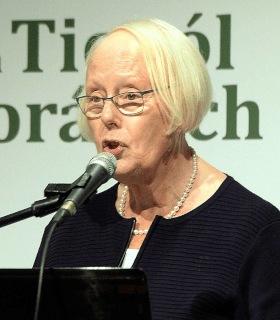
Birth of Mary Laffoy, Retired High Court & Supreme Court Judge

Mary Eleanor Laffoy, SC, retired Irish judge who is currently President of the Law Reform Commission, is born on North Circular Road, Dublin, on June 17, 1945. She previously serves as a Judge of the Supreme Court of Ireland from 2013 to 2017, and a Judge of the High Court from 1995 to 2013. She chairs the Citizens’ Assembly between 2016 and 2018.

Laffoy moves to Manorhamilton and Swinford, before returning to Dublin to live in Donabate following the death of her father. She attends Tourmakeady College in Toormakeady, County Mayo.

Initially after leaving school Laffoy tries primary school teaching at Carysfort College and joins the civil service. She is subsequently educated at University College Dublin (UCD) and King’s Inns. She receives the John Brooks Scholarship at the Inns for achieving the highest marks. She receives a BA from UCD in 1968 and a BCL in 1971.

Laffoy is called to the Bar in 1971 and to the Inner Bar in 1987. She devils for Brian McCracken. She becomes a Senior Counsel on the same day as future Supreme Court colleagues Susan Denham and Liam McKechnie and at the time is only one of four women seniors.

Laffoy’s expertise at the Bar is in property law. She appears in the Cityview Press case which clarifies the law on the nondelegation doctrine in Ireland. In 1983, she is appointed by the Supreme Court to argue against the constitutionality of the Electoral (Amendment) Bill 1983 following a reference made by President Patrick Hillery under Article 26 of the Constitution of Ireland. She appears in another Article 26 reference made by Mary Robinson regarding the Matrimonial Home Bill 1993. For both references, the Supreme Court finds for her side.

In 1986, Laffoy appears on The Late Late Show in a simulated court case to argue for a vote against the Fifteenth Amendment of the Constitution of Ireland.

Laffoy is appointed as a judge of the High Court in 1995, primarily presiding over cases involving chancery law.

Laffoy presides over the Commission to Inquire into Child Abuse from 1999 to 2003, an inquiry into child abuse. Her decision to resign as chair before the commission completes its report is controversial. In her letter of resignation from the commission of September 2, 2003, she outlines her belief that the actions of the Government and the Department of Education have frustrated her efforts and have slowed the commission’s work. She feels that “the cumulative effect of those factors effectively negated the guarantee of independence conferred on the Commission and militated against it being able to perform its statutory functions.” The commission is chaired from 2003 to 2009 by Judge Sean Ryan.

Laffoy presides over the High Court hearing in A v Governor of Arbour Hill Prison, ordering the release of a prisoner convicted of statutory rape due an earlier finding that the offence he was convicted of was contrary to the Constitution of Ireland. Her decision is overturned on appeal to the Supreme Court. In 2012, she dismisses an action taken by Thomas Pringle regarding the legality of the European Stability Mechanism. The European Court of Justice, after reference from the Supreme Court, also rejects his claim. During her time at the High Court, ten percent of reported judgments are written by her.

Laffoy is appointed to the Supreme Court of Ireland in July 2013. She retires from the Supreme Court on June 16, 2017. A portrait of her is unveiled in the King’s Inns in March 2020.

In July 2016, Laffoy is appointed by Taoiseach Enda Kenny to chair the Citizens’ Assembly, which she chairs until June 2018. She becomes the president of the Law Reform Commission in 2018.


Leave a comment

Birth of Charles Patrick Meehan, Priest & Historian

Charles Patrick Meehan, priest and historian, is born on July 12, 1812, at 141 Great Britain Street (now Parnell Street), Dublin.

Meehan’s father, a native of Manorhamilton, County Leitrim, is a prosperous farmer at Ballymahon, County Longford. He receives his early education in a hedge school and from a local curate at Ballymahon. In 1828 he enters the Pontifical Irish College in Rome, where he is a brilliant student, acquiring fluency in several languages. As a child he had loved to listen to stories of the Flight of the Earls and the Flight of the Wild Geese, and during his time in Rome he discovers the neglected graves of Hugh O’Neill and Hugh O’Donnell in the church of San Pietro in Montorio. He begins his lifelong research on the seventeenth century by locating and transcribing hitherto unstudied documents held in Roman repositories. Ordained in 1835, he is appointed curate at Rathdrum, County Wicklow in August and five months later is transferred to the parish of Saints Michael and John, Dublin. He is an excellent preacher and a strong advocate of temperance, and zealously discharges his parish duties.

A supporter of Daniel O’Connell and the repeal movement, Meehan is particularly attracted by the ideals of Young Ireland and becomes friendly with the principal writers of The Nation, especially Charles Gavan Duffy and James Clarence Mangan. He is Mangan’s confessor and attends his deathbed in 1849. The Young Irelanders often meet in his presbytery in Lower Exchange Street. From 1842 he contributes occasional verse and translations to The Nation using the pseudonym ‘Clericus’ and the initials ‘C. P. M.’ He defends the Young Irelanders from accusations of irreligion. During the debates on physical force in Conciliation Hall in July 1846 he supports the Young Ireland position and is shouted down by O’Connellites.

He secedes with the Young Irelanders from the Repeal Association and becomes a member of their Irish Confederation on its foundation in January 1847. Later that year he becomes president of the St. Patrick’s Confederate Club and delivers lectures to it on Irish history. A strong believer in the importance of history in creating national pride and awareness, he contributes The Confederation of Kilkenny (1846) and a translation of Daniel O’Daly, The Geraldines, their Rise, Increase and Ruin (1847) to The Nation‘s Library of Ireland historical series. He publishes a translation, with a valuable introduction and notes, of John Lynch‘s Latin life of Francis Kirwan, bishop of Killala 1645–61, as Portrait of a Christian Bishop (1848). In 1848 he resigns his presidency of the St. Patrick’s Confederate Club in the hope of becoming librarian or professor of modern languages at Queen’s College Galway but is unsuccessful.

For the rest of his life Meehan devotes himself to parish work and historical research, occasionally publishing articles and poems in the Hibernian Magazine and Irish Catholic Magazine. He also edits six volumes of the second series of James Duffy‘s Duffy’s Hibernian Magazine (1862–65). Having acquired a vast store of anecdotes and curious information from his research, he is an interesting companion who loves the company of poets and scholars and forms friendships with many young nationalist writers, including Denis Florence MacCarthy, John Keegan Casey and John Francis O’Donnell.

Most of Meehan’s research is devoted to Irish history, but he occasionally tackles other subjects, such as his translation from the Italian of Vincenzo Marchese’s Lives of the most eminent sculptors and architects of the order of St Dominic (2 vols, 1852). Although his work is marked by a strong sympathy for Catholicism and Irish nationalism, he is among the more scholarly historians associated with the Young Ireland movement. He is elected Member of the Royal Irish Academy (MRIA) in February 1865. Gavan Duffy lauds his efforts and ranks him with the great patriotic clerical scholars of the past who had devoted their lives to the study of Irish history.

Meehan repeatedly takes the opportunity to amend and expand his published works, producing revised editions of The Geraldines (as The Geraldines, their Rise, Increase and Ruin (reprinted 1878)), Confederation of Kilkenny (1882), and Lynch’s Life of Kirwan (1884). His other important publications are The Fate and Fortunes of the Earls of Tyrone (Hugh O’Neill) and Tyrconnel (Rory O’Donel), their flight from Ireland and death in exile (1868), and Rise and Fall of the Irish Franciscan Monasteries and Memoirs of the Irish Hierarchy in the Seventeenth Century (1870). He edits the essays of the Young Irelanders in The Spirit of the Nation (1882) and publishes editions of the poetry of Mangan in The Poets and Poetry of Munster (1883), with an important biographical memoir. His last scholarly work is to re-edit Literary Remains of the United Irishmen (1887) to include material left in manuscript by Richard R. Madden.

A small man, Meehan always wears a monocle attached to a silk ribbon, a tall silk hat, and a stout blackthorn stick. He suffers badly from indigestion for most of his life, and this aggravates a testy personality and a waspish tongue. He regularly falls out with friends, and few parishioners are foolhardy enough to brave his confessional. He retains strong anti-English views all his life. In the 1880s he encounters the young Arthur Griffith pulling down a union flag from a lamppost in Dublin and astounds the boy by congratulating rather than chastising him. His Young Ireland nationalism and irascible personality ensure that he never progresses beyond the position of curate in his forty-five years at Saints Michael and John. Here, he works alongside Fr. James Healy, a renowned wit, and the two men delight in trading caustic remarks. Healy is present at Meehan’s deathbed and admits to brushing away a tear – the only thing, he remarks, that had been brushed in that room for many years.

Meehan dies on March 14, 1890, at his presbytery in Dublin, and is buried in Glasnevin Cemetery. He is survived by two brothers, one of whom is also a priest. He is commemorated by a mural tablet erected by his parishioners in the church of Saints Michael and John.

(From: “Meehan, Charles Patrick” by James Quinn and Linde Lunney, Dictionary of Irish Biography, http://www.dib.ie)


2 Comments

The Central Hotel Fire

A fire breaks out at the Central Hotel at the seaside resort of Bundoran, County Donegal, on August 8, 1980, killing ten people including both locals and holiday makers.

Just after midnight on Friday, August 8, 1980, a call is made to the emergency services after a fire has been discovered in a small corridor to the back of the main bar, and spreading towards the main staircase used by the hotel’s guests. The fire breaks out at the height of the summer season, with sixty guests, mainly couples and families, booked in on the night, while a function is also taking place in the main dance hall of the hotel.

Initially, the town’s own fire brigade is dispatched, and is to be aided by other units from across the northwest including Ballyshannon, Donegal, Killybegs, Letterkenny and Manorhamilton. As panic spreads throughout the town, many locals and holiday makers rush to the hotel in an effort to rescue some of those who have been trapped inside, with people jumping from the upper floors of the building into blankets held by those below.

The fire spreads rapidly and burns so intensely that cars parked on the street outside burst into flames. Ambulances are sent from Ballyshannon and Sligo to bring the many injured to hospital, while the fire brigade fights the blaze throughout the night.

The fire brigade and Garda forensic experts launch an investigation into the blaze, as the remains of the hotel smoulder for several days afterwards. The fire kills five adults and five children, including the entire Brennan family from Naas, County Kildare, while the body of a Belfast baby, Nicola Lamont, is never found in the rubble.

Despite calls from the victims’ families and Dáil Éireann debates for a public enquiry into the circumstances surrounding the fire, similar to that held after the Stardust fire several months later, none is ever held. Calls for an investigation are made again in 2002, when Fine Gael Senator Jim Higgins calls for the Garda handling of the fire to be investigated as part of the Morris Tribunal, an enquiry into police corruption in County Donegal. Higgins says that the fire warrants inclusion in the tribunal’s work as claims had been made by the owner of the hotel that Gardaí had tampered with the evidence. However, the terms of reference are not extended to include the fire.

The tragedy is covered as part of the RTÉ television series Disaster in the summer of 2007.

At the time of the tragedy, it is one of the worst fires in Irish history. The Bundoran fire is not commemorated physically for a long time, although in the aftermath of the RTÉ programme the town council votes in favour of a memorial plaque to the ten victims. There is reluctance to place a plaque on the site of the fire from both councillors and members of the new hotel’s board. The site of the Central Hotel lay vacant for several years, but is now occupied by the Grand Central Hotel and Apartments.

However, on Sunday, August 8, 2010, a memorial to those who died in the hotel fire is unveiled in the town, exactly 30 years after the tragedy. Families and relatives of the victims attend prayer services in two churches and an unveiling of the memorial bench with the names of the victims inscribed on it.