seamus dubhghaill

Promoting Irish Culture and History from Little Rock, Arkansas, USA


Leave a comment

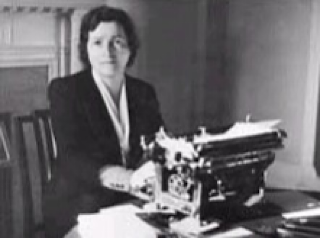
Birth of Kathleen O’Connell, Activist & de Valera’s Personal Secretary

Kathleen O’Connell, an Irish republican activist and Éamon de Valera‘s personal secretary, is born Catherine O’Connell at Caherdaniel, County Kerry, on October 5, 1888.

O’Connell is one of eleven children of farmer John O’Connell and Mary Ann O’Connell (née O’Sullivan). She is educated in County Kerry, and emigrates to Chicago in 1904 where she trains to be a secretary. She leaves a well-paid commercial job in 1912 to become secretary to the American delegation of the Gaelic League in New York City. She works closely with Thomas Ashe and Diarmuid Lynch on fund-raising and handles their secret Irish Republican Brotherhood (IRB) correspondence. She returns to Ireland briefly in 1915 to attend the Gaelic League Oireachtas na Gaeilge and ardfheis, voting in favour of the politicisation of the organisation. During the same visit she brings money and messages to the Irish Volunteers from John Devoy. She attends the New York Irish Race Convention, going on to work for the Friends of Irish Freedom. In this position she organises and collects for the “victory fund” for Irish independence. She is also a typist for Clan na Gael. After the 1916 Easter Rising, she becomes a member of Cumann na mBan in the United States, raising money for the widows and children of those killed or wounded during the Rising. It is through this work that she becomes a close friend of Arthur Griffith and his family.

Éamon de Valera requests that O’Connell join his “consular staff” on October 2, 1919, to support his tour of the United States. She works closely with him during this tour, traveling with him, assisting with speeches and dealing with his private and public correspondence. She is privy to secrets of the independence movement due to handling Harry Boland‘s correspondence as well. In November 1920, she returns to Ireland with de Valera and goes into hiding immediately. From February 1921 she lives at his secret headquarters at Strand Road, living in dangerous conditions until a truce is called in the Irish War of Independence. After this she lives with de Valera at Dr. Farnan’s house at Merrion Square and later in Blackrock. On June 22, 1921, she is arrested with him, and they are both released the next day. She is a member of the delegation that meets David Lloyd George in July 1921, and shares de Valera’s opposition to the Anglo-Irish Treaty. She joins de Valera and her sister Teresa in Suffolk Street in June 1922 when the Irish Civil War breaks out.

When fighting ends in Dublin in July 1922, she travels south, working closely with Dorothy Macardle, Robert Brennan, and Erskine Childers establishing a publicity department and publishing Poblacht na hÉireann. In September 1922, she returns to Dublin, and goes into hiding at 11 Upper Mount Street. She is a loyal follower of de Valera throughout the civil war, and is present at his arrest in Ennis in August 1923. She acts as his messenger and agent during his imprisonment, working with him on an Irish translation of shorthand which they later abandon. During this time she also works for the Sinn Féin TD for Mayo North P. J. Ruttledge.

O’Connell is present at the first meeting of the provisional organising committee of de Valera’s new political party, Fianna Fáil. During this time she continues to travel with de Valera, nationally and internationally. There are rumours regarding the nature of their relationship, leading to de Valera vehemently denying any impropriety in Dáil Éireann in 1928. The letter between O’Connell and de Valera’s wife, Sinéad, are cited as evidence there is no intimate relationship between O’Connell and de Valera. She resigns from her permanent civil service position of personal secretary to the Taoiseach when de Valera is defeated in 1948, returning in 1951 when he regains power. For her involvement in the Irish War of Independence, she is awarded an Irish military pension.

O’Connell is forced to retire in 1954 as she has developed cancer. Her niece, Maire O’Kelly, takes up her position. She dies on April 7, 1956, and is buried in Glasnevin Cemetery. Her funeral is attended by a guard of honour from the national executive of Fianna Fáil and the Old IRA. She receives full military honours and Seán MacEntee delivers the panegyric. During the writing of their biography of de Valera, Frank Pakenham, 7th Earl of Longford, and Thomas P. O’Neill use her papers, which are held in the University College Dublin archives, extensively.

In 2016, a plaque is unveiled to O’Connell at her birthplace in Caherdaniel by Eamon Ó Cuív, de Valera’s grandson.


1 Comment

Death of Joseph McGrath, Politician & Businessman

Joseph McGrath, Irish politician and businessman, dies in Ballsbridge, Dublin, on March 26, 1966. He is a Sinn Féin and later a Cumann na nGaedheal Teachta Dála (TD) for various constituencies: Dublin St James’s (1918–1921), Dublin North-West (1921–1923) and Mayo North (1923–1924), and develops widespread business interests.

McGrath is born in Dublin on August 12, 1888. By 1916 he is working with his brother George at Craig Gardiner & Co., a firm of accountants in Dawson Street, Dublin. He works with Michael Collins, a part-time fellow clerk and the two strike up a friendship. In his spare time he works as secretary for the Volunteer Dependents’ Fund.

McGrath soon joins the Irish Republican Brotherhood. He fights in Marrowbone Lane in the 1916 Easter Rising. He is arrested after the rising, and jailed in Wormwood Scrubs and Brixton prisons in England. In the 1918 Irish general election, he is elected as Sinn Féin TD for the Dublin St. James’s constituency, later sitting in the First Dáil. He is also a member of the Irish Republican Army (IRA), and successfully organises many bank robberies during the Irish War of Independence (1919–1921), where a small percentage of the proceeds is retained as a reward by him and his fellow-soldiers. During this time he is interred briefly at Abercorn Barracks but escapes by dressing in army uniform and walking out of the gate with soldiers going on leave. He is eventually recaptured and spends time in jail in Belfast.

In October 1921 McGrath travels with the Irish Treaty delegation to London as one of Michael Collins’ personal staff. When the Provisional Government of Ireland is set up in January 1922, he is appointed Minister for Labour. In the Irish Civil War of 1922–1923, he takes the pro-Treaty side and is made Director of Intelligence, replacing Liam Tobin. In a strongly worded letter, written in red ink, he warns Collins not to take his last, ill-fated trip to County Cork.

McGrath is later put in charge of the police Intelligence service of the new Irish Free State, the Criminal Investigation Department (CID). It is modelled on the London Metropolitan Police department of the same name, but is accused of the torture and killing of a number of republican (anti-Treaty) prisoners during the civil war. It is disbanded at the war’s end with the official reason given that it is unnecessary for a police force in peacetime. He goes on to serve as Minister for Labour in the Second Dáil and the Provisional Government of Ireland. He also serves in the 1st and 2nd Executive Councils holding the Industry and Commerce portfolio.

In September 1922 McGrath uses strikebreakers to oppose a strike by Trade Unionists in the Post Office service, despite having threatened to resign in the previous March of the same year when the government threatened to use British strikebreakers.

In December 1922 McGrath is a reluctant supporter of the government’s decision to execute four high profile IRA prisoners: Liam Mellows, Dick Barrett, Rory O’Connor, and Joe McKelvey.

McGrath resigns from office in April 1924 because of dissatisfaction with the government’s attitude to the Army Mutiny officers and as he says himself, “government by a clique and by the officialdom of the old regime.” By this he means that former IRA fighters are being overlooked and that the Republican goals on all Ireland has been sidelined. He and eight other TDs, who had resigned from Cumann na nGaedheal, resign their seats in the Dáil and form a new political party, the National Party. However, the new party does not contest the subsequent by-elections for their old seats. Instead, Cumann na nGaedheal wins seven of the seats and Sinn Féin wins the other two.

In 1927, McGrath takes a libel case against the publishers of The Real Ireland by poet Cyril Bretherton, a book that claims he is responsible for the abduction and murder of Noel Lemass, the brother of Seán Lemass, in June 1923 during the civil war, as well as a subsequent coverup. He wins the court case. During the 1930s, he and Seán Lemass reconcile and regularly play poker together.

Following his political career, McGrath goes on to become involved in the building trade. In 1925 he becomes labour adviser to Siemens-Schuckert, German contractors for the Shannon hydroelectric scheme near Limerick. He founds the Irish Hospitals’ Sweepstake in 1930, and the success of its sweepstakes makes him an extremely wealthy man. He has other extensive and successful business interests always investing in Ireland and becomes Ireland’s best-known racehorse owner and breeder, winning The Derby with Arctic Prince in 1951.

McGrath dies at his home, Cabinteely House, in Ballsbridge, Dublin on March 26, 1966. Cabinteely House is donated to the state in 1986 and the land is developed as a public park. His son, Patrick W. McGrath, inherits many of his father’s business interests, and also serves as Fine Gael Senator from 1973 to 1977.

(Pictured: Screenshot of a film of Irish politician Joseph McGrath shot in 1922)


Leave a comment

Tribute to Fianna Fáil Politician Denis Gallagher

Politicians from all parties join hundreds of mourners on Achill Island on November 5, 2001, to pay tribute to former Gaeltacht Minister and Mayo Fianna Fáil Teachta Dála (TD) Denis Gallagher who died the previous day. He serves as Minister for the Gaeltacht on two occasions.

Gallagher is born in Currane, County Mayo, by Clew Bay, facing Achill Island, on November 23, 1922. He is educated locally and at Coláiste Éinde in Salthill, County Galway. He qualifies as a national school teacher having graduated from St. Patrick’s College in Drumcondra, Dublin. He teaches in Drimnagh in Dublin for several years before returning to Mayo in 1946 to take up a teaching post. He stands as a Clann na Poblachta candidate at the 1954 Irish general election for Mayo North but is not elected.

In the 1960s Gallagher changes allegiance and becomes a member of Fianna Fáil. He is elected to Mayo County Council in 1967 and is elected to Dáil Éireann on his third attempt at the 1973 Irish general election for the Mayo West constituency. He does not remain on the backbenches for very long. He joins the Fianna Fáil front bench in 1974 as spokesperson on Fisheries. He remains in that position until 1977 when the party returns to power, and he is appointed Minister for the Gaeltacht. He is an active Minister with an interest in Irish language affairs.

During the 1979 Fianna Fáil leadership election Gallagher supports George Colley. However, Charles Haughey becomes party leader and Taoiseach. Because of this Gallagher is demoted to the position of Minister of State. In October 1982, following the resignations of Martin O’Donoghue and Desmond O’Malley from the Cabinet, after they supported Charlie McCreevy‘s motion of no confidence, he returns as Minister for the Gaeltacht. He remains in that post until December when Fianna Fáil goes into opposition.

Following the 1987 Irish general election, Gallagher is not appointed to cabinet. He is, however, appointed as Minister of State at the Department of the Gaeltacht, while Haughey has appointed himself as Minister for the Gaeltacht. As a result, he retires from politics at the following general election in 1989. After his retirement, he works to advance the Irish language cause and also serves as chairman of the Gaelic Athletic Association in Mayo.

Gallagher dies on November 4, 2001, at the age of 78 in Castlebar, County Mayo. He is buried at Polranny Cemetery, Achill Sound, County Mayo. He is survived by his wife Hannah, twelve children and thirty grandchildren.