
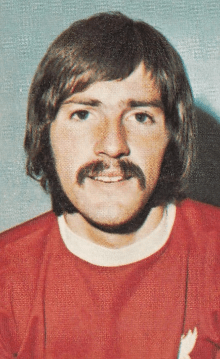
Stephen Derek Heighway, former Irish footballer who plays as a winger, is born in Dublin on November 25, 1947. He is part of the successful Liverpool F.C. team of the 1970s. Following his eleven-years with the club, he is ranked 23rd in the 100 Players Who Shook the Kop poll.
Heighway’s early education takes place in Sheffield, South Yorkshire, where he attends Ecclesall Junior School until 1959, followed by High Storrs School and latterly Moseley Hall Grammar School for Boys in Cheadle, near Stockport.
Heighway’s early promise as a winger is not spotted by professionals. Instead, he concentrates on his studies in economics and politics at the University of Warwick in Coventry achieving a 2:1.
In 1970, Heighway is studying for his final exams and playing for Skelmersdale United F.C. when he is spotted by Liverpool’s scouting system. With manager Bill Shankly keen to rebuild his ageing, underachieving team of the 1960s, Heighway is signed up swiftly in May of that year. It is due to his academic achievements that he gets his nickname “Big Bamber,” while teammate and fellow university graduate Brian Hall is dubbed “Little Bamber” – both after the television programme University Challenge host Bamber Gascoigne.
A strong and fast left winger with two good feet, Heighway settles into topflight football after making his debut on September 22, 1970, in a League Cup 2nd round replay at Anfield against Mansfield Town F.C. (3-2). He opens his goalscoring account in the 51st minute of a 2–0 home league win over Burnley F.C. on October 1, 1970.
A month later, Heighway scores against Merseyside rivals Everton F.C. in a hard-fought 3–2 win, after his team had found themselves down 2–0 early in the second half. He stays in the side for the rest of the season as Liverpool’s new charges finish the league campaign strongly and also defeat Everton in the semi-finals of the FA Cup to reach the final at Wembley Stadium.
Their opponents are Arsenal F.C., who are after a coveted “double” having won the Football League First Division championship. Heighway plays confidently in a match that is goalless after 90 minutes and therefore needs a period of extra-time. Just two minutes into the added half-hour, he receives the ball wide on his left flank from substitute Peter Thompson and starts a run toward the Arsenal penalty area, with Gunners full back Pat Rice tracking his run but unwilling to put in a tackle. With a swift turn outside, he gains a yard on Rice and hits a low drive into the net past Arsenal goalkeeper Bob Wilson, who had committed the cardinal goalkeeping sin of coming out too far from his near post to anticipate a cross, thereby leaving a gap that Heighway exploits. Sadly, for Heighway and Liverpool, their opponents scored two goals in response.
Heighway settles into the Liverpool team for the next decade, winning the first of four League titles in 1973, along with the UEFA Cup. He returns to Wembley for another FA Cup final a year later as Liverpool faces Newcastle United F.C. He scores again with 16 minutes remaining in the match to make the score 2–0, latching on to a flick from John Toshack after a long clearance from goalkeeper Ray Clemence to slot a right-footed shot into the far corner. The game ends 3–0.
By now, Heighway is a regular for the Republic of Ireland national football team, making his debut on September 23, 1970, against the Poland national football team. He remains so for the whole of the 1970s, winning a total of 34 caps but never managing to score. He does have a goal disallowed in a qualifier for the 1978 FIFA World Cup against the Bulgaria national football team in Sofia. On the domestic front, he attains another League and UEFA Cup double with Liverpool in 1976 and then forms part of the side which comes so close to the “treble” of League, FA Cup and European Cup.
Liverpool wins the League by a single point and again defeats rivals Everton in the semi-final to reach the FA Cup final, this time to face bitter rival Manchester United F.C. at Wembley. Liverpool loses 2–1 and the “treble” dream is dead.
Heighway scores his first goal of the 1977 European Cup in a 5–0 first round second leg win over Crusaders F.C. He then scores in a 3–0 second round win against Trabzonspor and in the 3–1 semi-final first leg win over FC Zürich. Liverpool beats Borussia Mönchengladbach 3–1 to win their first European Cup, with Heighway setting up both outfield goals for Terry McDermott, a defence-splitting pass, and Tommy Smith, a corner.
In 1978, Heighway is on the bench as Liverpool retains the European Cup with a 1–0 victory over Club Brugge KV at Wembley, coming on as a substitute for Jimmy Case. The following year he is again in the side frequently as Liverpool wins another League title, but from 1980 onward his opportunities in the side diminish.
Heighway stays for two more seasons, appearing only occasionally in the team and missing out on two more League title medals, another European Cup triumph and a first EFL Cup medal, which is successfully defended a year later. He leaves Anfield in 1982 after 444 matches and 76 goals.
Heighway then prolongs his career with a move to the United States, joining the Minnesota Kicks for the 1981 season. He plays 26 games, scoring four goals. He then joins the coaching staff of Umbro, which leads to a position with the Clearwater Chargers where he pioneers the role of director of coaching in the United States. In 1989 he is asked to rejoin Liverpool to run their youth academy, bringing promising youngsters up through the system until they were ready for the professional game. Among his successes are Steve McManaman, Robbie Fowler, Steven Gerrard, Jamie Carragher, Dominic Matteo, David Thompson and Michael Owen.
On September 4, 2006, a poll on Liverpool’s official web site names Heighway 23rd out of 100 Players Who Shook the Kop.
Heighway announces his retirement from Liverpool on April 26, 2007, immediately after the side he manages won the FA Youth Cup for the second year running. He comments, “I don’t know what the future holds just yet, we’ll have to wait and see.”
Heighway returns to working at Liverpool’s Academy part-time in 2015, at the request of Academy Director Alex Inglethorpe, before taking up a full-time consultancy role later that year. After seven years in this position, he retires for a second time in December 2022.
Heighway also features in the popular Liverpool chant, The Fields of Anfield Road, which is frequently sung by Liverpool fans during matches.


 seamus dubhghaill