seamus dubhghaill

Promoting Irish Culture and History from Little Rock, Arkansas, USA


Leave a comment

Marriage of John Bligh, 3rd Earl of Darnley

john-bligh-3rd-earl-of-darnley

John Bligh, 3rd Earl of Darnley and former Member of Parliament (MP) for Athboy, who suffers from the delusion that he is a teapot, marries suddenly and unexpectedly on September 11, 1766 at nearly 50 years of age. Suffering from the delusion that he is a teapot, from the date of his marriage until his death in 1781 he fathers at least seven children “in spite of his initial alarm that his spout would come off in the night.”

Bligh is born on October 1, 1719 near Gravesend, Kent, the son of John Bligh, 1st Earl of Darnley and Lady Theodosia Hyde, later Baroness Clifton (in her own right). At the age of eight he is sent to Westminster School. He matriculates at Merton College on May 13, 1735 and is created MA on July 13, 1738.

Outwardly, Bligh appears “solid” and “capable,” a man “terribly conscious of his own dignity.” His eccentricities do not stop him becoming MP for Athboy, which he represents from 1739 until 1748, and for Maidstone, Kent, which he serves from 1741 to 1747.

After failing to be elected MP for Tregony, Cornwall, in 1754, Bligh never stands again for parliament, either in England or Ireland. The seat that he gains in the House of Lords, in 1765, gives him the opportunity to return to Ireland more frequently.

In Dublin, on September 11, 1766, the “ageing nobleman” of almost 48-years-old, suddenly marries eighteen-year-old Mary Stoyte, a wealthy heiress and only child of John Stoyte, a leading barrister from Streete, County Westmeath. The unexpected marriage, between a sworn bachelor and a young woman, shocks Dublin society.

The new Countess of Darnley has to cope with the odd private behaviour of her touchy husband. According to a manuscript in the possession of the Tighe family, on the night of his marriage, Bligh “imagined himself to be a fine China tea pot, and was under great fears, lest the spout should be broken off before morning!”

In spite of his nocturnal fears, the earl manages to father at least seven children: John (1767), Mary (1768), Edward (1769), Theodosia (1771), Sarah (1772), Catherine (1774), and William (1775).

Each summer, Bligh takes his family to Weymouth, where the seawater is believed to strengthen weak constitutions and help brace nerves.

Despite every precaution, in 1781 Bligh catches malaria. Attempts to treat him with quinine and peppermint-water purges fail, and on July 31, 1781, he dies at the age of 61, his spout supposedly still intact. Mary lives on until 1803.

Leave a comment

Death of Sir Richard Steele, Writer, Playwright & Politician

richard-steele

Sir Richard Steele, writer, playwright, and politician, remembered as co-founder, with his friend Joseph Addison, of the magazine Tatler, dies in Carmarthen, Wales on September 1, 1729.

Steele is born in Dublin on March 12, 1672, to Richard Steele, an attorney, and Elinor Symes (née Sheyles). He is largely raised by his uncle and aunt, Henry Gascoigne and Lady Katherine Mildmay. A member of the Protestant gentry, he is educated at Charterhouse School, where he first meets Addison. After starting at Christ Church, Oxford, he goes on to Merton College, Oxford, then joins the Life Guards of the Household Cavalry in order to support King William‘s wars against France. He is commissioned in 1697 and rises to the rank of captain within two years. He leaves the army in 1705, perhaps due to the death of the 34th Foot’s commanding officer, Robert Lucas, 3rd Baron Lucas, which limits his opportunities of promotion.

Steele is a member of the Kit-Kat Club. Both Steele and Addison become closely associated with Child’s Coffee-house in St. Paul’s Churchyard.

Steele’s first published work, The Christian Hero (1701), attempts to point out the differences between perceived and actual masculinity. Written while he is serving in the army, it expresses his idea of a pamphlet of moral instruction.

Steele writes a comedy that same year titled The Funeral. This play meets with wide success and is performed at Theatre Royal, Drury Lane, bringing him to the attention of the King and the Whig party. Next, he writes The Lying Lover, one of the first sentimental comedies, but a failure on stage. In 1705, he writes The Tender Husband with contributions from Addison, and later that year writes the prologue to The Mistake, by John Vanbrugh, also an important member of the Whig Kit-Kat Club with Addison and Steele.

In 1706 Steele is appointed to a position in the household of Prince George of Denmark, consort of Anne, Queen of Great Britain. He also gains the favour of Robert Harley, 1st Earl of Oxford and Earl Mortimer.

The Tatler, Steele’s first journal, first appears on April 12, 1709, and appears three times a week. He writes this periodical under the pseudonym Isaac Bickerstaff and gives Bickerstaff an entire, fully developed personality. The Tatler is closed down to avoid the complications of running a Whig publication that had come under Tory attack.

Steele becomes a Whig Member of Parliament in 1713, for Stockbridge. He is soon expelled for issuing a pamphlet in favor of the Hanoverian succession. When George I of Great Britain comes to the throne in the following year, Steele is knighted and given responsibility for the Theatre Royal, Drury Lane in London. He returns to parliament in 1715, for Boroughbridge.

While at Drury Lane, Steele writes and directs the sentimental comedy The Conscious Lovers, which is an immediate hit. However, he falls out with Addison and with the administration over the Peerage Bill (1719), and in 1724 he retires to his second wife’s homeland of Wales. He remains in Carmarthen after his wife’s death, dying there on September 1, 1729. He is buried there at St. Peter’s Church. During restoration of the church in 2000, his skull is discovered in a lead casket, having previously been accidentally disinterred during the 1870s.

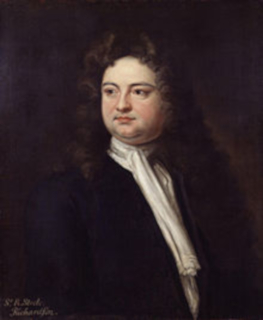
(Pictured: Portrait of Sir Richard Steele by Jonathan Richardson)


Leave a comment

Birth of Sir Richard Steele, Writer & Politician

sir-richard-steele

Sir Richard Steele, Irish writer and politician, remembered as co-founder, with his friend Joseph Addison, of the magazine Tatler, is born in Dublin on March 12, 1672.

Steele is born to Richard Steele, an attorney, and Elinor Symes (née Sheyles). He is largely raised by his uncle and aunt, Henry Gascoigne and Lady Katherine Mildmay. A member of the Protestant gentry, he is educated at Charterhouse School, where he first meets Addison. After starting at Christ Church, Oxford, he goes on to Merton College, Oxford, then joins the Life Guards of the Household Cavalry in order to support King William’s wars against France. He is commissioned in 1697 and rises to the rank of captain within two years. Steele leaves the army in 1705, perhaps due to the death of the 34th Foot’s commanding officer, Robert Lucas, which limits his opportunities of promotion.

Steele’s first published work, The Christian Hero (1701), attempts to point out the differences between perceived and actual masculinity. Written while he serves in the army, it expresses his idea of a pamphlet of moral instruction. The Christian Hero is ultimately ridiculed for what some thought was hypocrisy because Steele did not necessarily follow his own preaching.

Steele writes a comedy that same year entitled The Funeral. This play meets with wide success and is performed at the Theatre Royal, Drury Lane, London, bringing him to the attention of the King and the Whig party. Next, Steele writes The Lying Lover, one of the first sentimental comedies, but a failure on stage. In 1705, he writes The Tender Husband, and later that year writes the prologue to The Mistake, by John Vanbrugh.

In 1706 Steele is appointed to a position in the household of Prince George of Denmark, consort of Anne, Queen of Great Britain. He also gains the favour of Robert Harley, Earl of Oxford.

The Tatler, Steele’s first journal, is first published on April 12, 1709, and appears three times a week. Steele writes this periodical under the pseudonym Isaac Bickerstaff and gives Bickerstaff an entire, fully developed personality. Steele describes his motive in writing Tatler as “to expose the false arts of life, to pull off the disguises of cunning, vanity, and affectation, and to recommend a general simplicity in our dress, our discourse, and our behavior.”

The Tatler is closed down to avoid the complications of running a Whig publication that has come under Tory attack. Addison and Steele then found The Spectator in 1711 and also The Guardian in 1713.

Steele becomes a Whig Member of Parliament in 1713, for Stockbridge. He is soon expelled for issuing a pamphlet in favour of the Hanoverian succession. When George I of Great Britain comes to the throne in the following year, Steele is knighted and given responsibility for the Theatre Royal, Drury Lane, London. He returns to parliament in 1715, for Boroughbridge.

While at Drury Lane, Steele writes and directs the sentimental comedy The Conscious Lovers, which is an immediate hit. However, he falls out with Addison and with the administration over the Peerage Bill (1719), and in 1724 he retires to his wife’s homeland of Wales, where he spends the remainder of his life.

Steele remains in Carmarthen after his wife Mary’s death, and is buried there, at St. Peter’s Church. During restoration of the church in 2000, his skull is discovered in a lead casket, having previously been accidentally disinterred during the 1870s.