seamus dubhghaill

Promoting Irish Culture and History from Little Rock, Arkansas, USA


Leave a comment

The Coolavokig Ambush

The Coolavokig ambush (Irish: Luíochán Chúil an Bhuacaigh) is carried out by the Irish Republican Army (IRA) on February 25, 1921, during the Irish War of Independence. It takes place at Coolavokig, on the road between Macroom and Ballyvourney, County Cork. A 60-man flying column of the IRA’s 1st Cork Brigade under Seán O’Hegarty, ambushes a 70-man convoy of the Auxiliary Division under Major Seafield Grant, sparking a four-hour battle. Ten Auxiliaries are killed, including Major Grant, and others wounded. The IRA column leaves the area when British reinforcements arrive. After the ambush, British forces stop carrying out raids and patrols in the area.

The IRA flying column had been attempting to ambush the Auxiliaries for two weeks but had always missed them. As they occupy the ambush position over a few days, their position becomes known and a force of seventy Auxiliaries and seven Royal Irish Constabulary (RIC) constables move against them, heavily armed with rifles, machine guns and grenades. The sixty-two IRA volunteers include units from the 1st, 7th, and 8th battalions of the 1st Cork Brigade, and are divided into four sections. Apart from commander Seán O’Hegarty, the main IRA officers are Dan “Sandow” O’Donovan and Dan Corkery. The IRA is armed with sixty rifles, several shotguns and revolvers, and two Lewis guns, but significantly, no grenades. The British forces, traveling in eight lorries and two cars, also carry four Irish hostages with them.

Around 8:00 a.m. on February 25, IRA scouts signal the approach of the British force. The British are forewarned about the IRA position however, and approach with caution, when a republican leaving his post turns to run back and is seen from the leading lorry. When half of the lorries come into the ambush position the IRA opens fire. According to An Cosantóir, one lorry immediately turns around and speeds back to Macroom.

Rifles and a Lewis machine gun from the IRA’s No. 1 section, and ten rifles from the No. 4 section, open fire, as they are the only republican units that have a field of fire on the lorries. They then drop to the ground to avoid return fire. Sections No. 2 and No. 3 swing around to the east, on a hillside, in an attempt to encircle the British northern flank, but they can get no closer than 500 yards.

The Auxiliaries are quickly losing ground and taking casualties. Major Grant is killed while rallying his forces. The British forces retreat into two nearby cottages. The IRA closes in and as they are preparing to bomb the cottages, large numbers of RIC reinforcements approach and begin encircling the area. After fighting a half-hour rear guard action, the IRA flying column retreats toward the northwest. The engagement at Coolavokig lasts four hours, until soldiers of the Manchester Regiment arrive.

It later transpires that the Auxiliary forces are just part of a large round-up operation planned for that day which includes 600 British Army troops from Cork, Ballincollig, Bandon, Clonakilty, Skibbereen, Bantry, Dunmanway, Millstreet, Macroom, and Killarney. After the ambush, British forces cease raiding and patrolling the area west of Macroom, effectively handing it over to IRA control. They are reluctant to enter the area and only do so later with a strong force of 2,000 men.

The IRA suffers no casualties. However, the number of British casualties has been disputed to this day. The British claim that only Major (Auxiliary Commandant) James Seafield-Grant was killed during the ambush, and that two other Auxiliaries later died of their wounds. The IRA claims that between 14 and 16 members of the British force were killed. The Digest of Service for the 1st Battalion, Manchester Regiment, records that on March 18, 1921, a party proceeds to Coolavokig to destroy houses believed to have been used by the IRA.

Leave a comment

The Upton Train Ambush

The Upton train ambush takes place on February 15, 1921, during the Irish War of Independence. The Irish Republican Army (IRA) mounts an attack on a train carrying British soldiers at Upton, County Cork. The action is a disaster for the IRA with three of its volunteers killed and two wounded. Six British soldiers are wounded, three seriously. Six civilian passengers are killed and ten wounded in the crossfire.

According to a study of the region, Cork is “by far the most violent county in Ireland” during the War of Independence and has several active guerrilla brigades. Of these, the 3rd Cork Brigade is one of the most effective and it is a unit from this Brigade that carries out the Upton ambush.

Up until the end of 1920, the British had been unable to move troops by train, due to a nationwide boycott by railway workers of trains carrying the British military. However, the strike is lifted in December 1920. While this helps the British military’s mobility, it also gives the IRA a new target: trains carrying soldiers. A week before the Upton ambush, the local IRA had made a successful attack on a train travelling from Killarney to Millstreet near Drishanbeg, killing one sergeant and wounding five more soldiers.

Five days after the Drishanbeg ambush, plans are made for an attack at Upton and Innishannon railway station on a train traveling between Cork city and Bandon. The ambushers, led by Charlie Hurley, are thirteen strong. Seven are armed with rifles and the remainder with revolvers or semi-automatic pistols. They take up position at the station ten minutes before the train pulls in, imprisoning the station master, clearing the station and taking cover behind sacks of grain and flour taken from a store.

The train is carrying approximately 50 British soldiers of the Essex Regiment, who are mingled with civilian passengers throughout the train’s carriages. The IRA party is therefore quite heavily outnumbered and out-gunned, but are unaware of this, as two IRA scouts, who were supposed to have been on the train and signaled to them the British numbers, never turn up. They also wrongly believe that the British troops are all in the central carriage. As a result, when the IRA opens fire on the train, there are heavy civilian casualties, including two commercial travelers killed by the first volley. The New York Times reports that “a shower of bullets was rained on the train, practically every compartment being swept.”

The firefight lasts only ten minutes, but in that time six civilian passengers are killed and ten wounded. Six British soldiers are injured, three of them seriously. Two IRA volunteers are killed outright and another is fatally wounded. Two more are badly wounded but survive. Charlie Hurley, who had led the ambush, is struck in the face by a bullet. IRA leader Tom Barry later writes, “Through some miracle, the nine unwounded and two wounded got away across country, in small parties, with the British following close behind.” Three civilian passengers, one unwounded and two wounded, are detained by the British on suspicion of belonging to the ambush party.

The Upton ambush is part of what Tom Barry describes as “twelve dark days” for the 3rd Cork Brigade of the IRA. Between February 4 and February 16, eleven members of the Brigade are killed. One is shot dead by British troops when they raid a safehouse on February 4, another dies in an accidental shooting on February 7, two more (brothers James and Timothy Coffey) are assassinated in their beds on February 14 by Black and Tans or Auxiliaries, three die at Upton on February 15 and four are killed on February 16 when they are arrested by the Essex Regiment in Kilbrittain while digging a trench and shot dead. Of the eleven dead, only those at Upton are killed in combat.

The Upton attack also highlights the dangers, and particularly the risk to civilians, of attacking trains carrying troops. Only a month later at the Headford Ambush in neighbouring County Kerry, an IRA column successfully attacks a train-load of troops, but again, there are civilian casualties alongside the IRA and British Army losses. One of the three men captured by the British at Upton is reported to give information leading to the 3rd Cork Brigade’s main column of over 100 fighters almost being encircled at the Crossbarry Ambush. Hurley is killed in this action.

The Upton ambush is later made famous in a popular 1960s Irish ballad titled “The Lonely Woods of Upton.”

(Pictured: A portion of the cover of an Italian magazine from 1921 that reported on the Upton ambush)


1 Comment

Capture of Mallow Barracks

The Cork No. 2 Brigade, Irish Republican Army (IRA), attacks and captures a military barracks in Mallow, County Cork, on September 28, 1920, the only military barracks to be captured during the Irish War of Independence. British forces later burn and sack the town.

Mallow had been a garrison town for several hundred years. Eight miles to the north lay Buttevant where one of the largest military barracks in the country is located. Not far from Buttevant are the great military training camps of Ballyvonaire, while nineteen miles to the northeast is Fermoy with its large permanent military garrisons and huge barracks adjacent to the big training centres of Kilworth and Moorepark. Twenty miles to the southeast is the city of Cork with its many thousands of troops both in the posts within the city and at Ballincollig, about six miles west of it, on the Macroom road. Thirteen miles westward a detachment from a British machine gun corps holds Kanturk. Every town and village has its post of Royal Irish Constabulary (RIC) men armed to the teeth.

The idea of capturing the barracks comes from two members of the Mallow IRA Battalion, Dick Willis, a painter, and Jack Bolster, a carpenter, who are employed on the civilian maintenance staff of the barracks which is occupied by the 17th Lancers. Willis and Bolster are able to observe the daily routine of the garrison and form the opinion that the capture of the place would not be difficult. They are instructed by their local battalion officers to make a sketch map of the barracks. After that is prepared, Liam Lynch and Ernie O’Malley go with Willis and Tadhg Byrnes to Mallow to study the layout of the surrounding district. Among the details of the garrison’s routine that Willis and Bolster report to the Column leaders, is the information that each morning the officer in charge, accompanied by two-thirds of the men, take the horses for exercise outside the town. It is obvious to the two Mallow volunteers that this is the ideal time for the attack.

Situated at the end of a short, narrow street and on the western verge of the Town Park, Mallow barracks stand on an unusually low-lying location and is relatively small in size. Surrounded by a high stone wall, the barracks can be approached from the town park as well as from the main street. The various details are carefully studied by Lynch and O’Malley. While Willis and Bolster are allotted tasks within the walls of the barracks, Byrnes and Jack Cunningham are chosen to attack with the main body of the column which includes Commandant Denny Murphy of Kanturk.

On the morning of September 27, at their Burnfort headquarters, the men are ordered to prepare for action. Under cover of darkness they move into the town and enter the Town Hall by way of the park at the rear. The eighteen men of the column are strengthened by members of the Mallow battalion, a number of men posted in the upper storey of the Town Hall, from which they can command the approaches to the nearby RIC barracks. Initially it is planned that Willis and Bolster will enter the military barracks that morning in the normal manner, accompanied by an officer of the column who will pose as a contractor’s overseer. The officer is Paddy McCarthy of Newmarket, who would die a few months later in a gun battle with the Black and Tans at Millstreet.

McCarthy, Willis and Bolster enter the barracks without mishap. Members of the garrison follow their normal routine, with the main body of troops under the officer in charge leaving the barracks with the horses. In the barracks remain about fifteen men under the command of a senior N.C.O., Sergeant Gibbs.

Once the military has passed, the attackers, numbering about twenty men and led by Liam Lynch, advance toward the bottom of Barrack Street. All are armed with revolvers which are considered the most convenient and suitable weapons for the operation. Lynch has issued strict instructions that there is to be no shooting by the attackers, unless as a last resort. Inside the walls are McCarthy, Willis and Bolster, their revolvers concealed. Then Ernie O’Malley presents himself at the wicket gate with a bogus letter in his hand. Behind him and out of sight of the sentry are the other members of the main attacking party, led by Lynch, O’Brien and George Power. When the gate is opened sufficiently, O’Malley wedges his foot between it and the frame and the soldier is overpowered and the attackers rush in. McCarthy, Bolster and Willis immediately go to the guardroom where they hold up the guard. Realising what is happening, Sergeant Gibbs, rushes toward the guardroom in which rifles are kept. Although called upon to halt, he continues even though a warning shot is fired over his head. As he reaches the guardroom door, the IRA officer and one of the volunteers in the guardroom fire simultaneously. Mortally wounded, the sergeant falls at the guardroom door.

By this time the majority of the attacking party is inside the gate. Military personnel in different parts of the barracks are rounded up and arms are collected. Three waiting motor cars pull up to the gate and all the rifles, other arms and equipment found in the barracks are loaded into them. The prisoners are locked into one of the stables, with the exception of a man left to care for Sergeant Gibbs. The whole operation goes according to plan, except for the shooting of the sergeant. Twenty minutes after the sentry had been overpowered the pre-arranged signal of a whistle blast is sounded and the attackers withdraw safely to their headquarters at Burnfort, along the mountain road out of Mallow.

Expecting reprisals, the column moves to Lombardstown that night, and positions are taken up around the local co-operative creamery as it is the custom of the British to wreak their vengeance on isolated country creameries after incidents such as what had just occurred. The Mallow raid, however, has greater repercussions than the destruction of a creamery and co-operative stores. The following night, large detachments of troops from Buttevant and Fermoy enter Mallow. They rampage through the town, burning and looting at will. High over the town, the night sky is red with the flames of numerous burning buildings.

Townspeople run through the blazing streets, in search of refuge. A number of women and children are accorded asylum in the nearby convent schools. Another group of terrified women, some with children in arms, take refuge in the cemetery at the rear of St. Mary’s Church, where they kneel or lay above the graves. It is a night of terror such as which had never before been endured by the people of Mallow.

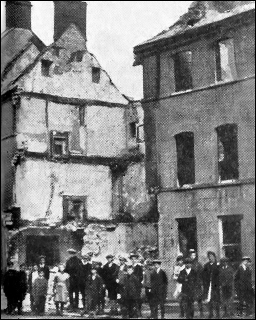
The extent of the wanton destruction outrages fair-minded people all over the world. Details of the havoc that had been wrought and pictures of the scenes of destruction are published worldwide.

(Pictured: Townspeople gather in front of one of the many buildings in Mallow which were reduced to ruins during British Army reprisals)


1 Comment

The Rathcoole Ambush

rathcoole-ambush-monument

The Rathcoole Ambush, one of the largest ambushes of the Irish War of Independence, takes place at Rathcoole, County Cork on June 16, 1921.

The railway line between Banteer and Millstreet had been cut in several places so the British Auxiliary forces based at Millstreet have to travel to Banteer by road for their supplies twice a week. As a result, a combined force of 130 Irish Republican Army (IRA) volunteers from the Millstreet, Kanturk, Newmarket, Charleville and Mallow battalion columns are mobilised to attack the Auxiliaries as they return from Banteer. The volunteers are under the command of Paddy O’Brien from Liscarroll.

On the night before the ambush the IRA volunteers sleep at Rathcoole Wood, which overlooks the planned ambush position. Shortly after sunrise the following morning, Captain Dan Vaughan lays six land mines on the untarred road and covers them with dust. After a wait of several hours a convoy of four armour-plated lorries, each mounted with a machine gun and carrying ten men, is observed heading for Banteer.

The volunteers prepare themselves and at 6:20 in the evening, as the lorries pass through the ambush area on their return journey, three of the land mines explode with devastating results. One mine detonates as the last of the four lorries drives over it and another explodes under the leading lorry in the convoy. Both vehicles are out of action with the two other lorries trapped between them. A third mine explodes amid a party of Auxiliaries as they attempted to outflank the position. A bitter firefight develops. Each time Auxiliaries attempt to outflank the IRA they are driven back, suffering losses of more than twenty dead and over a dozen wounded.

When it becomes clear that the IRA cannot achieve a complete victory because of their limited ammunition supply, the order for withdrawal is given and the whole force retires without a single casualty. Although no arms are captured during the action, a reconnaissance party from the column returns the next day to search the ambush position and recovers 1,350 rounds of ammunition which the Auxiliaries had left behind them as they removed their dead and wounded.

The ambush at Rathcoole is one of the Irish Republican Army’s most successful actions during the War of Independence. A week after the ambush, British Forces from Kanturk, Buttevant, Ballyvonaire, Macroom, Ballincollig, Killarney and Tralee carry out a widespread search throughout the Rathcoole area. Michael Dineen, a Volunteer in Kilcorney Company is taken from his brother’s house at Ivale by a party of Auxiliaries and shot dead. On the evening of July 1, the Auxiliaries set fire to and destroy the wood at Rathcoole from where the ambush had been launched. That same day that they shoot and kill a local man, Bernard Moynihan, as he is out cutting hay.

(Pictured: Monument at the site of the Rathcoole Ambush)


Leave a comment

The Death of Art Ó Laoghaire

art-o-laoghaire

Art Ó Laoghaire, an Irish Roman Catholic and captain in the Hungarian Hussars Regiment of the army of Maria Theresa of Austria, is killed by soldiers near Millstreet, County Cork on May 4, 1773.

Ó Laoghaire marries Eibhlín Dubh Ní Chonaill, aunt of Daniel O’Connell, in 1767. She has been a widow from the age of 15 and is now 23. They have three children, Cornelius, Fiach and a third who apparently does not survive infancy.

Having returned home to Rathleigh House near Macroom, Cork, the hot-tempered Ó Laoghaire becomes involved in a feud with a protestant landowner and magistrate, Abraham Morris of Hanover Hall, Macroom. When Morris is High Sheriff of County Cork in 1771, he lays charges against Ó Laoghaire following his alleged attack on Morris and the wounding of his servant on July 13, 1771, at Hanover Hall. In October of that year, Ó Laoghaire is indicted in his absence, and Morris offers a 20-guinea reward for his capture.

The feud between the two men continues and in 1773, Morris demands that Ó Laoghaire sell him the fine horse that Ó Laoghaire had brought back from his service in the Austro-Hungarian army for £5. The Penal Laws state that no Catholic might own a horse worth more than £5 and could be forced to sell a more valuable one on demand to any Protestant at this price. Ó Laoghaire refuses to sell and challenges Morris to a duel, which Morris declines. Morris uses, or misuses, his position as magistrate to persuade his fellow magistrates to proclaim Ó Laoghaire an outlaw, who can then legally be shot on sight. Morris leads a contingent of soldiers that track Ó Laoghaire down to Carrignanimma on May 4, 1773. He gives the order to fire on Ó Laoghaire. The first shot, which kills him, is fired by a soldier called Green.

Morris and the soldiers are held to be guilty of Ó Laoghaire’s murder by a coroner’s inquest on May 17, but Morris is acquitted of the murder by Cork magistrates on September 6, 1773. Morris is shot in Cork on July 7 by Ó Laoghaire’s brother Cornelius, who sees Morris at a window of a house in Hammond’s Lane where he is lodging. He fires three shots, wounding Morris. The shots are not immediately fatal, but Morris dies in September 1775, presumably as the result of the shooting. The soldier Green is decorated for his “gallantry.”

Ó Laoghaire’s wife Eibhlín Dubh Ní Chonaill composes the long poem “Caoineadh Airt Uí Laoghaire” (Lament for Art O’Leary), mourning his death and calling for revenge.

Ó Laoghaire’s tomb at Kilcrea Friary has the epitaph likely composed by his widow:

Lo Arthur Leary, generous, handsome, brave,
Slain in his bloom lies in this humble grave.