seamus dubhghaill

Promoting Irish Culture and History from Little Rock, Arkansas, USA


Leave a comment

Birth of Barry Yelverton, 1st Viscount Avonmore

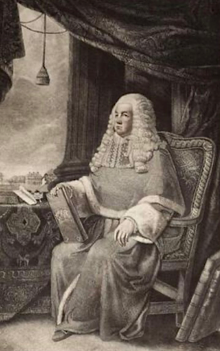
Barry Yelverton, 1st Viscount AvonmorePC (Ire) KC, Irish judge and politician, is born in Newmarket, County Cork, on May 28, 1736. He gives his name to Yelverton’s Act 1782, which effectively repeals Poynings’ Law and thus restores the independence of the Parliament of Ireland. This achievement is destroyed by the Acts of Union 1800, which he supports. By doing so, he gravely harms his reputation for integrity, which had already been damaged by his leading role in the conviction and execution for treason of the United Irishman William Orr, which is now seen as a major miscarriage of justice.

Yelverton is the eldest son of Francis Yelverton of KanturkCounty Cork, and Elizabeth Barry, daughter of Jonas Barry of Kilbrin (now Ballyclogh, County Cork). His father dies when he is only ten. His mother reaches a great age, dying only a year before her son. He goes to school in Charleville and Midleton College, and attends Trinity College Dublin, where he takes a degree of Bachelor of Arts in 1757 and of Bachelor of Laws in 1761. His family lacks wealth and social position and he is for some years an assistant master under Andrew Buck in the Hibernian Academy. This menial occupation is later a source of great embarrassment to him, as his enemies love to ridicule him as “Buck’s usher.”

In 1761, Yelverton marries Mary Nugent, daughter of William Nugent of Clonlost, County Westmeath, and his wife Ursula Aglionby, a lady of some fortune, and is thus enabled to read for the Irish Bar, entering the Middle Temple. He is called to the Bar in 1764. Despite his lack of family connections, his success in his profession is rapid, due to his legal ability, charm and remarkable eloquence, and he takes silk eight years afterward.

Yelverton is elected to the Irish House of Commons as member for Donegal Borough from 1774 to 1776. In the latter year, he is elected for both Belfast and Carrickfergus. He chooses to sit for the latter constituency and represents Carrickfergus until 1784. Although few examples of his oratory survive, all contemporaries agree on his eloquence, which gives him a dominant position in the Commons. He also serves as Recorder of Carrickfergus from 1778 until his death. This is not a Crown appointment as the Recorder is elected by a vote of the entire town corporation.

Yelverton gives his support to Henry Grattan and the Whigs during the greater part of his parliamentary career. He is a strong supporter of the demand for an independent Irish Parliament, but later changes his stance.

Yelverton plays a crucial role in the reforms which are collectively called the Irish Constitution of 1782. In particular he sponsors the Act 21 and 22 of George III, An Act to regulate the manner of passing bills and to prevent delays in summoning of Parliaments – which is popularly known as “Yelverton’s Act.” This radically modifies Poynings’ Law of 1495 by which all legislation to be passed by the Irish Parliament has to be drafted by the Privy Council of Ireland, then sent to the English privy council for approval. Under Yelverton’s Act, the role of the Irish Privy Council is abolished and legislation is commenced in the normal way in the Irish Parliament, which for the last 17 years of its existence enjoys a wide measure of independence.

In his latter days, Yelverton becomes identified with the court party and votes for the Act of Union 1800, for which his viscounty is a reward. For this he is never forgiven by many of his former friends. Sir Jonah Barrington, who continues to regard Yelverton with affection and respect, regrets that this action should have destroyed his reputation forever, but he argues that such a mistake of judgment is understandable in a man who lacks worldly wisdom, and despite his many good qualities, does not have a strong moral sense.

Yelverton becomes Attorney-General for Ireland in 1782, and is elevated to the bench as Lord Chief Baron of the Irish Exchequer in 1783. He is created Baron Yelverton in 1795, and in 1800 Viscount Avonmore in the Peerage of Ireland. As Chief Baron, he leads the opposition to the proposal to increase the number of judges in each of the courts of common law from three to four, on the practical ground that four-judge courts often divide evenly and thus cannot reach an effective decision. Despite this common-sense view, the new judges are eventually appointed.

Yelverton becomes a member of the Royal Irish Academy in 1787.

In 1797, Yelverton attains a degree of infamy for presiding over what is widely regarded as a “show trial” which leads to the execution of the United Irishman, William Orr, although he is said to have shed tears when passing the death sentence on Orr. Orr is charged with administering the United Irish oath to a soldier called Hugh Wheatly. This had recently become a capital offence. In fact, it is generally believed that another man, William McKeever, administered the oath. Wheatly, who is the principal witness for the prosecution, later confesses that he had perjured himself, but despite a superb defence by John Philpot Curran, Orr is found guilty and hanged. Yelverton may have formed an early impression of Orr’s guilt and acted on it – even his admirers admitted that as a judge he lacks impartiality.

Peter Finnerty, a journalist, is later convicted of seditious libel for publishing an attack on Yelverton over his conduct of Orr’s trial and this does nothing to enhance the judge’s reputation.

Yelverton dies on August 19, 1805, at his mansion, Fortfield House, TerenureCounty Dublin, which he had built at great expense around 1785. He is buried nearby in Rathfarnham.
Leave a comment

Birth of Patrick Guiney, Irish Nationalist Politician

Patrick Guiney, Irish Nationalist politician, agrarian agitator and Member of Parliament (MP) in the House of Commons of the United Kingdom of Great Britain and Ireland, is born in NewmarketCounty Cork, on March 16, 1867.

Guiney is the eldest son of Timothy Guiney, a shopkeeper and later clerk of Kanturk poor law union, and Ellen Carver. He is educated at St. Patrick’s Monastery, MountrathCounty Laois. He serves three terms of imprisonment for activity in the Land War and later Plan of Campaign movement during the 1880s under the Coercion Act. He becomes a farmer and serves as councillor for Newmarket and on the Cork County Council (1908–11) as well as Chair of Newmarket Agricultural Society, Newmarket Gaelic League and Newmarket Old-Age Pensions Committee.

With strong family connection in the North Cork area, Guiney builds a personal political base as a Land and Labour Association activist, skilled in organising land agitation and deploying it at a local level to make landlords agree to sales terms under the Land Purchase (Ireland) Act 1903. A supporter of William O’Brien‘s All-for-Ireland League, he is elected MP for North Cork in the January 1910 United Kingdom general election. He is re-elected in the following December 1910 United Kingdom general election, when he also contests (unsuccessfully) for East Kerry.

Guiney marries Nanette O’Connor of BallycloghMallow, County Cork, in 1895.

Guiney dies at his home in Newmarket on October 12, 1913, after contracting pneumonia and is buried in Clonfert Cemetery, Newmarket.

Guiney’s brother, John, a solicitor in Kanturk, is returned unopposed for his seat in the resulting 1913 North Cork by-election. They are uncles of Philip BurtonFine Gael TD for Cork North-East from 1961 to 1969, and member of the Seanad from 1973 to 1977.

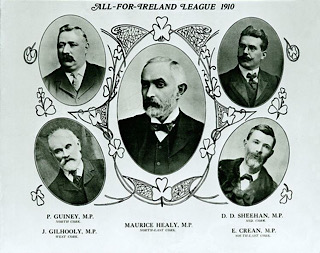
(Pictured: All-for-Ireland League group portrait of five of its Members of Parliament, in the “Cork Free Press”, 30 July 1910. These are: Patrick Guiney (North Cork), James Gilhooly (West Cork), Maurice Healy (North-east Cork), D. D. Sheehan (Mid Cork), and Eugene Crean (South-east Cork))


Leave a comment

Birth of John Philpot Curran, Orator, Politician, Lawyer & Judge

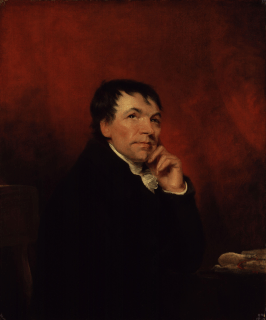
John Philpot Curran, Irish orator, politician, wit, lawyer and judge, who holds the office of Master of the Rolls in Ireland, is born in Newmarket, County Cork, on July 24, 1750.

Curran is the eldest of five children of James Curran, seneschal of the Newmarket manor court, and Sarah, née Philpot. The Curran family are said to have originally been named Curwen, their ancestor having come from Cumberland as a soldier under Oliver Cromwell during the Cromwellian conquest of Ireland, originally settling in County Londonderry.

Curran is educated at Midleton College, County Cork, before studing law at Trinity College Dublin. He continues his legal studies at King’s Inns and the Middle Temple. He is called to the Irish Bar in 1775. Upon his first trial, his nerves get the better of him and he cannot proceed. His short stature, boyish features, shrill voice and a stutter are said to have impacted his career, and earn him the nickname “Stuttering Jack Curran.”

However, Curran can speak passionately in court on subjects close to his heart. He eventually overcomes his nerves and gets rid of his speech impediment by constantly reciting Shakespeare and Henry St. John, 1st Viscount Bolingbroke, in front of a mirror, becoming a noted orator and wit. His championing of popular Irish causes such as Catholic emancipation make him one of the most popular lawyers in Ireland. He is also fluent in the Irish language which is still the language of the majority at the time. He writes a large amount of humorous and romantic poetry.

The case which cements Curran’s popularity is that of Father Neale and St. Leger St. Leger, 1st Viscount Doneraile at the County Cork Assizes in 1780. Having a passion for lost causes, he represents the priest and wins over the jury by setting aside the issue of religion.

A liberal Protestant whose politics are similar to Henry Grattan, Curran employs all his eloquence to oppose the illiberal policy of the Government, and also the Union with Britain. He stands as Member of Parliament (MP) for Kilbeggan in 1783. He subsequently represents Rathcormack (1790-98) and Banagher from 1800 until the Act of Union in 1801, which bitterly disappoints him, forcing him to contemplate emigrating to the United States.

In 1798, Ireland rebels against the British House of Commons and lack of reforms on Catholic emancipation. The British defeat the Irish rebels in numerous battles and soon establish their control over the country by 1799. Many of the Irish ring leaders are charged with treason and are facing death sentences. Curran plays an important role in court defending the leaders of the United Irishmen.

Curran’s youngest daughter Sarah‘s romance with United Irishmen leader Robert Emmet scandalises Curran, who had tried to split them up. He is arrested and agrees to pass their correspondence on to Standish O’Grady, 1st Viscount Guillamore, the Attorney-General for Ireland. In the circumstances he cannot defend Emmet. He is suspected of involvement in Emmet’s Rebellion, but is completely exonerated. However, his friend Arthur Wolfe, 1st Viscount Kilwarden, is killed by the rebels, and he loses any faith in the beliefs of the United Irishmen. Emmet is found guilty of rebelling against the Crown and the union between Great Britain and Ireland and is hanged in 1803. Curran disowns Sarah, who dies of tuberculosis five years later.

Curran is appointed Master of the Rolls in Ireland in 1806, following William Pitt the Younger‘s replacement by a more liberal cabinet.

Curran retires in 1814 and spends his last three years in London. He dies in his home in Brompton on October 14, 1817. In 1837, his remains are transferred from Paddington Cemetery, London to Glasnevin Cemetery in Dublin, where they are laid in an 8-foot-high classical-style sarcophagus. In 1845 a white marble memorial to him, with a carved bust by Christopher Moore, is placed near the west door of St. Patrick’s Cathedral, Dublin.


1 Comment

Capture of Mallow Barracks

The Cork No. 2 Brigade, Irish Republican Army (IRA), attacks and captures a military barracks in Mallow, County Cork, on September 28, 1920, the only military barracks to be captured during the Irish War of Independence. British forces later burn and sack the town.

Mallow had been a garrison town for several hundred years. Eight miles to the north lay Buttevant where one of the largest military barracks in the country is located. Not far from Buttevant are the great military training camps of Ballyvonaire, while nineteen miles to the northeast is Fermoy with its large permanent military garrisons and huge barracks adjacent to the big training centres of Kilworth and Moorepark. Twenty miles to the southeast is the city of Cork with its many thousands of troops both in the posts within the city and at Ballincollig, about six miles west of it, on the Macroom road. Thirteen miles westward a detachment from a British machine gun corps holds Kanturk. Every town and village has its post of Royal Irish Constabulary (RIC) men armed to the teeth.

The idea of capturing the barracks comes from two members of the Mallow IRA Battalion, Dick Willis, a painter, and Jack Bolster, a carpenter, who are employed on the civilian maintenance staff of the barracks which is occupied by the 17th Lancers. Willis and Bolster are able to observe the daily routine of the garrison and form the opinion that the capture of the place would not be difficult. They are instructed by their local battalion officers to make a sketch map of the barracks. After that is prepared, Liam Lynch and Ernie O’Malley go with Willis and Tadhg Byrnes to Mallow to study the layout of the surrounding district. Among the details of the garrison’s routine that Willis and Bolster report to the Column leaders, is the information that each morning the officer in charge, accompanied by two-thirds of the men, take the horses for exercise outside the town. It is obvious to the two Mallow volunteers that this is the ideal time for the attack.

Situated at the end of a short, narrow street and on the western verge of the Town Park, Mallow barracks stand on an unusually low-lying location and is relatively small in size. Surrounded by a high stone wall, the barracks can be approached from the town park as well as from the main street. The various details are carefully studied by Lynch and O’Malley. While Willis and Bolster are allotted tasks within the walls of the barracks, Byrnes and Jack Cunningham are chosen to attack with the main body of the column which includes Commandant Denny Murphy of Kanturk.

On the morning of September 27, at their Burnfort headquarters, the men are ordered to prepare for action. Under cover of darkness they move into the town and enter the Town Hall by way of the park at the rear. The eighteen men of the column are strengthened by members of the Mallow battalion, a number of men posted in the upper storey of the Town Hall, from which they can command the approaches to the nearby RIC barracks. Initially it is planned that Willis and Bolster will enter the military barracks that morning in the normal manner, accompanied by an officer of the column who will pose as a contractor’s overseer. The officer is Paddy McCarthy of Newmarket, who would die a few months later in a gun battle with the Black and Tans at Millstreet.

McCarthy, Willis and Bolster enter the barracks without mishap. Members of the garrison follow their normal routine, with the main body of troops under the officer in charge leaving the barracks with the horses. In the barracks remain about fifteen men under the command of a senior N.C.O., Sergeant Gibbs.

Once the military has passed, the attackers, numbering about twenty men and led by Liam Lynch, advance toward the bottom of Barrack Street. All are armed with revolvers which are considered the most convenient and suitable weapons for the operation. Lynch has issued strict instructions that there is to be no shooting by the attackers, unless as a last resort. Inside the walls are McCarthy, Willis and Bolster, their revolvers concealed. Then Ernie O’Malley presents himself at the wicket gate with a bogus letter in his hand. Behind him and out of sight of the sentry are the other members of the main attacking party, led by Lynch, O’Brien and George Power. When the gate is opened sufficiently, O’Malley wedges his foot between it and the frame and the soldier is overpowered and the attackers rush in. McCarthy, Bolster and Willis immediately go to the guardroom where they hold up the guard. Realising what is happening, Sergeant Gibbs, rushes toward the guardroom in which rifles are kept. Although called upon to halt, he continues even though a warning shot is fired over his head. As he reaches the guardroom door, the IRA officer and one of the volunteers in the guardroom fire simultaneously. Mortally wounded, the sergeant falls at the guardroom door.

By this time the majority of the attacking party is inside the gate. Military personnel in different parts of the barracks are rounded up and arms are collected. Three waiting motor cars pull up to the gate and all the rifles, other arms and equipment found in the barracks are loaded into them. The prisoners are locked into one of the stables, with the exception of a man left to care for Sergeant Gibbs. The whole operation goes according to plan, except for the shooting of the sergeant. Twenty minutes after the sentry had been overpowered the pre-arranged signal of a whistle blast is sounded and the attackers withdraw safely to their headquarters at Burnfort, along the mountain road out of Mallow.

Expecting reprisals, the column moves to Lombardstown that night, and positions are taken up around the local co-operative creamery as it is the custom of the British to wreak their vengeance on isolated country creameries after incidents such as what had just occurred. The Mallow raid, however, has greater repercussions than the destruction of a creamery and co-operative stores. The following night, large detachments of troops from Buttevant and Fermoy enter Mallow. They rampage through the town, burning and looting at will. High over the town, the night sky is red with the flames of numerous burning buildings.

Townspeople run through the blazing streets, in search of refuge. A number of women and children are accorded asylum in the nearby convent schools. Another group of terrified women, some with children in arms, take refuge in the cemetery at the rear of St. Mary’s Church, where they kneel or lay above the graves. It is a night of terror such as which had never before been endured by the people of Mallow.

The extent of the wanton destruction outrages fair-minded people all over the world. Details of the havoc that had been wrought and pictures of the scenes of destruction are published worldwide.

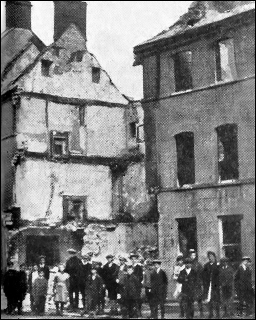
(Pictured: Townspeople gather in front of one of the many buildings in Mallow which were reduced to ruins during British Army reprisals)


1 Comment

The Rathcoole Ambush

rathcoole-ambush-monument

The Rathcoole Ambush, one of the largest ambushes of the Irish War of Independence, takes place at Rathcoole, County Cork on June 16, 1921.

The railway line between Banteer and Millstreet had been cut in several places so the British Auxiliary forces based at Millstreet have to travel to Banteer by road for their supplies twice a week. As a result, a combined force of 130 Irish Republican Army (IRA) volunteers from the Millstreet, Kanturk, Newmarket, Charleville and Mallow battalion columns are mobilised to attack the Auxiliaries as they return from Banteer. The volunteers are under the command of Paddy O’Brien from Liscarroll.

On the night before the ambush the IRA volunteers sleep at Rathcoole Wood, which overlooks the planned ambush position. Shortly after sunrise the following morning, Captain Dan Vaughan lays six land mines on the untarred road and covers them with dust. After a wait of several hours a convoy of four armour-plated lorries, each mounted with a machine gun and carrying ten men, is observed heading for Banteer.

The volunteers prepare themselves and at 6:20 in the evening, as the lorries pass through the ambush area on their return journey, three of the land mines explode with devastating results. One mine detonates as the last of the four lorries drives over it and another explodes under the leading lorry in the convoy. Both vehicles are out of action with the two other lorries trapped between them. A third mine explodes amid a party of Auxiliaries as they attempted to outflank the position. A bitter firefight develops. Each time Auxiliaries attempt to outflank the IRA they are driven back, suffering losses of more than twenty dead and over a dozen wounded.

When it becomes clear that the IRA cannot achieve a complete victory because of their limited ammunition supply, the order for withdrawal is given and the whole force retires without a single casualty. Although no arms are captured during the action, a reconnaissance party from the column returns the next day to search the ambush position and recovers 1,350 rounds of ammunition which the Auxiliaries had left behind them as they removed their dead and wounded.

The ambush at Rathcoole is one of the Irish Republican Army’s most successful actions during the War of Independence. A week after the ambush, British Forces from Kanturk, Buttevant, Ballyvonaire, Macroom, Ballincollig, Killarney and Tralee carry out a widespread search throughout the Rathcoole area. Michael Dineen, a Volunteer in Kilcorney Company is taken from his brother’s house at Ivale by a party of Auxiliaries and shot dead. On the evening of July 1, the Auxiliaries set fire to and destroy the wood at Rathcoole from where the ambush had been launched. That same day that they shoot and kill a local man, Bernard Moynihan, as he is out cutting hay.

(Pictured: Monument at the site of the Rathcoole Ambush)


Leave a comment

Birth of Alice Taylor, Writer & Novelist

alice-taylor

Alice Taylor, best-selling Irish writer and novelist particularly known for her nostalgia works looking back at life in a small village, is born on February 28 , 1938, on a farm in Lisdangan, Newmarket in northern County Cork.

Taylor is educated at Drishane Convent. She works in Bandon before marrying Gabriel Murphy. They have four sons and one daughter. When she marries she moves to Innishannon in the southern part of the county in 1961. There she runs a guesthouse, the local post office, and a shop.

In 1984 she edits and publishes a local magazine, Candlelight, and in 1986 she publishes an illustrated collection of her poetry. However it is the launch of her book To School Through the Fields, published in May 1988, which brings her fame. She has numerous interviews on national shows including RTÉ Radio‘s Gay Byrne Show and The Late Late Show. The next books are equally successful and have been sold internationally. Since then she has moved on to novels which have also become best sellers.

Her husband dies in 2005. Taylor remains very connected to the village of Innishannon where she continues to live. Since her eldest son has taken over responsibility for the shop, she has been able to devote more time to her writing. One of the programs she has been involved in is the restoration of the old Innishannon Tower.