seamus dubhghaill

Promoting Irish Culture and History from Little Rock, Arkansas, USA


Leave a comment

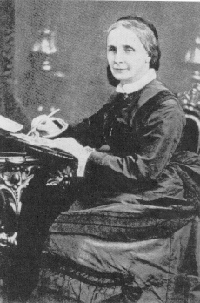
Birth of Irish Author Mary Anne Sadlier

mary-anne-sadlier

Mary Anne Sadlier, Irish author, is born Mary Anne Madden in Cootehill, County Cavan, on December 30, 1820.

Sadlier publishes roughly sixty novels and numerous stories in her lifetime. She writes for Irish immigrants in both the United States and Canada, encouraging them to attend mass and retain the Catholic faith. In so doing, Sadlier also addresses the related themes of anti-Catholicism, the Great Famine, emigration, and domestic work. Her writings are often found under the name Mrs. J. Sadlier.

Upon the death of her father, Francis, a merchant, Mary Madden emigrates to Sainte-Marthe, Quebec in 1844, where she marries publisher James Sadlier, also from Ireland, on November 24, 1846. Sadlier publishes much of her work in the family’s Catholic magazine, The Tablet. Sadlier experiences her most productive literary period after her marriage and is most creative after the time all of her children are born. While living in Canada, Sadlier publishes eighteen books — five novels, one collection of short stories, a religious catechism, and nine translations from the French — in addition to assorted magazine articles she contributes to the Pilot and American Celt free of charge. In New Lights (1853), Sadlier deals with the Great Famine for the first time. The book proves one of her most popular, going through at least eight editions in fifty years. In this novel, Sadlier focuses a polemical attack on the Protestant practice of converting Irish peasants by promising them soup but condemns peasant retaliation and violence.

In the early 1860s, the couple moves to New York City. The Sadlier’s New York home becomes the hub of literary activity in the Catholic community, and Sadlier also enjoys the company of the brightest Irish writers in the United States and Canada, including New York Archbishop John Hughes, editor Orestes Brownson, and Thomas D’Arcy McGee. She holds weekly salons in her Manhattan home, as well as her summer home on Far Rockaway on Long Island. Her closest friend is D’Arcy McGee, a poet, Irish nationalist exile and Canadian statesman known as one of the founding “Fathers of Confederation” who helps bring about Canada’s independence. McGee and Sadlier share an interest in a “national poetry” that does not only capture the spirit of a people but inspires them to political and national independence. While McGee, as a man, can take part in political rallies and organize Irish American support for Home Rule, Sadlier, as a woman, directs her support for Irish independence into literature. McGee’s biographer notes that Sadlier’s success inspires him to write emigrant novels and is planning a novel on this subject at the time of his assassination by an Irish American radical in 1868. His death is a crushing blow to Sadlier and her husband. Sadlier edits a collection of McGee’s poetry in 1869 in tribute to his memory.

Sadlier remains in New York for nine years before returning to Canada, where she dies in Montreal on April 5, 1903. In later years she loses the copyright to all her earlier works, many of which remain in print. One of Mary Anne’s daughters, Anna Theresa Sadlier, also becomes a writer.


Leave a comment

The Bombing of Air India Flight 182

air-india-182

Air India Flight 182, an Air India flight operating on the Montreal, CanadaLondon, U.K.Delhi, India route, is destroyed by a bomb on June 23, 1985, at an altitude of 31,000 feet and crashes into the Atlantic Ocean while in Irish airspace.

It is the first bombing of a 747 jumbo jetliner. A total of 329 people are killed, including 268 Canadian citizens, 27 Britons, and 24 Indians. The majority of the victims were Canadian citizens of Indian ancestry. The incident is the largest mass murder in Canadian history. It is the deadliest terrorist attack involving an airplane until the September 11, 2001, attacks in the United States in 2001. The bombing of Air India 182 occurs at the same time as the Narita Airport bombing in Japan. Investigators believe that the two plots are linked, and that those responsible are aiming for a double bombing. However, the bomb at Narita explodes before it can be loaded onto a plane.

At 07:14:01 GMT, the crew of Air India 182 “squawked 2005,” a routine activation of its aviation transponder, as requested by Shannon International Airport Air Traffic Control (ATC). The plane then disappears from radar. A bomb in a Sanyo tuner in a suitcase in the forward cargo hold explodes while the plane is at 31,000 feet at 51°3.6′N 12°49′W. It causes rapid decompression and the break-up of the aircraft in mid-air. The wreckage settles in 6,700-feet deep water off the southwest coast of Ireland, 120 miles offshore of County Cork. No “mayday” call is received by Shannon ATC. ATC asks aircraft in the area to try to contact Air India, to no avail. By 07:30:00 GMT, ATC has declared an emergency and requests nearby cargo ships and the Irish Naval Service vessel Aisling to begin searching for the aircraft.

The bomb kills all 22 crew and 307 passengers. One hundred thirty-two bodies are recovered. The remaining 197 are lost at sea. Eight bodies exhibit “flail pattern” injuries, indicating that they had exited the aircraft before it hit the water. This is a sign that the aircraft had broken up in mid-air. Twenty-six bodies show signs of hypoxia (lack of oxygen). Twenty-five, mostly victims who were seated near windows, show signs of explosive decompression. Twenty-three have signs of “injuries from a vertical force.” Twenty-one passengers are found with little or no clothing.

Canadian law enforcement determines that the main suspects in the bombing are members of the Sikh militant group Babbar Khalsa. The attack is thought to be a retaliation against India for the operation carried out by the Indian Army Operation Blue Star to flush out several hundred Sikh militants who were within the premises of the Golden temple and the surrounding structures ordered by the Indian government, headed by Prime Minister Indira Gandhi. Though a handful of members are arrested and tried, Inderjit Singh Reyat, a Canadian national, remains the only person convicted of involvement in the bombing. Singh pleads guilty in 2003 to manslaughter. He is sentenced to 15 years in prison for building the bombs that exploded aboard Flight 182 and at Narita.

The subsequent investigation and prosecution lasts almost twenty years and is the most expensive trial in Canadian history, costing nearly CAD 130 million. The Governor General-in-Council in 2006 appoints the former Supreme Court Justice John C. Major to conduct a commission of inquiry. His report is completed and released on June 17, 2010. It concludes that a “cascading series of errors” by the government of Canada, the Royal Canadian Mounted Police (RCMP), and the Canadian Security Intelligence Service (CSIS) had allowed the terrorist attack to take place.