seamus dubhghaill

Promoting Irish Culture and History from Little Rock, Arkansas, USA


Leave a comment

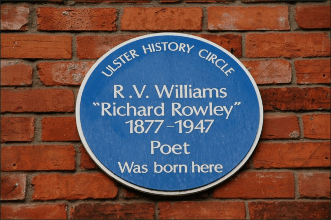
Birth of Richard Rowley, Poet, Playwright & Writer

Richard Valentine Williams, who writes poetry, plays and stories under the pseudonym of Richard Rowley, is born on April 2, 1877, at 79 Dublin Road in Belfast, in what is now Northern Ireland.

At the age of sixteen, Rowley enters the family firm, McBride and Williams, which manufactures cotton handkerchiefs and eventually becomes its managing director. After the collapse of the company in 1931 he is Chairman of the Northern Ireland Unemployment Assistance Board. His early poems, in The City of Refuge and Other Poems (1917), are rhetorical celebrations of industry. His next volume, City Songs and Others (1918), includes his most quoted poem, The Islandmen, and is regarded as containing his most original work: “Browning-like monologues straight from the mouths of Belfast’s working-class.”

In 1918, Rowley goes to live in the Mourne country, residing in Brook Cottage, Bryansford Rd., Newcastle, County Down. He writes short stories, including Tales of Mourne (1937), as well as at least one highly successful play, Apollo In Mourne (1926). During World War II, he founds, and runs from his Newcastle home, the short-lived Mourne Press. He publishes first collections of Sam Hanna Bell and Michael McLaverty, but the press fails in 1942.

With Bell, Rowley is one of a set of Linen Hall Library members who retires regularly to Campbell’s Cafe. The regulars, at various points, include writers John Boyd and Denis Ireland, actors Joseph Tomelty, Jack Loudon and J. G. Devlin, poets John Hewitt and Robert Greacen, artists Padraic Woods, Gerard Dillon, and William Conor and the Rev. Arthur Agnew, an outspoken opponent of sectarianism. The ebullient atmosphere the circle creates is a backdrop for the appearance of Campbell’s Cafe in Brian Moore‘s wartime Bildungsroman, The Emperor of Ice-Cream.

In 1946, Rowley sells Brook Cottage, which has since been demolished, and moves with his wife, the former Margaret Pollock, to Drumilly, Loughgall, County Armagh, as paying guests of their friends, Mr. and Mrs. Ralph Cope. He dies there on April 25, 1947.

George MacCann and Jack Loudan presents a commemoration of Rowley’s life on the radio in 1952. The programme uses recordings of his friends Lady Mabel Annesley, who illustrated several of his publications, along with the poet John Irvine, the playwright Thomas Carnduff and William Conor. In Newcastle, Rowley’s name is remembered through the Rowley Meadows housing development and the Rowley Path, which runs along the southern boundary of the Islands Park.

(Pictured: Blue plaque at Richard Rowley’s birthplace in Belfast, Northern Ireland)


Leave a comment

Birth of British General & Explorer Francis Rawdon Chesney

francis-rawdon-chesney

Francis Rawdon Chesney, British general and explorer, is born in Annalong, County Down, on March 16, 1789.

Chesney is a son of Captain Alexander Chesney, an Irishman of Scottish descent who, having emigrated to South Carolina in 1772, serves under Lord Francis Rawdon-Hastings (afterwards Marquess of Hastings) in the American War of Independence, and subsequently receives an appointment as coast officer at Annalong, County Down, where Chesney is born.

Lord Rawdon gives Chesney a cadetship at the Royal Military Academy, Woolwich, and he is gazetted to the Royal Artillery in 1805. Although he rises to be lieutenant-general and colonel-commandant of the 14th brigade Royal Artillery (1864), and general in 1868, Chesney’s memory lives not for his military record, but for his connection with the Suez Canal, and with the exploration of the Euphrates valley, which starts with his being sent out to Constantinople in the course of his military duties in 1829, and his making a tour of inspection in Egypt and Syria. In 1830, after taking command of 7th Company, 4th Battalion Royal Artillery in Malta, he submits a report on the feasibility of making a Suez Canal. This is the original basis of Ferdinand de Lesseps’ great undertaking. In 1831 he introduces to the home government the idea of opening a new overland route to India, by a daring and adventurous journey along the Euphrates valley from Anahto the Persian Gulf. Returning home, Acting Lt. Colonel Chesney busies himself to get support for the latter project, to which the East India Company’s board is favourable. In 1835 he is sent out in command of a small expedition, on which he takes a number of soldiers from 7th Company RA and for which Parliament votes £20,000, in order to test the navigability of the Euphrates.

After encountering immense difficulties, from the opposition of the Egyptian pasha, and from the need of transporting two steamers, one of which is subsequently lost, in sections from the Mediterranean Sea over the hilly country to the river, they successfully arrive by water at Bushirein the summer of 1836, and prove Chesney’s view to be a practical one. In the middle of 1837, Chesney returns to England, and is given the Royal Geographical Society’s gold medal, having meanwhile been to India to consult the authorities there. The preparation of his two volumes on the expedition, published in 1850, is interrupted by his being ordered out in 1843 to command the artillery at Hong Kong.

In 1847, his period of service is completed, and he goes home to Ireland, to a life of retirement. However, in 1856 and again in 1862 he goes out to the East to take a part in further surveys and negotiations for the Euphrates valley railway scheme, which, however, the government does not take up, in spite of a favourable report from the House of Commons committee in 1871. In 1868 Chesney publishes a further volume of narrative on his Euphrates expedition.

In 1869, Lesseps greets him in Paris as the “father “ of the canal. Francis Rawdon Chesney dies at the age of 82 in Mourne, County Down, on January 30, 1872.