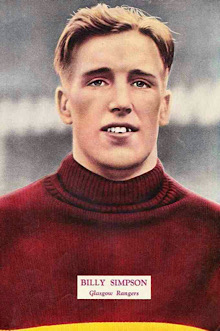
Simpson signs for Rangers from Linfield for a sum of £11,500 in 1950. He spends nine years (1950–59) at Rangers making 239 appearances and scoring 163 goals. He wins three championship medals and a Scottish Cup winners medal with Rangers to add to the two Northern Ireland Football League and two Irish Cups he wins with Linfield. He leaves Ibrox Stadium in 1959 and spends the last couple of years of his career with Stirling Albion, Partick Thistle and (then non-league) Oxford United.
As an illustration of his popularity, in the fictional song “A Trip to Ibrox,” Simpson is credited with scoring twice in a “Ne’erday” Old Firm Derby at Ibrox. Whereby Rangers are 1-0 down at halftime, and Simpson inspires his team to a second half comeback after Willie Waddell has scored an equaliser.
In recognition of his service to that club, Simpson is made a member of the Rangers F.C. Hall of Fame.
Simpson makes his debut for Northern Ireland in 1951 against Wales, scoring in the process. He represents his country twelve times in total between 1951 and 1958, scoring five goals. He is selected in Northern Ireland’s squad for the 1958 FIFA World Cup in Sweden but a late injury ensures he does not play at all during the finals.
In April 2015, the feature-length documentarySpirit of ’58 is screened as part of the Belfast Film Festival. It features Simpson prominently alongside the other surviving players (Billy Bingham, Peter McParland, Jimmy McIlroy and Harry Gregg) as it tells the story of Northern Ireland’s journey throughout the 1950s under the managership of Peter Doherty, culminating in the 1958 World Cup.
Patrick “Paddy” Coad, Irish football player and manager, is born at 100 Lower Yellow Road in Waterford, County Waterford, on April 14, 1920. He plays as a forward for Waterford, Glenavon, Shamrock Rovers and Ireland. Although known, primarily, as a maker of goals, he scores 126 goals in the League of Ireland and a further 41 in the FAI Cup. In 1946–47, he is top goal scorer in the League of Ireland. As a player manager, he also guides Shamrock Rovers to three League of Ireland titles and two FAI Cups, before he returns to Waterford and guides them to their first league title in 1966. He is appointed manager of Limerick in September 1967.
Coad is educated at De La Salle College Waterford and first distinguishes himself as a sportsman playing hurling and table tennis, becoming a Munster champion at the latter sport. He also begins to play football with Corinthians, a local junior club based in the Lower Yellow Road area of Waterford. He is soon spotted by Waterford, making his League of Ireland debut in 1937 at the young age of seventeen. He then moves to the Northern Ireland Football League (NIFL) club Glenavon but returns to Waterford after the start of World War II. He is a member of the Waterford team that finishes as a runner up to Cork United in both the League of Ireland and the FAI Cup. Waterford could have won the league title, but their players refuse to turn up for a play-off game against Cork after a dispute over bonus payments.
Coad signs with Shamrock Rovers in 1942 and on February 8 makes his debut against Brideville in the FAI Cup. During his early seasons with the club, he plays alongside Peter Farrell, Tommy Eglington, Jimmy McAlinden and Tommy Breen. He also helps Rovers win the FAI Cup three times. In November 1949, after the untimely death of Jimmy Dunne, he reluctantly accepts the position of player manager. He brings in many young players, including Liam Tuohy, and the team becomes known as Coad’s Colts. The Colts win 19 trophies between 1954 and 1959. Under his guidance, Rovers win three League of Ireland titles and the FAI Cup twice. In 1957, they also make their debut in the European Cup. Despite losing 9–2 on aggregate to Manchester United, Coad at the age of 37, dominates the away game at Old Trafford. He makes two appearances in the European Cup. On May 2, 1955, he is rewarded with a benefit game against Chelsea F.C. with Rovers winning 3-2.
Coad returns home to manage the Blues in 1960. In the 1965–66 League of Ireland season Waterford wins the Championship for the first time. Coad reflects on his legacy: “To bring the first title to my native Waterford leaves everything else in the shade.”
Between 1946 and 1952, Coad also makes eleven appearances and scored three goals for Ireland. He makes his debut on September 30, 1946, in a 1–0 defeat to England. On March 2, 1947, he scores his first goal for Ireland in a 3–2 win against Spain. During this game he also sets up both of Ireland’s other goals for Davy Walsh. On May 22, 1949, he scores the only goal, a penalty, in a 1–0 win over Portugal. His third goal for Ireland comes on May 30, 1951, in 3–2 away win over Norway. Ireland is 2–0 down until Peter Farrell and Alf Ringstead level the score. Then in the 82nd minute Coad scores from 20 yards to win the game. He plays his last game for Ireland in a 6–0 away defeat against Spain on June 1, 1952.
After his professional playing career Coad works for twelve years as a commercial traveler for B. P. Ganley Ltd, a bacon and pork distributor in Waterford. He and his wife, Bud, have two daughters and a son. He is ill for six months prior to his death on March 8, 1992, at his daughter’s home in Waterford.
Coad’s brother, Seamus, plays for Waterford in the late 1960s and manages the team in the 1990s. Seamus’ sons Gary and Nigel Coad continue the family name by lining out for the Blues under their father before both going on to win many trophies locally. Amazingly, both Gary and Nigel become only the third set of second-generation brothers to play together for Waterford, following Paddy and Seamus, the Hales and Fitzgeralds. In 2012, Seamus’ grandson, Conor, becomes the latest Coad to play for Waterford United.
The Shamrock Rovers Player of the Year trophy is named after Paddy Coad.
Aherne is born in Limerick, County Limerick, on January 26, 1919. As a youth, he initially emerges as a prominent hurler with Treaty Sarsfields and also plays one game for Limerick. However, he subsequently decides to concentrate on football and begins his senior career with Limerick United where his teammates include Davy Walsh. During World War II, he serves in the Irish Army and is stationed at Crosshaven. His impressive performances in the League of Ireland attract attention and in 1946 he is signed by Belfast Celtic.
While at Belfast Celtic, Aherne plays alongside Jackie Vernon, Billy McMillan, Robin Lawler and Johnny Campbell and helps them win the Irish Cup in 1947 and an Irish League title in 1948. He is also at Celtic during the infamous Boxing Day riot which breaks out during a game against local rivals Linfield F.C. In March 1949, he leaves Celtic and signs for Luton Town. However, in May 1949, he temporarily rejoins Celtic for their final tour before the club disbands. Together with McMillan, Campbell, Lawlor, guest player Mick O’Flanagan and manager Elisha Scott, he goes on the Celtic tour of North America. The highlight of the 10-game tour comes on May 29 when Celtic beats the reigning British champions, Scotland, 2–0.
Aherne signed for Luton Town for a fee of £6,000 and makes his English Football League debut on March 19 in a 2–1 away defeat to Tottenham Hotspur. Despite the fact he is over 30 when he joins Luton, he quickly establishes himself as a regular. He plays competitive football into his late thirties and is ever-present during the 1954–55 season when Luton wins promotion to Division One. After playing 288 games for Luton, including 267 in the league, he retires after a hairline fracture of the ankle ends his career. Even then he continues to play for a local league team, Luton Celtic, into his forties.
When Aherne begins his international career in 1946 there are in effect, two Ireland teams, chosen by two rival associations. Both associations, the Belfast-based Irish Football Association and the Dublin-based Football Association of Ireland, claim jurisdiction over the whole of Ireland and select players from the whole island. As a result, several notable Irish players from this era, including Aherne play for both teams.
Between 1946 and 1953 Aherne makes 16 appearances for the FAI XI. He makes his FAI debut in June 1946 during an Iberian tour, playing in both the 3–1 defeat to Portugal on June 16 and then helping the FAI XI gain a surprise 1–0 victory against Spain on June 23. He remains a regular in the FAI XI throughout the late 1940s and early 1950s and is featured prominently in the qualifying rounds for the 1950 FIFA World Cup. He is also a member of the FAI XI team that defeats England 2–0 at Goodison Park, becoming the first non-UK team to beat England at home.
On November 16, 1953, during a 1–1 draw with France, Aherne briefly becomes involved in controversy. Although only a friendly, the game quickly becomes heated and at one point, with Aherne chasing Raymond Kopa down the tunnel after play had been stopped for a foul. Kopa allegedly runs for his life after upsetting Aherne once too often. The FAI selectors are not impressed, and Aherne is told a repeat will end his international career. As it turns out, he makes only one more appearance for the FAI XI. That comes on October 4, 1953, in 5–3 defeat against France during a qualifier for the 1954 FIFA World Cup.
Between 1946 and 1950, Aherne also makes six appearances for the IFA XI. These include two Victory Internationals played in early 1946. On February 2 at Windsor Park, he makes his debut for the IFA XI in a 3–2 defeat to Scotland. Then on May 4 he helps the IFA XI defeat Wales 1–0 at Ninian Park. On September 28, 1946, he also plays for the IFA XI in a heavy defeat to England. The highlight of his career with the IFA XI comes on October 4, 1947, when he helps them gain a 2–0 win against Scotland.
Ahern makes his last appearance for the IFA XI in a 0–0 draw with Wales on March 8, 1950. As well as being part of the 1950 British Home Championship, the game also doubles up as a qualifier for the 1950 FIFA World Cup. Aherne, together with Con Martin, Reg Ryan and Davy Walsh, is one of four players from the Republic, included in the IFA XI that day and as a result he plays for two different associations in the same FIFA World Cup tournament. This situation eventually leads to intervention by FIFA and as a result Aherne becomes one of the last four Republic-born players to play for the IFA XI.
After retiring as a player Aherne settles in Luton where he coaches the Luton Town youth team, works in the local car industry and runs a very successful licensed premises. He also continues to visit Limerick regularly and remains healthy and active until he is diagnosed with Alzheimer’s disease in the mid-1990s. He dies on December 30, 1999, at the age of 80 and is survived by his wife, Eileen, two sons, Pat and Brian, and three daughters, Maura, Trisha and Catherine.
The IFA’s first decisions are to elect its first President, Major Spencer Chichester, and to form an annual challenge cup competition similar to the FA Cup and Scottish Cup competitions, called the Irish Cup. Two years later, Ireland plays its first international against England, losing 13–0, which remains a record for both teams, a record win for England and a record loss for Ireland.
Shortly after the partition of Ireland in 1921, the Football Association of Ireland (FAI) is established as a rival association to regulate the game in what is to become the Irish Free State. The immediate cause of the split lay in a bitter dispute over the venue for the replay of an Irish Cup match in 1921 involving Glentoran F.C. of Belfast and Shelbourne F.C. of Dublin. When the first cup match is drawn in Belfast, because of the Irish War of Independence, the IFA reneges on a promise to play the replay in Dublin and schedules the rematch again for Belfast. Shelbourne refuses to comply and forfeits the Cup.
Such is the anger over the issue that the Leinster Football Association breaks away from the IFA and forms its own national association. Those behind the FAI believe that football should be regulated by a federation based in the Irish Free State’s capital, Dublin. They also accuse the IFA of neglecting the development of the game in the South. The IFA’s supporters argue that the federation should be based where the game is primarily played – namely Ulster, and its principal city Belfast.
Both associations claim to represent the whole of the island, each competing internationally under the name “Ireland” and selecting players from both the rival national leagues, which also split at this time. Interventions by FIFA give the FAI de jure organising rights over the 26 counties of the Republic, with the IFA restricted to Northern Ireland. From the 1950s onwards, the IFA no longer claims it is the association for the whole of Ireland.
In 1960, the association moves to its present location on Windsor Avenue in south Belfast, in a building once occupied by Thomas Andrews. The IFA continues to regulate the game in Northern Ireland, and all results obtained by the Irish national side and records in the Irish Football League and the cup competition stand as Northern Irish records.


 seamus dubhghaill