
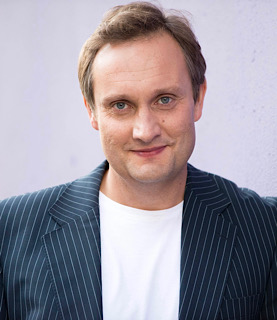
Mario Rosenstock, Irish actor, comedian, impressionist and musician, is born in London, England, on August 31, 1970.
Rosenstock first comes to the attention of the Irish public playing the role of Dr. David Hanlon in the soap opera Glenroe in the 1990s.
However, he is now best known for the popular Gift Grub segments which have featured on The Ian Dempsey Breakfast Show on Today FM since May 1999 which Rosenstock creates alongside Paul McLoone, a radio presenter with Today FM and frontman of the Northern Irish pop-punk/new-wave band, The Undertones.
Gift Grub is a series of comic sketches, impersonations and parodies that featured Rosenstock assuming the personae of Bertie Ahern, Ronan Keating, Colin Farrell and Roy Keane among many others. He also provides the manic voice of Right Price Tiles radio spokesperson “Daft Dave.”
Rosenstock performs an impersonation of José Mourinho in a parody of a song from the musical Joseph and the Amazing Technicolor Dreamcoat. This spreads like wildfire on Internet message boards and eventually it is played on a Sky Sports broadcast. Mourinho hears the song and enjoys the impersonation so much he asks Rosenstock to perform a private show for him and the Chelsea F.C. squad. Rosenstock later releases, with Mourinho’s blessing, a single version of “José and his Amazing Technicolor Overcoat.” He also releases another song (“I Sign a Little Player or Two“) on the internet with a parody of Mourinho in an interview then breaking into song.
In 2005, Rosenstock stars as Keano in the comedy musical play I, Keano, which concerns Keane storming out of the Republic of Ireland national football squad during preparations for the 2002 FIFA World Cup.
In 2005, Rosenstock achieves the Christmas number one single in the Irish Singles Chart, with a parody of Will Young‘s song Leave Right Now (which itself is a Christmas number-one in 2003). The parody concerned Roy Keane’s controversial departure from Manchester United and his falling-out with Alex Ferguson.
Between December 2007 and May 2009, Rosenstock works on a puppet comedy series entitled Special 1 TV (originally known as I’m on Setanta Sports), which is presented as a parody weekly football talk show hosted by “José Mourinho.” He voices all the puppet characters on the sketch, with the exception of “Rafael Benitez,” who is performed by Keith Burke, including the main character Mourinho, his studio co-hosts “Sven-Göran Eriksson” and “Wayne Rooney,” and regular phone-in callers like “Alex Ferguson,” “Arsène Wenger,” “Roy Keane” and “Mick McCarthy,” as well as the non-football-related characters, Nelson Mandela, Willie Nelson, Barack Obama and Tom Cruise.
Rosenstock receives the Outstanding Achievement Award at the 11th annual PPI (Phonographic Performance Ireland) Radio Awards in 2011.
In November 2012 his new show called The Mario Rosenstock Show starts on RTÉ2. A second series of the show begins to air in September 2013.
Rosenstock is married, with two children. His uncle, Gabriel Rosenstock, is one of Ireland’s most notable Irish language poets and member of Innti with Michael Davitt, Nuala Ní Dhomhnaill and Liam Ó Muirthile. Rosenstock’s grandfather George is a doctor and writer from Schleswig-Holstein, Germany. He never speaks German again after the war out of shame. His grandmother is a nurse from Athenry, County Galway.

 seamus dubhghaill