seamus dubhghaill

Promoting Irish Culture and History from Little Rock, Arkansas, USA


Leave a comment

The Banishment Act Goes into Effect

The Banishment Act or Bishops’ Banishment Act, which receives royal assent on September 25, 1697, requires most Catholic clergy to leave the kingdom by May 1, 1698, and bans Catholic clergy from entering the kingdom. The Act is never efficiently enforced.

The Banishment Act is a 1697 Act of the Parliament of Ireland which banishes all ordinaries and regular clergy of the Roman Catholic Church from Ireland. All “popish archbishops, bishops, vicars general, deans, jesuits, monks, friars, and other regular popish clergy” are required to be in one of several named ports awaiting a ship out of the country by May 1, 1698. Remaining or entering the country after this date would result in punishment as a first offence with twelve months imprisonment followed by expulsion. A second offence would constitute high treason.

The Act is one of the Penal Laws passed after the Williamite War to safeguard the Church of Ireland as the established church and from fears of Catholic clerical support for Jacobitism. It is foreshadowed by proclamations issued by the Dublin Castle administration in 1673 and 1678 with similar terms. The banishment is originally and most effectively applied to regular clergy, many of whom register under the Registration Act of 1704, as parish priests to be treated as secular clergy and avoid deportation. The ban on bishops may have been intended to prevent ordination of new priests, which, coupled with a ban on clerical immigration, would lead to their eventual extinction. Of the eight Catholic bishops in Ireland when the act is passed, two leave, one (John Sleyne)is arrested, and five go into hiding. The port authorities pay for the passage of 424 clerics who emigrate. Mary of Modena estimates that about 700 in total leave, of whom 400 settle in France. Priest hunters are active in subsequent decades. Maurice Donnellan, Bishop of Clonfert, is arrested in 1703 but rescued by an armed crowd.

The Act is gradually less stringently enforced as the eighteenth-century progresses. The Roman Catholic Relief Act 1782 provides that its provisions cannot apply to a priest who has registered and taken the oath of supremacy. The Act is explicitly repealed by the Statute Law Revision (Ireland) Act 1878.

Leave a comment

St. Patrick’s Cathedral Designated National Cathedral

st-patricks-cathedral-dublin

St. Patrick’s Cathedral, Dublin, is designated the National Cathedral of the Church of Ireland on May 2, 1872. Chapter members at St. Patrick’s are drawn from each of the twelve dioceses of the Church of Ireland.

St. Patrick’s Cathedral is dedicated on March 17, 1191. With its 141-foot spire, it is the tallest church (not cathedral) in Ireland and the largest.

St. Patrick’s Cathedral is founded on the spot where St. Patrick himself is believed to have baptized the first Irish believers into the Christian faith. The sacred well which St. Patrick used has been lost, but the Cathedral is built in the area where the conversions are believed to have taken place.

The first church is constructed here in the 5th century but St. Patrick’s as it stands now is built between 1191 and 1270. In 1311, the Medieval University of Dublin is founded here, and the church begins a place of higher education as well as a place of worship.

By the 16th century, however, St. Patrick’s falls into disrepair following the English Reformation, a time when the Church of England breaks away from the Roman Catholic Church. In 1537, St. Patrick’s becomes designated as an Anglican Church of Ireland, and it remains a part of the Church of Ireland to this day.

Repairs to the cathedral begin in the 1660s and continued in phases over the following decades to save it from falling into complete ruin.

As its status grows, St. Patrick’s begins to rival Christ Church Cathedral in importance. This is where the history of St. Patrick’s Cathedral takes a bit of a complicated turn in term of church definitions. The current cathedral building is often hailed as one of the best examples of medieval architecture in Dublin, however, it is only fair to point out that the structure went through a massive rebuild in the 1860s, mainly financed by money from Benjamin Guinness.

As one of Dublin’s two Church of Ireland cathedrals, St. Patrick’s is actually designated as the “National Cathedral of Ireland.” However, it lacks the one thing that usually makes a church a cathedral – a bishop. The Archbishop of Dublin actually has his seat at Christ Church Cathedral, which is designated as the local cathedral of the Diocese of Dublin and Glendalough. St. Patrick’s is instead headed by a dean who is the ordinary for the cathedral. This office has existed since 1219 with its most famous office holder being Jonathan Swift.

Today St. Patrick’s Cathedral plays host to a number of public national ceremonies. Ireland’s Remembrance Day ceremonies, hosted by the Royal British Legion and attended by the President of Ireland, take place there every November. Its carol service (the Service of Nine Lessons and Carols), celebrated twice in December, including every December 24, is a colourful feature of Dublin life. On Saturdays in autumn the cathedral hosts the graduation ceremonies of Technological University Dublin.

The funerals of two Irish presidents, Douglas Hyde and Erskine Childers, take place in St. Patrick’s Cathedral in 1949 and 1974 respectively. In 2006, the cathedral’s national prominence is used by a group of 18 Afghan migrants seeking asylum, who occupied it for several days before being persuaded to leave without trouble.


Leave a comment

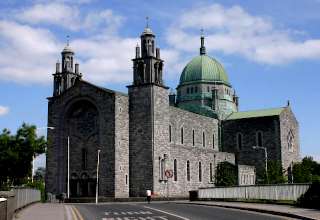
Creation of the Diocese of Galway

cathedral-of-our-lady-assumed-into-heaven-and-st-nicholas

The Diocese of Galway is created on April 23, 1831. The diocese has its origins in the ancient Kilmacduagh monastery and the Wardenship of Galway (1484–1831). Following the abolition of the Wardenship by the Holy See in 1831, the first Bishop of the new Diocese of Galway is appointed in the same year.

In 1866, Bishop John McEvilly of Galway is made Apostolic Administrator of the diocese of Kilmacduagh and Kilfenora. When he is appointed coadjutor bishop to the Archdiocese of Tuam in 1878, he retains Galway until he succeeds as archbishop in 1881. McEvilly continues to oversee Kilmacduagh and Kilfenora until 1883 when Pope Leo XIII unites the diocese with the neighbouring Diocese of Kilmacduagh. At the same time, the ordinary of the United Diocese of Galway and Kilmacduagh is appointed, in perpetuum, as the Apostolic Administrator of the Diocese of Kilfenora.

The bishopric of Kilmacduagh had been a separate title until 1750 when Pope Benedict XIV decrees that it is to be united with the bishopric of Kilfenora. Since Kilmacduagh is in the Ecclesiastical province of Tuam while Kilfenora is in the Province of Cashel, it is arranged that the ordinary of the united dioceses is to be alternately bishop of one diocese and apostolic administrator of the other. The first holder of this unusual arrangement is Peter Kilkelly, who had been Bishop of Kilmacduagh since 1744. He becomes Apostolic Administrator of Kilfenora in September 1750. Since that date, Kilfenora has been administered by that united diocese as an apostolic vicariate. Since the territory of an apostolic vicariate comes directly under the pope as “universal bishop”, the pope exercises his authority in Kilfenora through a “vicar.”

The geographic remit of the see includes the city of Galway, parts of County Galway and the northern coastal part of County Clare. Large population centres include Ennistymon, Oranmore and Oughterard. The cathedral church of the diocese is the Cathedral of Our Lady Assumed into Heaven and St. Nicholas. It is in the ecclesiastical province of Tuam and is subject to the Metropolitan Archdiocese of Tuam. The deanery of Kilfenora, previously a diocese in its own right, lies in the ecclesiastical province of Cashel. The Ordinary is Bishop Brendan Kelly who is appointed on December 11, 2017.

(Pictured: The Cathedral of Our Lady Assumed into Heaven and St. Nicholas)