seamus dubhghaill

Promoting Irish Culture and History from Little Rock, Arkansas, USA


Leave a comment

Bombings of King’s Cross and Euston Railway Stations

On September 10, 1973, the Provisional Irish Republican Army (IRA) bombs the King’s Cross railway station and Euston railway station, two mainline railway stations in Central London. The blasts wound 13 civilians, some of whom are seriously injured, and also causes large-scale but superficial damage. This is a second wave of bombing attacks launched by the IRA in England in 1973 after the Old Bailey car bombing earlier in the year which had killed one and injured around 200 civilians.

In 1971, during the Troubles, after two years engaged in violence based on a defensive strategy in Irish communal districts of Northern Ireland, the Provisional IRA launches an offensive against the United Kingdom. At a meeting of the IRA Army Council in June 1972 the organization’s Chief of Staff, Seán Mac Stíofáin, first proposes making bombing attacks in England. The Army Council does not at first agree to the suggestion, but in early 1973 after its negotiations with the British Government for a truce the previous year had failed to advance the political objective of the removal of Northern Ireland from the United Kingdom by the application of the threat of violence, it re-engages its paramilitary campaign and sanctions Mac Stíofáin’s proposal. Mac Stíofáin had put the strategy forward on the basis that extending the urban paramilitary violence of the Northern Ireland state into England would help to relieve pressure being exerted by the British Army on the IRA’s strongholds of Irish communal support in districts in the province, such as west Belfast and Derry, by diverting British security strength from them back into England, while at the same time increasing strategic pressure upon the British Government to resolve the conflict by political concessions to the IRA’s demands. He also believes that a successful bombing campaign in London, as the capital city of the United Kingdom, will offer substantial propaganda value for paramilitary Irish Republicanism, and provide a morale boost to its supporters.

The effects of the previous 1973 Old Bailey bombing appear to give some credence to the idea of the propaganda value of extending violence into London as, although it is considered almost routine in Northern Ireland by the mid-1970s and draws only brief media notice, being carried out instead in London, a global capital city, makes the event world news headlines. However, although the bombing of the Old Bailey is successfully carried out, and gains media attention, increasing political pressure upon the British Government to address the issue of the conflict in Northern Ireland with more urgency, it is costly to the IRA, as 10 out of the 11-man active service unit that carry it out are arrested by the British police while trying to leave England before the bombs they had planted detonate. Drawing the tactical lesson that large teams are a security liability, for the second wave of bombings in England later in 1973, instead of sending a large team to carry it out with orders to withdraw back to Ireland immediately afterwards, smaller detached “cell” units of 3-4 personnel are sent to carry out the operation, with instructions to remain in England afterward and wage a campaign of bombings around England upon a variety of targets.

There are bombings on September 8, 1973, including one at London Victoria station which injures four civilians.

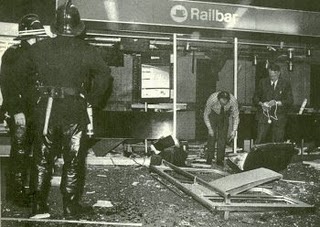
On September 10, 1973, a bomb (with no warning issued beforehand) explodes at King’s Cross railway station in the booking hall at 12:24 p.m. when a youth of around 16 to 17 years of age walks up to the entrance of the station’s old booking hall and throws a bag into it which contains a 3 lb. (1.4 kg) device, which detonates, shattering glass throughout the hall and throwing a baggage trolley several feet into the air. The youth then flees into the station’s crowd and escapes the scene.

Approximately 45 minutes after the attack at King’s Cross, after a telephone call warning to the Press Association five minutes beforehand by a man with an Irish accent, a second bomb detonates in a snack bar at Euston railway station, injuring another eight civilians. One witness at Euston says, “I saw a flash and suddenly people were being thrown through the air – it was a terrible mess, they were bleeding and screaming.” A total of 13 civilians are injured in the two attacks. The Metropolitan Police issue a photofit picture of a 5 ft. 2 in. (157 cm) tall youth they are seeking in regard to the King’s Cross attack.

On September 12, 1973, two more bombs explode, one in Oxford Street and another in Sloane Square, targeting retail shopping centres. Police subsequently announce that they are looking for five people in connection with this second wave of bomb attacks in England.

Judith Ward is later wrongly convicted of having been involved in the late 1973 London bombings, along with the M62 coach bombing. She is later acquitted. No one else is brought to trial for this IRA bombing campaign.
Leave a comment

Irish Republican Army Bombings in Central London

regent-street-london-1977

At least seven bombs explode in Central London on January 29, 1977. One person is injured. The Irish Republican Army (IRA) later claims responsibility.

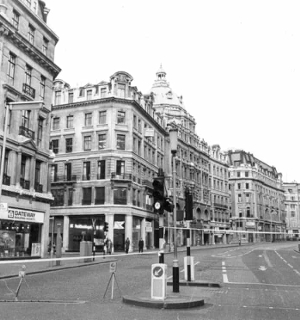
Hundreds of police seal off the Oxford Street area as Selfridges department store is set ablaze and one man is injured. The explosions occur over a two-mile area within 50 minutes. The bombs wreck buildings in Oxford Street, Regent Street, and Wardour Street, causing hundreds of thousands of pounds worth of damage and burying a taxi under the rubble, injuring the driver. Another man is trapped in a basement in Selfridges after the blast.

The attacks come less than 72 hours before the IRA commemoration of the Bloody Sunday massacre in Londonderry and, according to the police, bear all the hallmarks of the IRA. The bombs, left in doorways of shops and offices, are similar to those used in firebomb attacks on the centre of Belfast and Londonderry over the previous four years.

Hundreds of police are drafted into the Oxford Street area within minutes of the first blast, shortly after midnight. Police using sniffer dogs examine hundreds of cars stretched along Oxford Street and residents are warned to evacuate by police and fire officers using bullhorns. Dozens of fire engines respond to the resulting blaze in the huge department store.

A two-mile area around Oxford Street is cordoned off by police roadblocks shortly after the first explosions. Scotland Yard and the Fire Brigade are unable to keep pace with the bombs and fires as news reports flood in.

The first explosions occur in Wardour Street where two bombs blow out the front of a publishing office and a travel agency, hurling glass and furniture into the street. Within 20 minutes, three other bombs explode in Oxford Street, Regent Street, Poland Street and in the side-streets of Soho. The fire brigade simultaneously fights two major fires within a mile of each other, in Selfridges and in a building in Berwick Street, Soho. Debris from the bombs is littered around as bomb squad officers and police patrols begin examining all suspicious cars and packages in the area. Several bomb squad officers are standing within yards of a building when the fourth bomb, fortunately a small one, goes off.

The Assistant Commissioner for Crime, Jock Wilson, joins Bomb Squad officers in a special mobile control unit. A senior police officer says that many of the bombs are crammed through letterboxes in the business premises. However, the bomb at Selfridges is placed in the basement, police believe, on previous afternoon.

(Pictured: Police cordon off Regent Street following IRA bombs in the West End, London, January 1977. Photograph: ANL/REX/Shutterstock)


Leave a comment

Harrods Bombing

harrods-bombing

A Provisional Irish Republican Army (PIRA) car bomb kills six and injures ninety outside London‘s Harrods department store, a large, upmarket department store in the affluent Knightsbridge district near Buckingham Palace on December 17, 1983. The IRA Army Council claims that it has not authorised the attack and expresses regret for the civilian casualties. After the bombing, the IRA changes its tactic to focus on military targets on the mainland.

Harrods had been the target of an earlier IRA bomb on December 21, 1974, which was placed in the northeast corner of the first floor. There was a very short warning, and the store was in the process of being cleared when it exploded. It was also the target of a much smaller IRA bomb almost ten years later, in January 1993, which injured four people.

From 1973 the Provisional IRA has carried out waves of bombing attacks on commercial targets in London and elsewhere in England as part of its “economic war.” The goal is to damage the economy and cause disruption, which would put pressure on the British government to withdraw from Northern Ireland. On December 10, 1983, the IRA carries out its first attack in London in some time when a bomb explodes at the Royal Artillery Barracks, injuring three British soldiers.

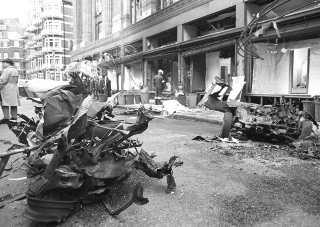
One week later, on the afternoon of December 17, IRA members park a car bomb near the side entrance of Harrods, on Hans Crescent. The bomb contains 25 to 30 lbs. of explosives and is set to be detonated by a timer. It is left in a 1972 blue Austin 1300 GT four-door sedan. At 12:44 PM a man using an IRA codeword phones the central London branch of the Samaritans charity. The caller says there is a car bomb outside Harrods and another bomb inside Harrods and gives the car’s registration plate. According to police, he does not give any other description of the car.

The bomb explodes at about 1:21 PM, as four police officers in a car, an officer on foot and a police dog-handler near the suspect vehicle. Three officers and three bystanders are killed, and 90 others are injured, including 14 police officers. The blast damages 24 cars and all five floors on the side of Harrods, sending a shower of glass down onto the street. The police car absorbs much of the blast and this likely prevents further casualties.

Five people die at the scene of the bombing and a sixth later dies in the hospital. The bystanders who die are Philip Geddes (24), a journalist who had heard about the alert and went to the scene, Jasmine Cochrane-Patrick (25) and Kenneth Salvesen (28), a United States citizen. The Metropolitan Police Service officers killed are Sergeant Noel Lane (28) and Constable Jane Arbuthnot (22). A third officer, Inspector Stephen Dodd (34), dies in the hospital from his injuries on December 24. Constable Jon Gordon survives but loses both legs and part of a hand in the blast.

At the time of the explosion, a second warning call is made by the IRA. The caller says that a bomb has been left in the C&A department store at the east end of Oxford Street. Police clear the area and cordon it off, but this claim is found to be false. In the aftermath of the attack, hundreds of extra police and mobile bomb squads are drafted into London. Aleck Craddock, chairman of Harrods, reports that £1 million in turnover has been lost as a result of the bombing. Despite the damage, Harrods re-opens three days later, proclaiming it will not be “defeated by acts of terrorism.” Denis Thatcher, the husband of British Prime Minister Margaret Thatcher, visits the store and tells reporters “no damned Irishman is going to stop me going there.”